Alpuche-Lazcano Sergio P, Stuible Matthew, Akache Bassel, Tran Anh, Kelly John, Hrapovic Sabahudin, Robotham Anna, Haqqani Arsalan, Star Alexandra, Renner Tyler M, Blouin Julie, Maltais Jean-Sébastien, Cass Brian, Cui Kai, Cho Jae-Young, Wang Xinyu, Zoubchenok Daria, Dudani Renu, Duque Diana, McCluskie Michael J, Durocher Yves
Human Health Therapeutics Research Centre, National Research Council Canada, 6100 Royalmount Avenue, Montreal, QC, H4P 2R2, Canada.
Human Health Therapeutics Research Centre, National Research Council Canada, 1200 Montreal Road, Ottawa, ON, K1A 0R6, Canada.
Commun Med (Lond). 2023 Aug 23;3(1):116. doi: 10.1038/s43856-023-00340-7.
As the COVID-19 pandemic continues to evolve, novel vaccines need to be developed that are readily manufacturable and provide clinical efficacy against emerging SARS-CoV-2 variants. Virus-like particles (VLPs) presenting the spike antigen at their surface offer remarkable benefits over other vaccine antigen formats; however, current SARS-CoV-2 VLP vaccines candidates in clinical development suffer from challenges including low volumetric productivity, poor spike antigen density, expression platform-driven divergent protein glycosylation and complex upstream/downstream processing requirements. Despite their extensive use for therapeutic protein manufacturing and proven ability to produce enveloped VLPs, Chinese Hamster Ovary (CHO) cells are rarely used for the commercial production of VLP-based vaccines.
Using CHO cells, we aimed to produce VLPs displaying the full-length SARS-CoV-2 spike. Affinity chromatography was used to capture VLPs released in the culture medium from engineered CHO cells expressing spike. The structure, protein content, and glycosylation of spikes in VLPs were characterized by several biochemical and biophysical methods. In vivo, the generation of neutralizing antibodies and protection against SARS-CoV-2 infection was tested in mouse and hamster models.
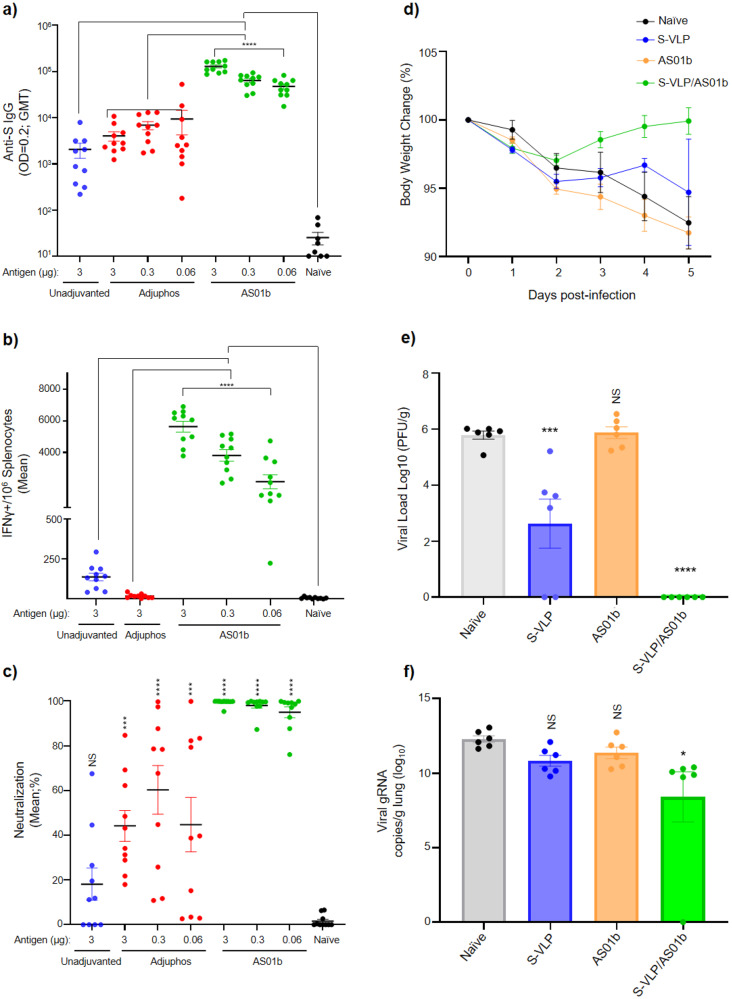
We demonstrate that spike overexpression in CHO cells is sufficient by itself to generate high VLP titers. These VLPs are evocative of the native virus but with at least three-fold higher spike density. In vivo, purified VLPs elicit strong humoral and cellular immunity at nanogram dose levels which grant protection against SARS-CoV-2 infection.
Our results show that CHO cells are amenable to efficient manufacturing of high titers of a potently immunogenic spike protein-based VLP vaccine antigen.
随着新冠疫情持续演变,需要研发易于生产且对新出现的严重急性呼吸综合征冠状病毒2(SARS-CoV-2)变体具有临床疗效的新型疫苗。表面呈现刺突抗原的病毒样颗粒(VLP)相较于其他疫苗抗原形式具有显著优势;然而,目前处于临床开发阶段的SARS-CoV-2 VLP候选疫苗面临诸多挑战,包括低体积生产力、刺突抗原密度低、表达平台驱动的不同蛋白质糖基化以及复杂的上游/下游加工要求。尽管中国仓鼠卵巢(CHO)细胞在治疗性蛋白质生产中广泛应用且已证明有能力生产包膜VLP,但很少用于基于VLP的疫苗的商业化生产。
我们旨在利用CHO细胞生产展示全长SARS-CoV-2刺突的VLP。采用亲和层析法从表达刺突的工程化CHO细胞捕获培养基中释放的VLP。通过多种生化和生物物理方法对VLP中刺突的结构、蛋白质含量和糖基化进行表征。在体内,在小鼠和仓鼠模型中测试中和抗体的产生以及对SARS-CoV-2感染的保护作用。
我们证明,CHO细胞中刺突的过表达本身足以产生高VLP滴度。这些VLP让人联想到天然病毒,但刺突密度至少高三倍。在体内,纯化的VLP在纳克剂量水平即可引发强烈的体液免疫和细胞免疫,从而提供对SARS-CoV-2感染的保护。
我们的结果表明,CHO细胞适合高效生产高滴度的基于具有强免疫原性的刺突蛋白的VLP疫苗抗原。