Department of Neurology, Multi-Omics Research Center for Brain Disorders, The First Affiliated Hospital, Hengyang Medical School, University of South China, Hunan, 421001, Hengyang, China.
Clinical Research Center for Immune-Related Encephalopathy of Hunan Province (The First Affiliated Hospital), Hengyang Medical School, University of South China, Hunan, 421001, Hengyang, China.
J Transl Med. 2023 Aug 23;21(1):563. doi: 10.1186/s12967-023-04399-7.
Brachial plexus root avulsion (BPRA), a disabling peripheral nerve injury, induces substantial motoneuron death, motor axon degeneration and denervation of biceps muscles, leading to the loss of upper limb motor function. Acetylglutamine (N-acetyl-L-glutamine, NAG) has been proven to exert neuroprotective and anti-inflammatory effects on various disorders of the nervous system. Thus, the present study mainly focused on the influence of NAG on motor and sensory recovery after BPRA in rats and the underlying mechanisms.
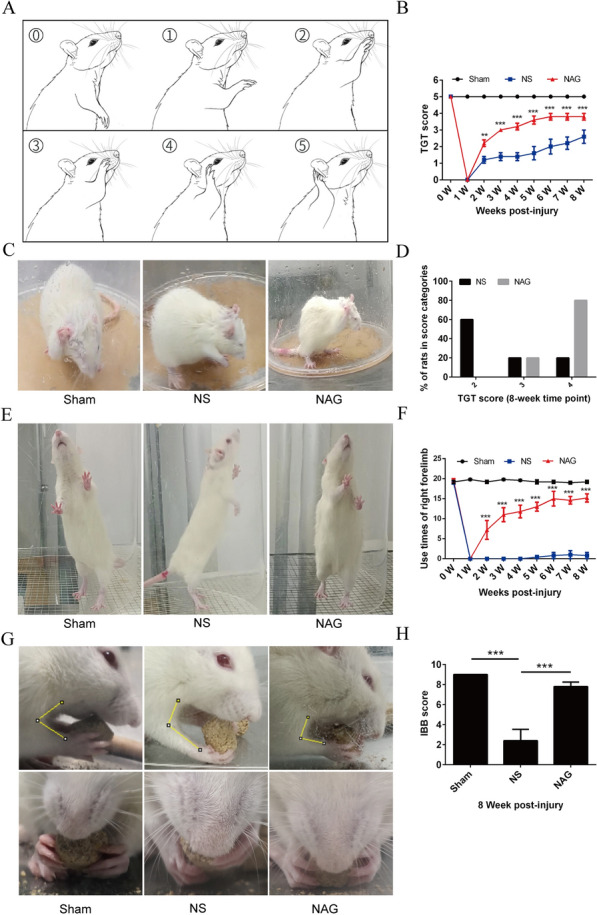
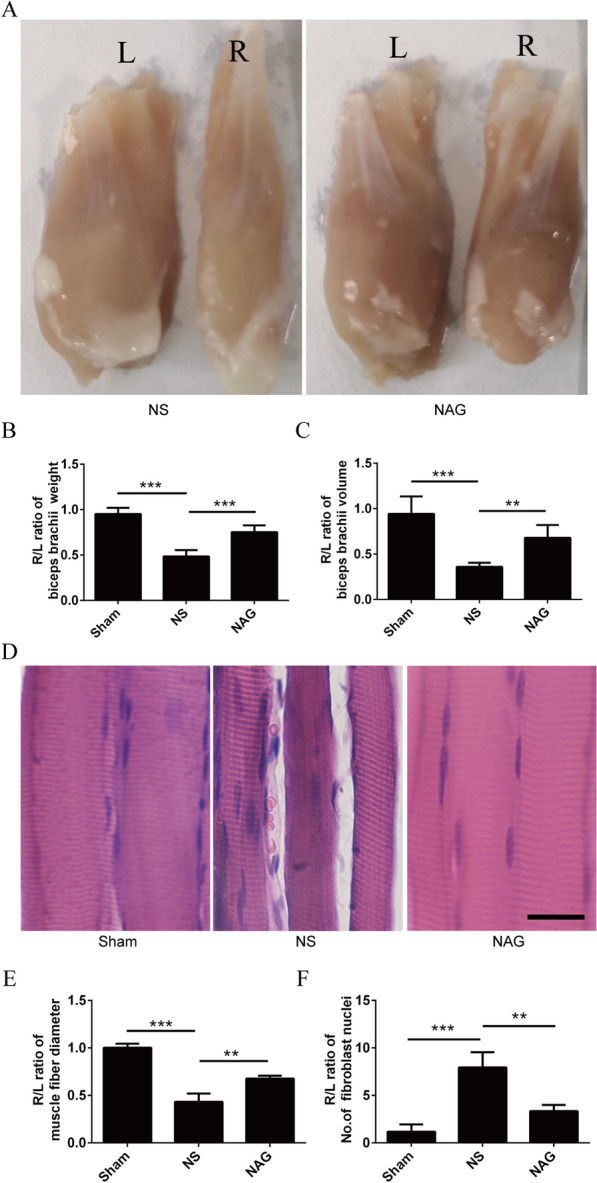
Male adult Sprague Dawley (SD) rats were subjected to BPRA and reimplantation surgery and subsequently treated with NAG or saline. Behavioral tests were conducted to evaluate motor function recovery and the mechanical pain threshold of the affected forelimb. The morphological appearance of the spinal cord, musculocutaneous nerve, and biceps brachii was assessed by histological staining. Quantitative real-time PCR (qRT‒PCR) was used to measure the mRNA levels of remyelination and regeneration indicators in myocutaneous nerves. The protein levels of inflammatory and pyroptotic indicators in the spinal cord anterior horn were measured using Western blotting.
NAG significantly accelerated the recovery of motor function in the injured forelimbs, enhanced motoneuronal survival in the anterior horn of the spinal cord, inhibited the expression of proinflammatory cytokines and pyroptosis pathway factors, facilitated axonal remyelination in the myocutaneous nerve and alleviated atrophy of the biceps brachii. Additionally, NAG attenuated neuropathic pain following BPRA.
NAG promotes functional motor recovery and alleviates neuropathic pain by enhancing motoneuronal survival and axonal remyelination and inhibiting the pyroptosis pathway after BPRA in rats, laying the foundation for the use of NAG as a novel treatment for BPRA.
臂丛神经根撕脱伤(BPRA)是一种使人致残的周围神经损伤,会导致大量运动神经元死亡、运动轴突退化和肱二头肌失神经支配,从而丧失上肢运动功能。乙酰谷氨酰胺(N-乙酰-L-谷氨酰胺,NAG)已被证明对各种神经系统疾病具有神经保护和抗炎作用。因此,本研究主要关注 NAG 对 BPRA 后大鼠运动和感觉功能恢复的影响及其潜在机制。
雄性成年 Sprague Dawley(SD)大鼠进行 BPRA 及再植入手术,随后给予 NAG 或生理盐水治疗。行为学测试用于评估运动功能恢复和受累前肢的机械痛阈。通过组织学染色评估脊髓、肌皮神经和肱二头肌的形态外观。使用实时定量 PCR(qRT-PCR)测量肌皮神经中髓鞘形成和再生指标的 mRNA 水平。使用 Western blot 测量脊髓前角中炎症和细胞焦亡途径指标的蛋白水平。
NAG 显著加速损伤前肢的运动功能恢复,增强脊髓前角运动神经元的存活,抑制促炎细胞因子和细胞焦亡途径因子的表达,促进肌皮神经中的轴突髓鞘形成,并减轻肱二头肌的萎缩。此外,NAG 减轻了 BPRA 后的神经病理性疼痛。
NAG 通过增强运动神经元存活和轴突髓鞘形成以及抑制 BPRA 后大鼠的细胞焦亡途径,促进运动功能的恢复并缓解神经病理性疼痛,为 NAG 作为治疗 BPRA 的新方法奠定了基础。