Musculoskeletal Research Unit, University of Bristol, UK; Medical Research Council Integrative Epidemiology Unit at the University of Bristol, UK.
Musculoskeletal Research Unit, University of Bristol, UK; Medical Research Council Integrative Epidemiology Unit at the University of Bristol, UK.
EBioMedicine. 2023 Sep;95:104759. doi: 10.1016/j.ebiom.2023.104759. Epub 2023 Aug 22.
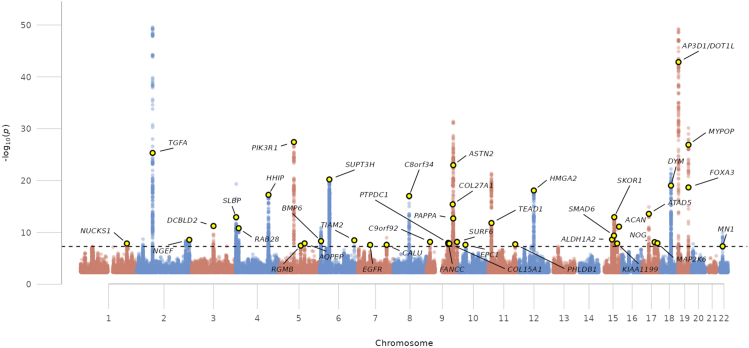
Hip minimum joint space width (mJSW) provides a proxy for cartilage thickness. This study aimed to conduct a genome-wide association study (GWAS) of mJSW to (i) identify new genetic determinants of mJSW and (ii) identify which mJSW loci convey hip osteoarthritis (HOA) risk and would therefore be of therapeutic interest.
GWAS meta-analysis of hip mJSW derived from plain X-rays and DXA was performed, stratified by sex and adjusted for age and ancestry principal components. Mendelian randomisation (MR) and cluster analyses were used to examine causal effect of mJSW on HOA.
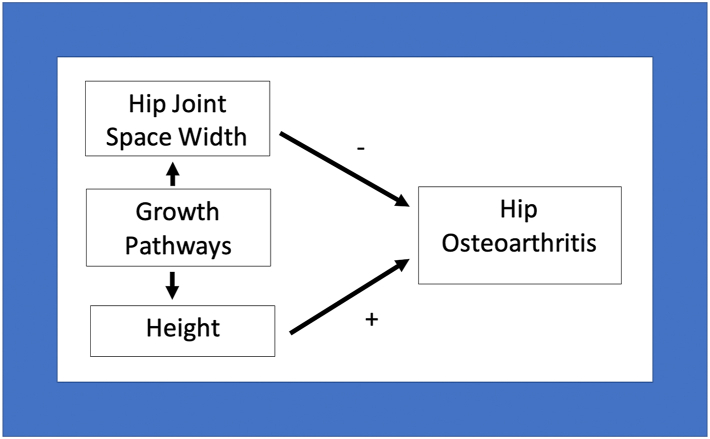
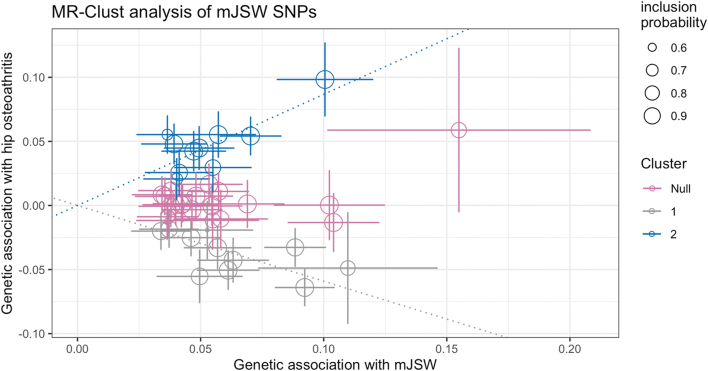
50,745 individuals were included in the meta-analysis. 42 SNPs, which mapped to 39 loci, were identified. Mendelian randomisation (MR) revealed little evidence of a causal effect of mJSW on HOA (OR 0.98 [95% CI 0.82-1.18]). However, MR-Clust analysis suggested the null MR estimates reflected the net effect of two distinct causal mechanisms cancelling each other out, one of which was protective, whereas the other increased HOA susceptibility. For the latter mechanism, all loci were positively associated with height, suggesting mechanisms leading to greater height and mJSW increase the risk of HOA in later life.
One group of mJSW loci reduce HOA risk via increased mJSW, suggesting possible utility as targets for chondroprotective therapies. The second group of mJSW loci increased HOA risk, despite increasing mJSW, but were also positively related to height, suggesting they contribute to HOA risk via a growth-related mechanism.
Primarily funded by the Medical Research Council and Wellcome Trust.
髋关节最小关节间隙宽度(mJSW)可作为软骨厚度的替代指标。本研究旨在对 mJSW 进行全基因组关联研究(GWAS),以确定 mJSW 的新遗传决定因素,并确定哪些 mJSW 位点传递髋关节骨关节炎(HOA)风险,从而具有治疗意义。
对来自 X 射线和 DXA 的髋关节 mJSW 进行 GWAS 荟萃分析,按性别分层,并根据年龄和祖系主成分进行调整。孟德尔随机化(MR)和聚类分析用于研究 mJSW 对 HOA 的因果效应。
荟萃分析共纳入 50745 名个体。鉴定出 42 个 SNP,映射到 39 个位点。孟德尔随机化(MR)发现 mJSW 对 HOA 没有因果效应的证据(OR 0.98 [95% CI 0.82-1.18])。然而,MR-Clust 分析表明,MR 估计值为零反映了两种不同因果机制相互抵消的净效应,其中一种是保护作用,而另一种则增加了 HOA 的易感性。对于后者机制,所有位点都与身高呈正相关,这表明导致身高和 mJSW 增加的机制会增加晚年 HOA 的风险。
一组 mJSW 位点通过增加 mJSW 降低 HOA 风险,这表明它们可能作为软骨保护治疗的靶点。第二组 mJSW 位点增加了 HOA 的风险,尽管增加了 mJSW,但也与身高呈正相关,这表明它们通过与生长相关的机制对 HOA 风险有贡献。
主要由医学研究理事会和惠康信托基金会资助。