Wen Han, Huapaya Julio A, Kanth Shreya M, Sun Junfeng, Matthew Brianna P, Lee Simone C, Do Michael, Chen Marcus Y, Malayeri Ashkan A, Suffredini Anthony F
National Heart, Lung, and Blood Institute, National Institutes of Health, Bethesda, MD 20892, USA.
Critical Care Medicine Department, Clinical Center, National Institutes of Health, Bethesda, MD 20892, USA.
J Imaging. 2023 Jul 26;9(8):150. doi: 10.3390/jimaging9080150.
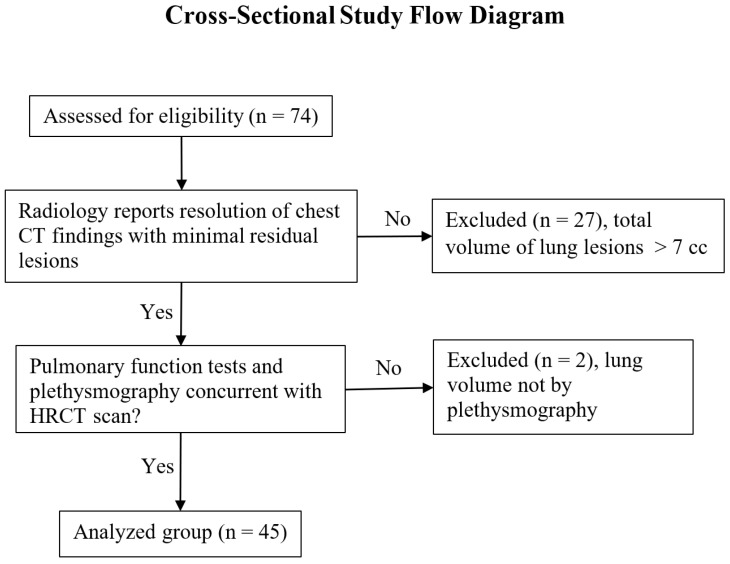
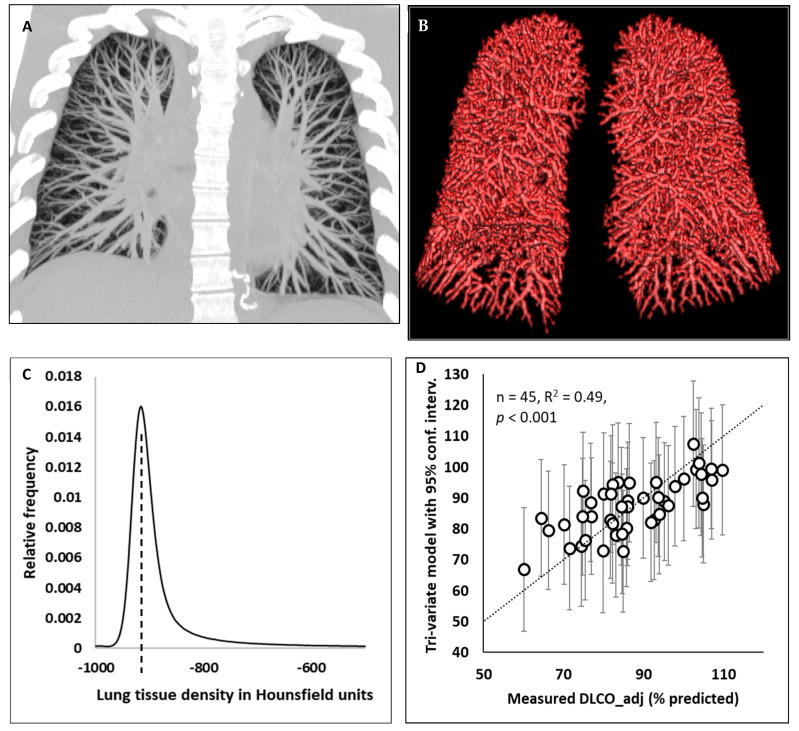
(1) Background: A reduction in the diffusion capacity of the lung for carbon monoxide is a prevalent longer-term consequence of COVID-19 infection. In patients who have zero or minimal residual radiological abnormalities in the lungs, it has been debated whether the cause was mainly due to a reduced alveolar volume or involved diffuse interstitial or vascular abnormalities. (2) Methods: We performed a cross-sectional study of 45 patients with either zero or minimal residual lesions in the lungs (total volume < 7 cc) at two months to one year post COVID-19 infection. There was considerable variability in the diffusion capacity of the lung for carbon monoxide, with 27% of the patients at less than 80% of the predicted reference. We investigated a set of independent variables that may affect the diffusion capacity of the lung, including demographic, pulmonary physiology and CT (computed tomography)-derived variables of vascular volume, parenchymal density and residual lesion volume. (3) Results: The leading three variables that contributed to the variability in the diffusion capacity of the lung for carbon monoxide were the alveolar volume, determined via pulmonary function tests, the blood vessel volume fraction, determined via CT, and the parenchymal radiodensity, also determined via CT. These factors explained 49% of the variance of the diffusion capacity, with values of 0.031, 0.005 and 0.018, respectively, after adjusting for confounders. A multiple-regression model combining these three variables fit the measured values of the diffusion capacity, with R = 0.70 and < 0.001. (4) Conclusions: The results are consistent with the notion that in some post-COVID-19 patients, after their pulmonary lesions resolve, diffuse changes in the vascular and parenchymal structures, in addition to a low alveolar volume, could be contributors to a lingering low diffusion capacity.
(1) 背景:肺一氧化碳弥散量降低是新冠病毒感染常见的长期后果。对于肺部影像学残留异常为零或极少的患者,其病因主要是肺泡容积减小还是涉及弥漫性间质或血管异常一直存在争议。(2) 方法:我们对45例新冠病毒感染后2个月至1年肺部残留病变为零或极少(总体积<7立方厘米)的患者进行了横断面研究。肺一氧化碳弥散量存在相当大的变异性,27%的患者低于预测参考值的80%。我们研究了一组可能影响肺弥散量的独立变量,包括人口统计学、肺生理学以及通过计算机断层扫描(CT)得出的血管容积、实质密度和残留病变体积等变量。(3) 结果:导致肺一氧化碳弥散量变异性的前三个变量分别是通过肺功能测试确定的肺泡容积、通过CT确定的血管容积分数以及同样通过CT确定的实质放射密度。在调整混杂因素后,这些因素分别解释了弥散量方差的49%,其系数分别为0.031、0.005和0.018。结合这三个变量的多元回归模型与弥散量测量值拟合良好,R = 0.70,P<0.001。(4) 结论:这些结果与以下观点一致,即在一些新冠病毒感染后的患者中,肺部病变消退后,除了肺泡容积较低外,血管和实质结构的弥漫性改变可能也是导致持续低弥散量的原因。