Manoharan Vijayalaxmi, Rodrigues Rui, Sadati Sara, Swann Marcus J, Freeman Neville, Du Bowen, Yildirim Ender, Tamer Ugur, Arvanitis Theodoros N, Isakov Dmitry, Asadipour Ali, Charmet Jérôme
Institute of Digital Healthcare, WMG, University of Warwick, Coventry, CV4 7AL, UK.
5D Health Protection Group Ltd, Accelerator Building, 1 Daulby Street, Liverpool L7 8XZ, UK.
Analyst. 2023 Sep 25;148(19):4857-4868. doi: 10.1039/d2an01350a.
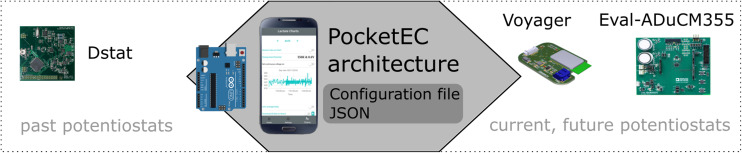
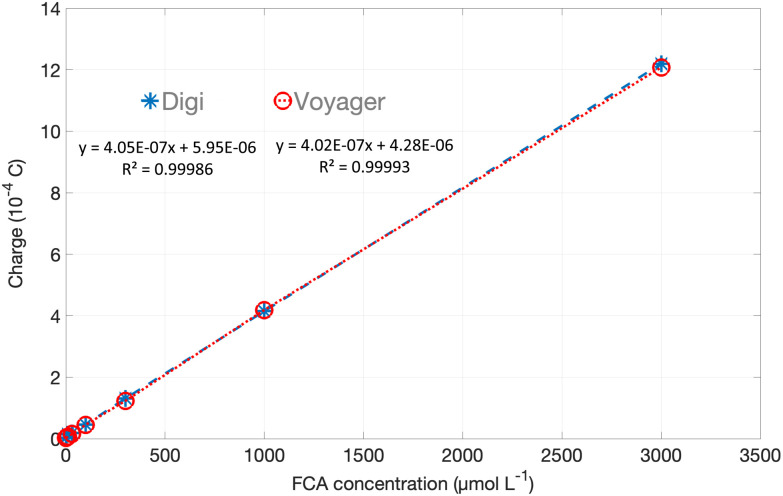
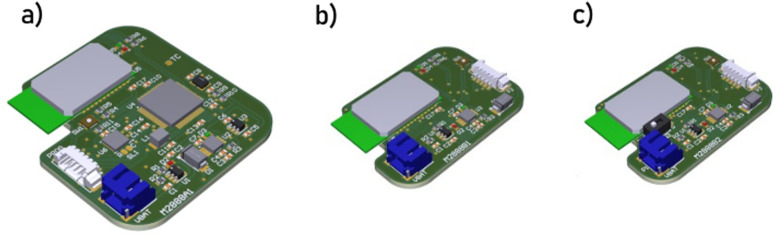
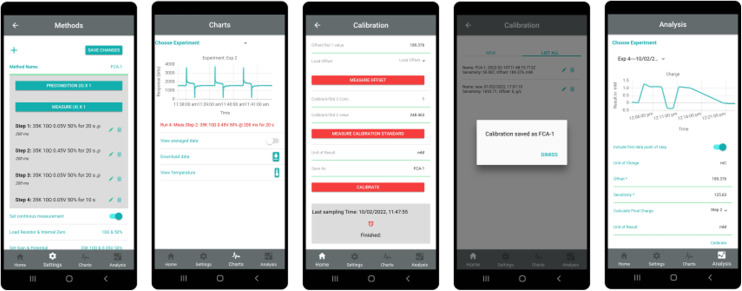
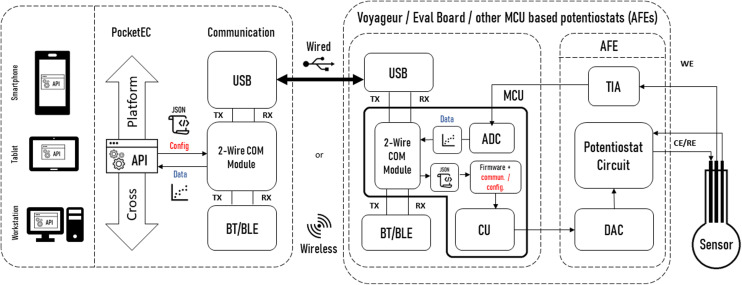
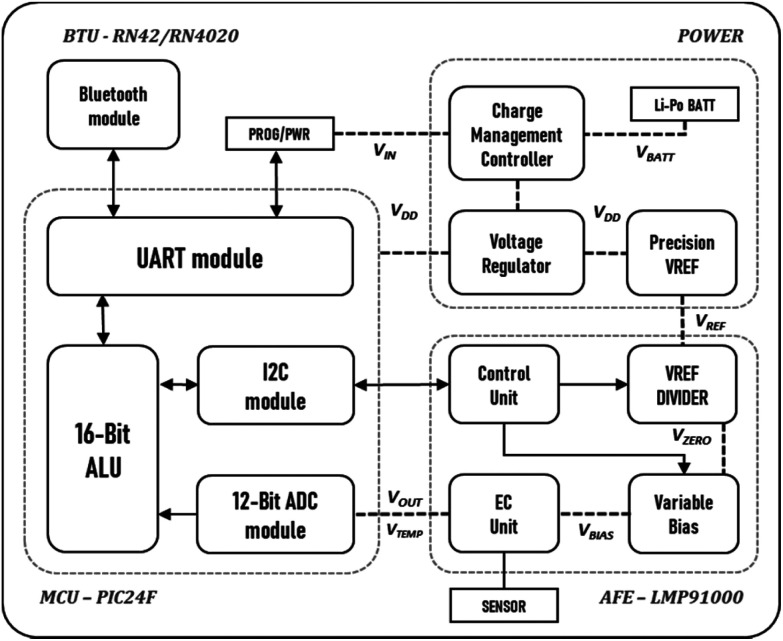
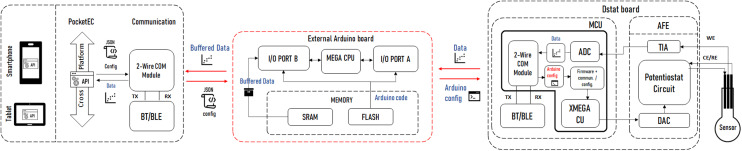
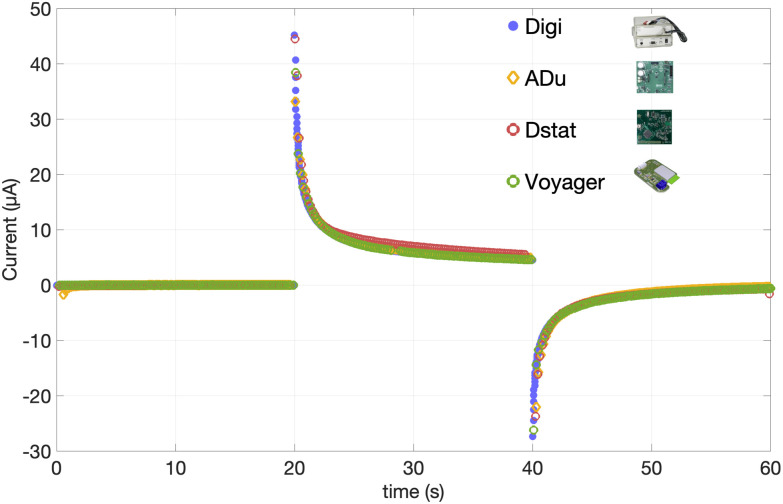
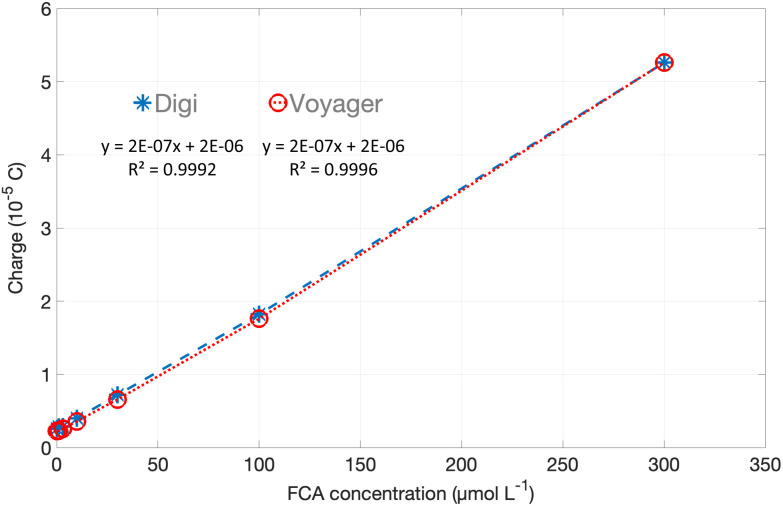
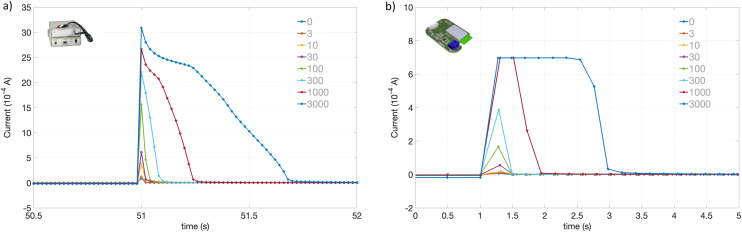
Electrochemical sensing is ubiquitous in a number of fields ranging from biosensing, to environmental monitoring through to food safety and battery or corrosion characterisation. Whereas conventional potentiostats are ideal to develop assays in laboratory settings, they are in general, not well-suited for field work due to their size and power requirements. To address this need, a number of portable battery-operated potentiostats have been proposed over the years. However, most open source solutions do not take full advantage of integrated circuit (IC) potentiostats, a rapidly evolving field. This is partly due to the constraining requirements inherent to the development of dedicated interfaces, such as apps, to address and control a set of common electrochemical sensing parameters. Here we propose the PocketEC, a universal app that has all the functionalities to interface with potentiostat ICs through a user defined property file. The versatility of PocketEC, developed with an assay developer mindset, was demonstrated by interfacing it, Bluetooth, to the ADuCM355 evaluation board, the open-source DStat potentiostat and the Voyager board, a custom-built, small footprint potentiostat based around the LMP91000 chip. The Voyager board is presented here for the first time. Data obtained using a standard redox probe, Ferrocene Carboxylic Acid (FCA) and a silver ion assay using anodic stripping multi-step amperometry were in good agreement with analogous measurements using a bench top potentiostat. Combined with its Voyager board companion, the PocketEC app can be used directly for a number of wearable or portable electrochemical sensing applications. Importantly, the versatility of the app makes it a candidate of choice for the development of future portable potentiostats. Finally, the app is available to download on the Google Play store and the source codes and design files for the PocketEC app and the Voyager board are shared Creative Commons license (CC BY-NC 3.0) to promote the development of novel portable or wearable applications based on electrochemical sensing.
电化学传感在从生物传感、环境监测到食品安全以及电池或腐蚀表征等众多领域中无处不在。传统的恒电位仪在实验室环境中开发检测方法时非常理想,但由于其尺寸和功率要求,总体上不太适合野外工作。为满足这一需求,多年来已提出了许多便携式电池供电的恒电位仪。然而,大多数开源解决方案并未充分利用集成电路(IC)恒电位仪这一快速发展的领域。部分原因在于开发专用接口(如应用程序)以处理和控制一组常见电化学传感参数时存在的固有约束要求。在此,我们提出了PocketEC,这是一款通用应用程序,它具有通过用户定义属性文件与恒电位仪IC进行接口连接的所有功能。以检测开发者的思维方式开发的PocketEC的多功能性,通过将其与ADuCM355评估板、开源DStat恒电位仪以及基于LMP91000芯片构建的定制小尺寸恒电位仪Voyager板进行蓝牙连接得以展示。Voyager板在此首次亮相。使用标准氧化还原探针二茂铁羧酸(FCA)获得的数据以及使用阳极溶出多步安培法进行的银离子检测数据,与使用台式恒电位仪进行的类似测量结果高度一致。结合其Voyager板配套设备,PocketEC应用程序可直接用于许多可穿戴或便携式电化学传感应用。重要的是,该应用程序的多功能性使其成为未来便携式恒电位仪开发的首选候选方案。最后,该应用程序可在谷歌应用商店下载,并且PocketEC应用程序和Voyager板的源代码及设计文件根据知识共享许可协议(CC BY - NC 3.0)共享,以促进基于电化学传感的新型便携式或可穿戴应用的开发。