
重症新冠患者的肥胖具有独特的先天免疫表型。
Obesity in Severe COVID-19 Patients Has a Distinct Innate Immune Phenotype.
作者信息
Resende Ayane de Sá, de Oliveira Yrna Lorena Matos, de Franca Mariana Nobre Farias, Magalhães Lucas Sousa, Correa Cristiane Bani, Fukutani Kiyoshi Ferreira, Lipscomb Michael Wheeler, de Moura Tatiana Rodrigues
机构信息
Health Sciences Graduate Program, Federal University of Sergipe, Aracaju 49060-100, Sergipe, Brazil.
Department of Parasitology and Pathology, ICBS, Federal University of Alagoas, Maceio 57072-900, Alagoas, Brazil.
出版信息
Biomedicines. 2023 Jul 27;11(8):2116. doi: 10.3390/biomedicines11082116.
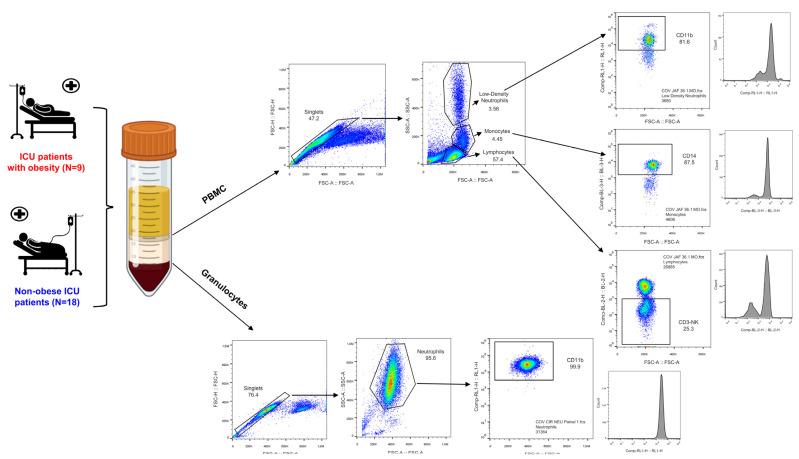
Obesity alters the capacity of effective immune responses in infections. To further address this phenomenon in the context of COVID-19, this study investigated how the immunophenotype of leukocytes was altered in individuals with obesity in severe COVID-19. This cross-sectional study enrolled 27 ICU COVID-19 patients (67% women, 56.33 ± 19.55 years) that were assigned to obese (BMI ≥ 30 kg/m, n = 9) or non-obese (BMI < 30kg/m, n = 18) groups. Monocytes, NK, and both Low-Density (LD) and High-Density (HD) neutrophils were isolated from peripheral blood samples, and surface receptors' frequency and expression patterns were analyzed by flow cytometry. Clinical status and biochemical data were additionally evaluated. The frequency of monocytes was negatively correlated with BMI, while NK cells and HD neutrophils were positively associated ( < 0.05). Patients with obesity showed a significant reduction of monocytes, and these cells expressed high levels of PD-L1 ( < 0.05). A higher frequency of NK cells and increased expression of TREM-1+ on HD neutrophils were detected in obese patients ( < 0.05). The expression of receptors related to antigen-presentation, phagocytosis, chemotaxis, inflammation and suppression were strongly correlated with clinical markers only in obese patients ( < 0.05). Collectively, these outcomes revealed that obesity differentially affected, and largely depressed, innate immune response in severe COVID-19.
肥胖会改变感染中有效免疫反应的能力。为了在新冠肺炎的背景下进一步研究这一现象,本研究调查了重症新冠肺炎肥胖个体中白细胞免疫表型是如何改变的。这项横断面研究纳入了27名入住重症监护病房的新冠肺炎患者(67%为女性,年龄56.33±19.55岁),这些患者被分为肥胖组(BMI≥30kg/m²,n = 9)和非肥胖组(BMI<30kg/m²,n = 18)。从外周血样本中分离出单核细胞、自然杀伤细胞(NK)以及低密度(LD)和高密度(HD)中性粒细胞,并通过流式细胞术分析表面受体的频率和表达模式。此外,还评估了临床状况和生化数据。单核细胞的频率与BMI呈负相关,而NK细胞和HD中性粒细胞呈正相关(P<0.05)。肥胖患者的单核细胞显著减少,且这些细胞表达高水平的程序性死亡受体配体1(PD-L1)(P<0.05)。在肥胖患者中检测到更高频率的NK细胞以及HD中性粒细胞上触发受体表达增加(TREM-1+)(P<0.05)。仅在肥胖患者中,与抗原呈递、吞噬作用、趋化作用、炎症和抑制相关的受体表达与临床指标密切相关(P<0.05)。总体而言,这些结果表明肥胖对重症新冠肺炎的固有免疫反应有不同影响,且在很大程度上抑制了该反应。



 Zotero 插件