Campbell Elena S B, Goens Melanie M, Cao Wenguang, Thompson Brad, Susta Leonardo, Banadyga Logan, Wootton Sarah K
Department of Pathobiology, University of Guelph, Guelph, ON N1G 2W1, Canada.
Public Health Agency of Canada, Winnipeg, MB R3E 3R2, Canada.
Biomedicines. 2023 Aug 8;11(8):2223. doi: 10.3390/biomedicines11082223.
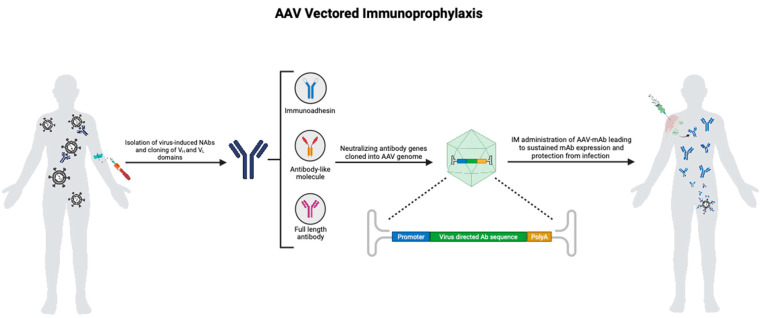
Monoclonal antibodies (mAbs) are important treatment modalities for preventing and treating infectious diseases, especially for those lacking prophylactic vaccines or effective therapies. Recent advances in mAb gene cloning from naturally infected or immunized individuals has led to the development of highly potent human mAbs against a wide range of human and animal pathogens. While effective, the serum half-lives of mAbs are quite variable, with single administrations usually resulting in short-term protection, requiring repeated doses to maintain therapeutic concentrations for extended periods of time. Moreover, due to their limited time in circulation, mAb therapies are rarely given prophylactically; instead, they are generally administered therapeutically after the onset of symptoms, thus preventing mortality, but not morbidity. Adeno-associated virus (AAV) vectors have an established record of high-efficiency in vivo gene transfer in a variety of animal models and humans. When delivered to post-mitotic tissues such as skeletal muscle, brain, and heart, or to organs in which cells turn over slowly, such as the liver and lungs, AAV vector genomes assume the form of episomal concatemers that direct transgene expression, often for the lifetime of the cell. Based on these attributes, many research groups have explored AAV-vectored delivery of highly potent mAb genes as a strategy to enable long-term expression of therapeutic mAbs directly in vivo following intramuscular or intranasal administration. However, clinical trials in humans and studies in nonhuman primates (NHPs) indicate that while AAVs are a powerful and promising platform for vectored immunoprophylaxis (VIP), further optimization is needed to decrease anti-drug antibody (ADA) and anti-capsid antibody responses, ultimately leading to increased serum transgene expression levels and improved therapeutic efficacy. The following review will summarize the current landscape of AAV VIP in NHP models, with an emphasis on vector and transgene design as well as general delivery system optimization. In addition, major obstacles to AAV VIP, along with implications for clinical translation, will be discussed.
单克隆抗体(mAbs)是预防和治疗传染病的重要治疗手段,尤其适用于那些缺乏预防性疫苗或有效疗法的疾病。从自然感染或免疫个体中克隆mAb基因的最新进展,已促成了针对多种人类和动物病原体的高效人源单克隆抗体的开发。虽然单克隆抗体有效,但其血清半衰期差异很大,单次给药通常只能提供短期保护,需要重复给药以长时间维持治疗浓度。此外,由于其在循环中的时间有限,单克隆抗体疗法很少用于预防性给药;相反,它们通常在症状出现后进行治疗性给药,从而预防死亡,但不能预防发病。腺相关病毒(AAV)载体在多种动物模型和人类体内基因转移方面有着高效的记录。当递送至有丝分裂后组织如骨骼肌、脑和心脏,或细胞更新缓慢器官如肝脏和肺时,AAV载体基因组呈游离串联体形式,指导转基因表达,通常在细胞的整个生命周期内表达。基于这些特性,许多研究小组探索了通过AAV载体递送高效单克隆抗体基因,作为在肌肉内或鼻内给药后直接在体内实现治疗性单克隆抗体长期表达的一种策略。然而,人类临床试验和非人类灵长类动物(NHPs)研究表明,虽然AAV是载体免疫预防(VIP)的一个强大且有前景的平台,但需要进一步优化以降低抗药物抗体(ADA)和抗衣壳抗体反应,最终提高血清转基因表达水平并改善治疗效果。以下综述将总结AAV VIP在NHP模型中的当前情况,重点关注载体和转基因设计以及一般递送系统优化。此外,还将讨论AAV VIP的主要障碍及其对临床转化的影响。