Suganuma Shinya, Idei Masafumi, Nakano Hidehiko, Koyama Yasuaki, Hashimoto Hideki, Yokoyama Nobuyuki, Takaki Shunsuke, Nakamura Kensuke
Department of Critical Care Medicine, Yokohama City University Hospital, 3-9 Fukuura, Kanazawa-ku, Yokohama 236-0004, Japan.
Department of Emergency and Critical Care Medicine, Hitachi General Hospital, 2-1-1, Jonan-cho, Hitachi 317-0077, Japan.
J Clin Med. 2023 Aug 21;12(16):5427. doi: 10.3390/jcm12165427.
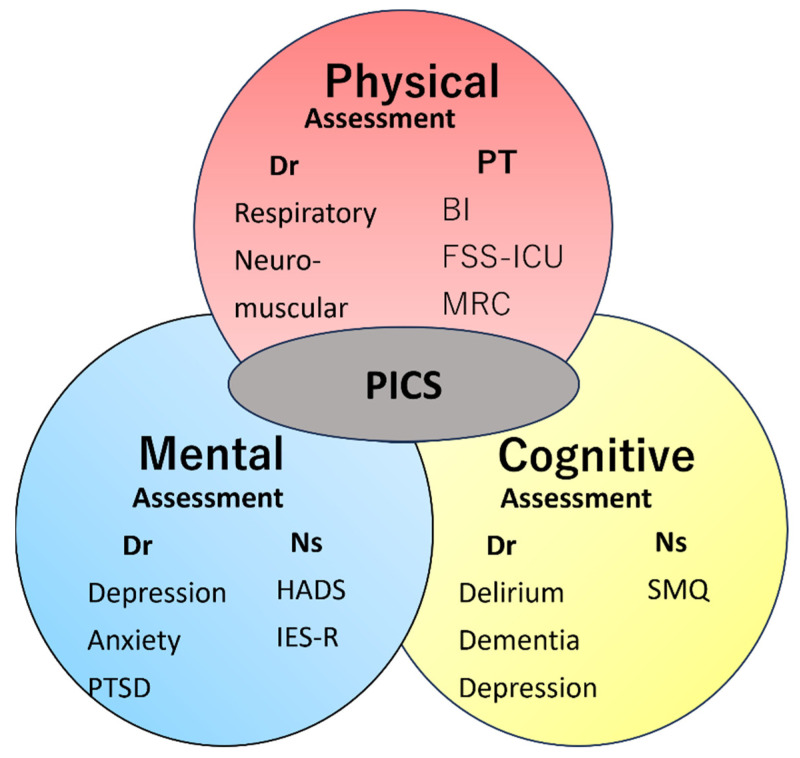
Persistent inflammation, immunosuppression, and catabolism syndrome (PIICS) is known as a prolonged immunodeficiency that occurs after severe infection. Few studies have demonstrated a direct relationship between PIICS and physical dysfunction in post-intensive care syndrome (PICS). We herein investigated how each component of PICS was affected by the diagnosis of PIICS during hospitalization and examined the relationship between PIICS and PICS using PICS assessments performed at the Hitachi General Hospital PICS Clinic.
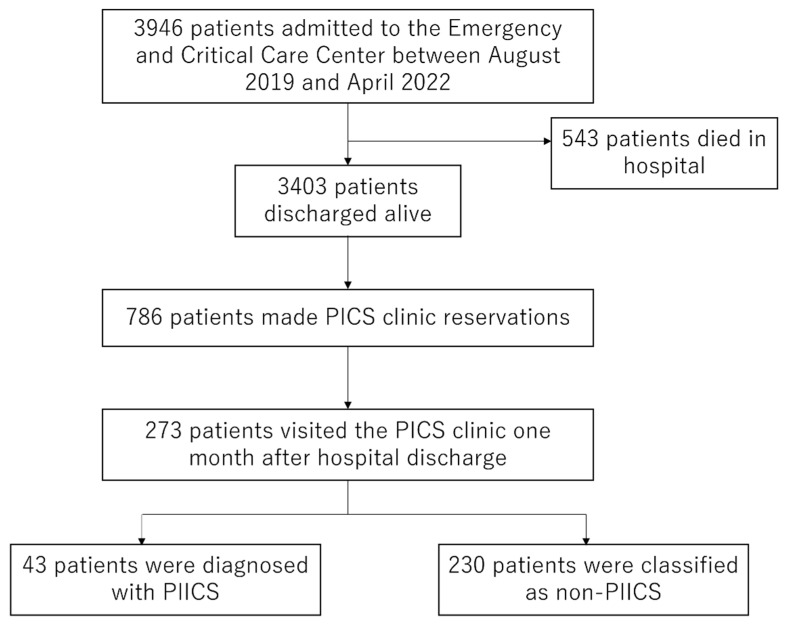
The 273 patients who visited the PICS clinic at one month after discharge from the ICU at Hitachi General Hospital were included in the study. We used the diagnostic criteria for PIICS described in previous studies. At least two of the following blood test values on day 14 of hospitalization had to be met for a diagnosis of PIICS: C-reactive protein (CRP) > 2.0 mg/dL, albumin (Alb) < 3.0 g/dL, and lymphocytes (Lym) < 800/μL. Blood test values closest to day 14 out of 11-17 days of hospitalization were used. The primary outcome was a Barthel Index (BI) < 90, while secondary outcomes were the results of various PICS assessments, including mental and cognitive impairments, performed at the PICS clinic. We supplemented missing data with multiple imputations by chained equations. We performed a nominal logistic regression analysis with age, sex, BMI, SOFA, and the presence of PIICS as variables for BI < 90.
Forty-three out of two hundred seventy-three PICS outpatients met the diagnostic criteria for PIICS during hospitalization. In comparisons with non-PIICS patients, significantly higher severity scores for APACHE II and SOFA and a longer hospital stay were observed in PIICS patients, suggesting a higher clinical severity. The primary outcome, BI, was lower in the PIICS group (97.5 (58.5, 100) vs. 100 (95, 100), = 0.008), as were the secondary outcomes (FSS-ICU: 35 (31, 35) vs. 35 (35, 35), MRC score: 55 (50.25, 58) vs. 58 (53, 60), grip strength: 16.45 (9.2, 25.47) vs. 20.4 (15.3, 27.7)). No significant differences were noted in mental or cognitive function assessments, such as HADS, IES-R, and SMQ. A multivariable analysis supplemented with missing data revealed that PIICS (odds ratio: 1.23 (1.08-1.40 = 0.001) and age (odds ratio: 1.007 (1.004-1.01), < 0.001) correlated with BI < 90, independent of clinical severity such as sequential organ failure assessment (SOFA). Similar results were obtained in the sensitivity analysis excluding missing data.
The present study revealed a strong relationship between PIICS and post-discharge PICS physical dysfunction in patients requiring intensive care.
持续性炎症、免疫抑制和分解代谢综合征(PIICS)是一种严重感染后出现的长期免疫缺陷。很少有研究表明PIICS与重症监护后综合征(PICS)中的身体功能障碍有直接关系。我们在此研究了住院期间PIICS的诊断如何影响PICS的各个组成部分,并使用日立综合医院PICS诊所进行的PICS评估来检查PIICS与PICS之间的关系。
本研究纳入了273名在日立综合医院重症监护病房出院后1个月到PICS诊所就诊的患者。我们采用先前研究中描述的PIICS诊断标准。住院第14天的以下血液检测值中至少满足两项才能诊断为PIICS:C反应蛋白(CRP)>2.0mg/dL、白蛋白(Alb)<3.0g/dL和淋巴细胞(Lym)<800/μL。使用住院11 - 17天中最接近第14天的血液检测值。主要结局为巴氏指数(BI)<90,次要结局为在PICS诊所进行的各种PICS评估结果,包括精神和认知障碍。我们通过链式方程多重填补法补充缺失数据。我们以年龄、性别、BMI、序贯器官衰竭评估(SOFA)和是否存在PIICS作为BI<90的变量进行名义逻辑回归分析。
273名PICS门诊患者中有43名在住院期间符合PIICS诊断标准。与非PIICS患者相比,PIICS患者的急性生理与慢性健康状况评分系统II(APACHE II)和SOFA严重程度评分显著更高,住院时间更长,提示临床严重程度更高。主要结局指标BI在PIICS组更低(97.5(58.5,100)对100(95,100),P = 0.008),次要结局指标也是如此(重症监护病房功能状态量表(FSS - ICU):35(31,35)对35(35,35),医学研究委员会(MRC)评分:55(50.25,58)对58(53,60),握力:16.45(9.2,25.47)对20.4(15.3,27.7))。在精神或认知功能评估中,如医院焦虑抑郁量表(HADS)、事件影响量表修订版(IES - R)和简易精神状态问卷(SMQ),未发现显著差异。补充缺失数据后的多变量分析显示,PIICS(比值比:1.23(1.08 - 1.40),P = 0.001)和年龄(比值比:1.007(1.004 - 1.01),P < 0.001)与BI<90相关,独立于如序贯器官衰竭评估(SOFA)等临床严重程度。在排除缺失数据的敏感性分析中也得到了类似结果。
本研究揭示了PIICS与需要重症监护的患者出院后PICS身体功能障碍之间存在密切关系。