Tensen Esmée, van Sinderen Femke, Bekkenk Marcel W, Jaspers Monique W, Peute Linda W
Department of Medical Informatics, Amsterdam UMC location University of Amsterdam, Amsterdam, Netherlands.
Amsterdam Public Health, Digital Health, Amsterdam, Netherlands.
JMIR Dermatol. 2022 Sep 23;5(3):e40888. doi: 10.2196/40888.
Challenges remain for general practitioners (GPs) in diagnosing (pre)malignant and benign skin lesions. Teledermoscopy (TDsc) supports GPs in diagnosing these skin lesions guided by teledermatologists' (TDs) diagnosis and advice and prevents unnecessary referrals to dermatology care. However, the impact of the availability of TDsc on GPs' self-reported referral decisions to dermatology care before and after the TDsc consultation is unknown.
The objective of this study is to assess and compare the initial self-reported referral decisions of GPs before TDsc versus their final self-reported referral decisions after TDsc for skin lesions diagnosed by the TD as (pre)malignant or benign.
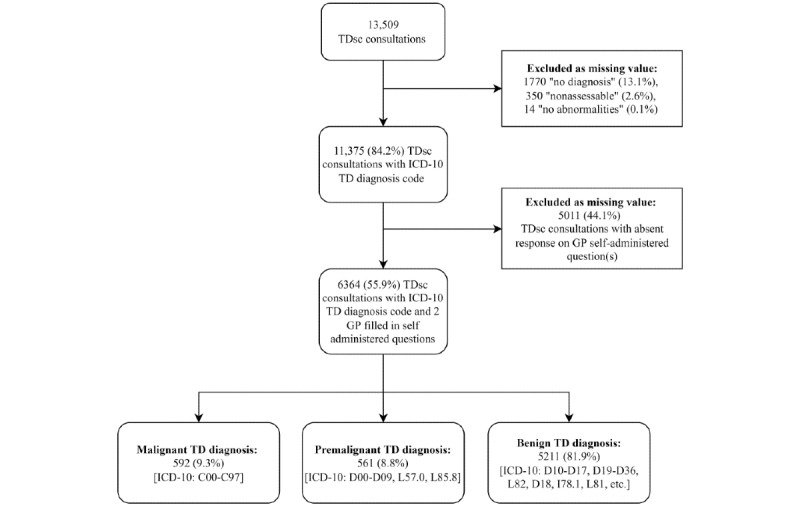
TDsc consultations requested by GPs in daily practice between July 2015 and June 2020 with a TD assessment and diagnosis were extracted from a nationwide Dutch telemedicine database. Based on GP self-administered questions, the GPs' referral decisions before and their final referral decision after TDsc consultation were assessed for (pre)malignant and benign TD diagnoses.
GP self-administered questions and TD diagnoses were evaluated for 6364 TDsc consultations (9.3% malignant, 8.8% premalignant, and 81.9% benign skin lesions). In half of the TDsc consultations, GPs adjusted their initial referral decision after TD advice and TD diagnosis. Initially, GPs did not have the intention to refer 67 (56.8%) of 118 patients with a malignant TD diagnosis and 26 (16.0%) of 162 patients with a premalignant TD diagnosis but then decided to refer these patients after the TDsc consultation. Furthermore, GPs adjusted their decision from referral to nonreferral for 2534 (74.9%) benign skin lesions (including 676 seborrheic keratosis and 131 vascular lesions).
GPs adjusted their referral decision in 52% (n=3306) of the TDsc consultations after the TD assessment. The availability of TDsc is thus of added value and assists GPs in their (non)referral for patients with skin lesions to dermatology care. TDsc resulted in referrals of patients with (pre)malignant skin lesions that GPs would not have referred directly to the dermatologist. TDsc also led to a reduction of unnecessary referrals of patients with low complex benign skin lesions (eg, seborrheic keratosis and vascular lesions).
全科医生(GP)在诊断(癌)前和良性皮肤病变方面仍面临挑战。远程皮肤镜检查(TDsc)在远程皮肤科医生(TD)的诊断和建议指导下,支持全科医生诊断这些皮肤病变,并避免不必要的皮肤科转诊。然而,TDsc的可用性对全科医生在TDsc咨询前后自我报告的皮肤科转诊决定的影响尚不清楚。
本研究的目的是评估和比较全科医生在TDsc之前最初自我报告的转诊决定与TDsc之后针对TD诊断为(癌)前或良性的皮肤病变的最终自我报告的转诊决定。
从荷兰全国远程医疗数据库中提取2015年7月至2020年6月全科医生在日常实践中请求的TDsc咨询以及TD评估和诊断。根据全科医生自行填写的问题,评估全科医生在TDsc咨询之前和之后针对(癌)前和良性TD诊断的转诊决定。
对6364次TDsc咨询(9.3%为恶性、8.8%为癌前病变、81.9%为良性皮肤病变)的全科医生自行填写的问题和TD诊断进行了评估。在一半的TDsc咨询中,全科医生在TD建议和TD诊断后调整了他们最初的转诊决定。最初,全科医生无意转诊118例TD诊断为恶性的患者中的67例(56.8%)以及162例TD诊断为癌前病变的患者中的26例(16.0%),但在TDsc咨询后决定转诊这些患者。此外,对于2534例(74.9%)良性皮肤病变(包括676例脂溢性角化病和131例血管病变),全科医生将他们的决定从转诊调整为不转诊。
在TD评估后,52%(n = 3306)的TDsc咨询中全科医生调整了他们的转诊决定。因此,TDsc的可用性具有附加价值,并有助于全科医生对有皮肤病变的患者进行(不)转诊至皮肤科。TDsc导致了全科医生原本不会直接转诊至皮肤科医生的(癌)前皮肤病变患者的转诊。TDsc还减少了低复杂性良性皮肤病变(如脂溢性角化病和血管病变)患者的不必要转诊。