Li Meng, Shi Yucheng
School of Politics and Public Administration, Zhengzhou University, Zhengzhou, 450001, China.
College of Intelligence and Computing, Tianjin University, Tianjin, 300350, China.
Heliyon. 2023 Aug 12;9(8):e19091. doi: 10.1016/j.heliyon.2023.e19091. eCollection 2023 Aug.
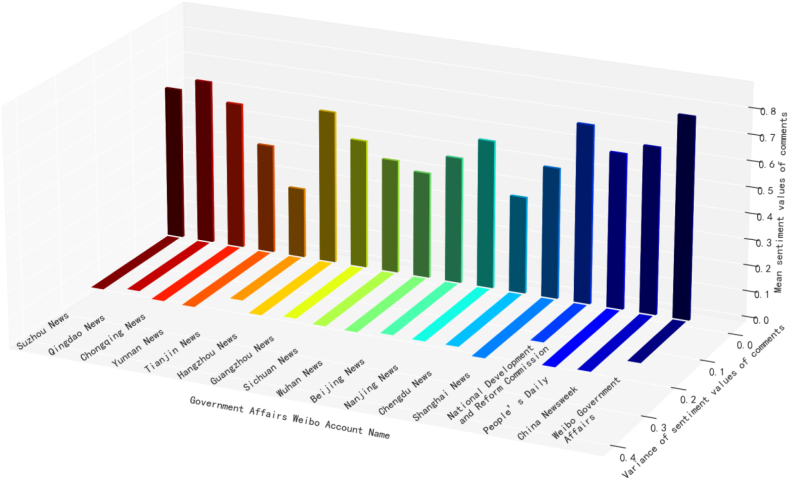
Existing sentiment analysis research on Chinese government affairs microblogs primarily focuses on the task of sentiment classification on microblogs. There has been a lack of investigation into the correlation of each government affairs microblog with the sentiment values of the corresponding comments below it. This study constructs a large-scale government affairs microblog dataset and explore the correlation of each microblog with the sentiment values of the corresponding comments below it. We proposed a new framework that includes data collection, sentiment analysis and sentiment prediction model training. This sentiment analysis framework is crucial in the government's understanding of the public's real-time sentiments toward policies. It also helps monitor the Internet public sentiment and actively guide the Internet public opinion. We first analyzed the sentiment distribution of government affairs microblogs and the sentiment values on meaningful words. We also discussed the discrepancy in text similarity and sentiment values between microblogs. Furthermore, we investigated the extreme emotional content and discussed the factors influencing the sentiment values of comments. Finally, we designed a collaborative attention regression model to predict the sentiments of microblogs. The sentiment prediction model performed well in the sentiment prediction regression task. The sentiment analysis and the prediction framework for government affairs microblogs in this study can be used as a reference for government-related Internet opinion monitoring.
现有关于中国政务微博的情感分析研究主要集中在微博的情感分类任务上。对于每条政务微博与其下方相应评论的情感值之间的相关性缺乏研究。本研究构建了一个大规模的政务微博数据集,并探讨每条微博与其下方相应评论的情感值之间的相关性。我们提出了一个新的框架,包括数据收集、情感分析和情感预测模型训练。这个情感分析框架对于政府了解公众对政策的实时情绪至关重要。它还有助于监测网络舆情并积极引导网络舆论。我们首先分析了政务微博的情感分布以及有意义词汇上的情感值。我们还讨论了微博之间文本相似度和情感值的差异。此外,我们调查了极端情感内容并讨论了影响评论情感值的因素。最后,我们设计了一个协同注意力回归模型来预测微博的情感。该情感预测模型在情感预测回归任务中表现良好。本研究中的政务微博情感分析和预测框架可为政府相关网络舆情监测提供参考。