Department of Orthopaedics, Xi-Jing Hospital, The Fourth Military Medical University, Xi'an, China.
School of Chemistry, Cardiff University, Cardiff, United Kingdom.
Front Immunol. 2023 Aug 10;14:1197493. doi: 10.3389/fimmu.2023.1197493. eCollection 2023.
The coronavirus disease (COVID-19) pandemic is a serious threat to public health worldwide. Growing evidence reveals that there are certain links between COVID-19 and autoimmune diseases; in particular, COVID-19 and idiopathic inflammatory myopathies (IIM) have been observed to be clinically comorbid. Hence, this study aimed to elucidate the molecular mechanisms of COVID-19 and IIM from a genomic perspective.
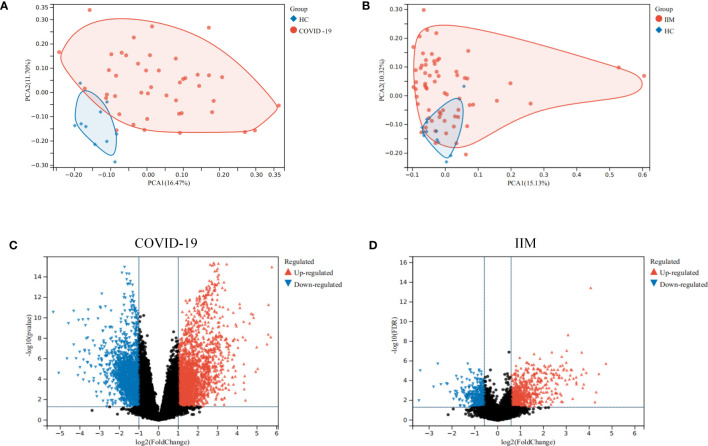
We obtained transcriptome data of patients with COVID-19 and IIM separately from the GEO database and identified common differentially expressed genes (DEGs) by intersection. We then performed functional enrichment, PPI, machine learning, gene expression regulatory network, and immune infiltration analyses of co-expressed genes.
A total of 91 common genes were identified between COVID-19 and IIM. Functional enrichment analysis revealed that these genes were mainly involved in immune dysregulation, response to external stimuli, and MAPK signaling pathways. The MCODE algorithm recognized two densely linked clusters in the common genes, which were related to inflammatory factors and interferon signaling. Subsequently, three key genes (CDKN1A, IFI27, and STAB1) were screened using machine learning to predict the occurrence of COVID-19 related IIM. These key genes exhibited excellent diagnostic performance in both training and validation cohorts. Moreover, we created TF-gene and miRNA-gene networks to reveal the regulation of key genes. Finally, we estimated the relationship between key genes and immune cell infiltration, of which IFI27 was positively associated with M1 macrophages.
Our work revealed common molecular mechanisms, core genes, potential targets, and therapeutic approaches for COVID-19 and IIM from a genomic perspective. This provides new ideas for the diagnosis and treatment of COVID-19 related IIM in the future.
冠状病毒病(COVID-19)大流行是全球公共卫生的严重威胁。越来越多的证据表明,COVID-19 与自身免疫性疾病之间存在一定联系;特别是,COVID-19 和特发性炎性肌病(IIM)已被观察到临床上同时存在。因此,本研究旨在从基因组学角度阐明 COVID-19 和 IIM 的分子机制。
我们分别从 GEO 数据库中获得 COVID-19 和 IIM 患者的转录组数据,并通过交集识别共同差异表达基因(DEGs)。然后,我们对共表达基因进行功能富集、PPI、机器学习、基因表达调控网络和免疫浸润分析。
共鉴定出 COVID-19 和 IIM 之间存在 91 个共同基因。功能富集分析表明,这些基因主要参与免疫失调、对外界刺激的反应和 MAPK 信号通路。MCODE 算法在共同基因中识别出两个紧密连接的簇,与炎症因子和干扰素信号有关。随后,使用机器学习筛选出三个关键基因(CDKN1A、IFI27 和 STAB1)来预测 COVID-19 相关 IIM 的发生。这些关键基因在训练和验证队列中均表现出出色的诊断性能。此外,我们构建了 TF-基因和 miRNA-基因网络,以揭示关键基因的调控。最后,我们估计了关键基因与免疫细胞浸润之间的关系,其中 IFI27 与 M1 巨噬细胞呈正相关。
从基因组学角度,我们的工作揭示了 COVID-19 和 IIM 的共同分子机制、核心基因、潜在靶点和治疗方法。这为未来 COVID-19 相关 IIM 的诊断和治疗提供了新的思路。