Century Eye Care Medical Center, Gardena, California.
Herbert Wertheim School of Optometry at the University of California, Berkeley, Berkeley, California.
Optom Vis Sci. 2023 Sep 1;100(9):597-605. doi: 10.1097/OPX.0000000000002060. Epub 2023 Aug 29.
Although the myopia control efficacy of orthokeratology lenses has been established with clinical trials, reports of axial length change in non-study-based patient care are scarce. This study investigates the use of orthokeratology lenses for myopia control in a clinical population and compares axial elongation against those published in recent clinical investigations.
This study aimed to investigate factors affecting axial elongation during use of orthokeratology lenses for myopia control in an academic clinical setting.
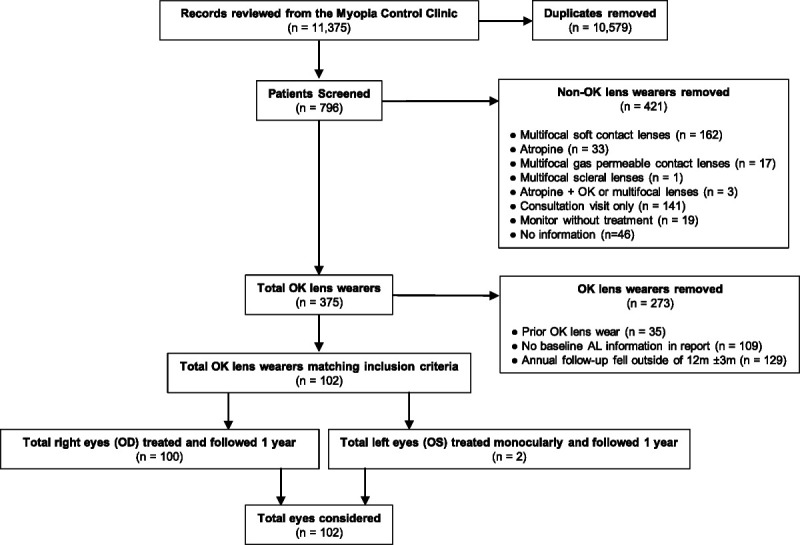
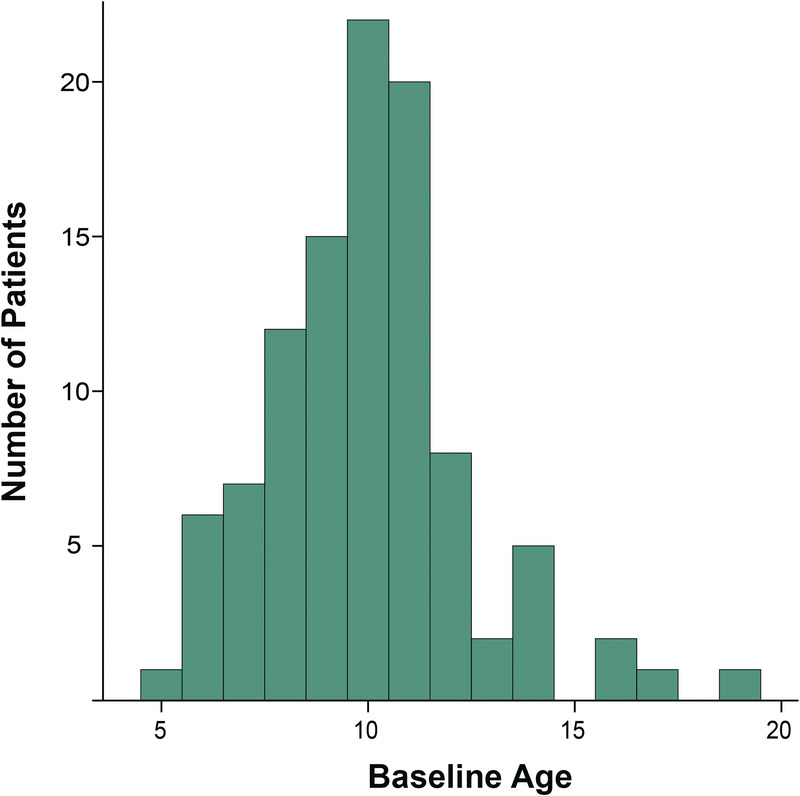
This study was a retrospective consecutive case series from the Myopia Control Clinic at the Herbert Wertheim School of Optometry at the University of California, Berkeley (Berkeley, CA). Patients ranging from 5 to 18 years old using orthokeratology for at least 1 year were included in the study. Data from 102 patients' eyes were analyzed at baseline (before the initiation of treatment) and after 1 year of wear (12 ± 3 months). Multivariate analysis was undertaken to identify factors significantly associated with axial elongation over this period.
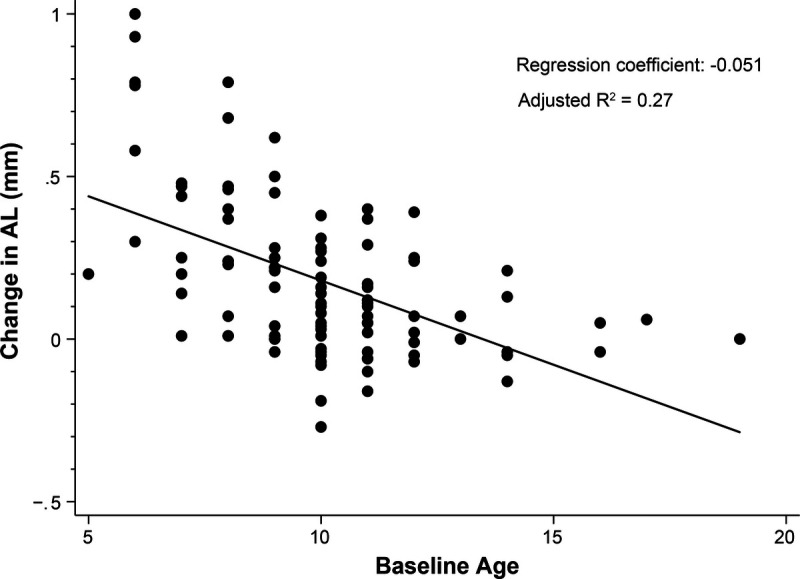
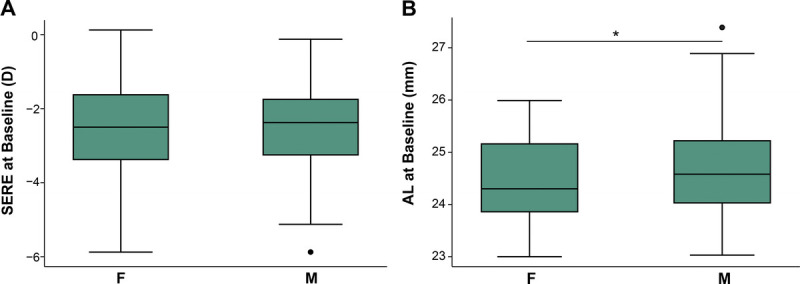
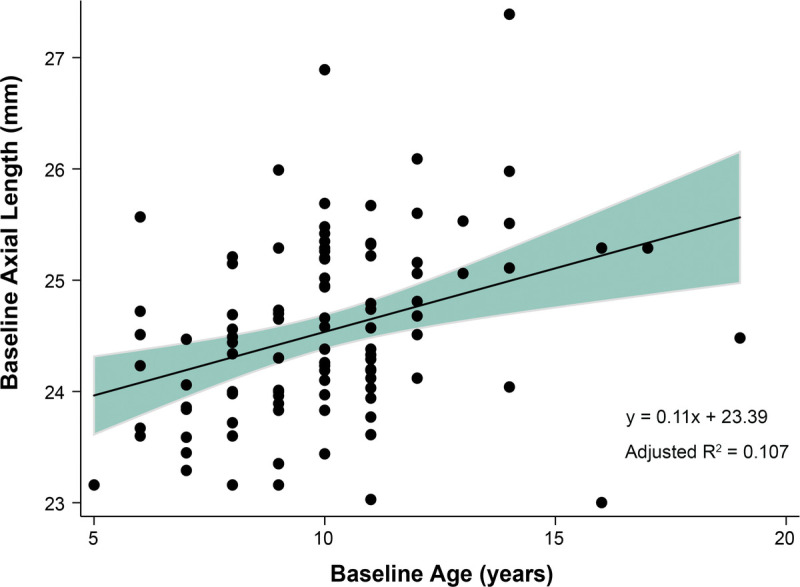
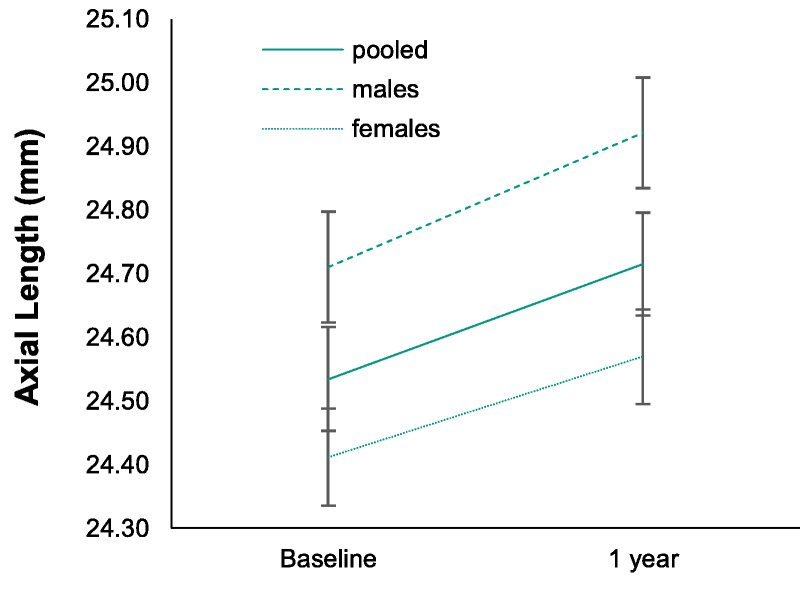
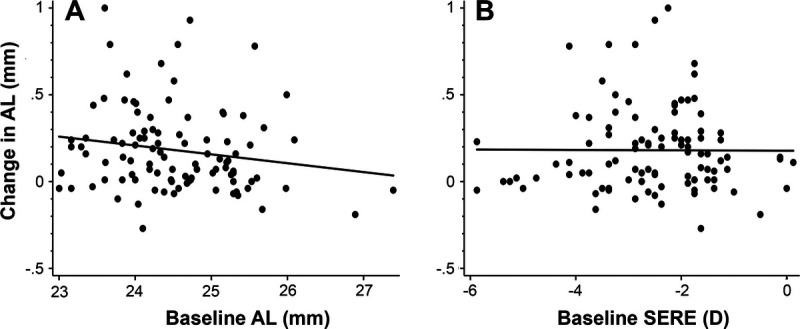
Mean (±standard deviation) spherical equivalent refraction and axial length at baseline were -2.54 (±1.21) D and 24.53 (±0.82) mm, respectively. By the 1-year follow-up, eyes had shown significant axial elongation (0.18 ± 0.24 mm; P < .001), which was found to be inversely correlated with age ( P < .001). Race, sex, baseline axial length, and baseline refraction were not significantly associated with axial elongation.
Factors influencing axial length and the magnitude of axial elongation in our orthokeratology patient population are consistent with orthokeratology treatment groups from published randomized clinical trials and support the use of these lenses for myopia control in a clinical practice setting.
虽然角膜塑形术镜片的近视控制效果已通过临床试验得到证实,但在基于研究的患者护理中关于眼轴长度变化的报告却很少。本研究调查了角膜塑形术在临床人群中用于近视控制的效果,并将眼轴伸长与最近的临床研究中的结果进行了比较。
本研究旨在调查在学术临床环境中使用角膜塑形术治疗近视的过程中影响眼轴伸长的因素。
本研究是加利福尼亚大学伯克利分校赫伯特·沃特海姆视光学院近视控制诊所的一项回顾性连续病例系列研究。该研究纳入了使用角膜塑形术治疗近视至少 1 年的患者。共分析了 102 名患者的 102 只眼的数据,这些患者分别在基线(治疗开始前)和佩戴 1 年(12±3 个月)后进行了检查。采用多元分析确定了在此期间与眼轴伸长显著相关的因素。
平均(±标准差)球镜等效屈光度和基线时的眼轴长度分别为-2.54(±1.21)D 和 24.53(±0.82)mm。在 1 年的随访中,眼轴显著延长(0.18±0.24mm;P<0.001),且与年龄呈负相关(P<0.001)。种族、性别、基线眼轴长度和基线屈光度与眼轴伸长均无显著相关性。
影响我们的角膜塑形术患者群体眼轴长度和眼轴伸长程度的因素与已发表的随机临床试验中的角膜塑形术治疗组一致,支持在临床实践中使用这些镜片来控制近视。