Department of Hygiene and Epidemiology, University of Ioannina School of Medicine, Ioannina, Greece.
Division of Biostatistics, Department of Population and Public Health Sciences, Keck School of Medicine, University of Southern California, Los Angeles, CA, United States.
Am J Clin Nutr. 2023 Nov;118(5):881-891. doi: 10.1016/j.ajcnut.2023.08.010. Epub 2023 Aug 26.
Epidemiological and experimental evidence suggests that higher folate intake is associated with decreased colorectal cancer (CRC) risk; however, the mechanisms underlying this relationship are not fully understood. Genetic variation that may have a direct or indirect impact on folate metabolism can provide insights into folate's role in CRC.
Our aim was to perform a genome-wide interaction analysis to identify genetic variants that may modify the association of folate on CRC risk.
We applied traditional case-control logistic regression, joint 3-degree of freedom, and a 2-step weighted hypothesis approach to test the interactions of common variants (allele frequency >1%) across the genome and dietary folate, folic acid supplement use, and total folate in relation to risk of CRC in 30,550 cases and 42,336 controls from 51 studies from 3 genetic consortia (CCFR, CORECT, GECCO).
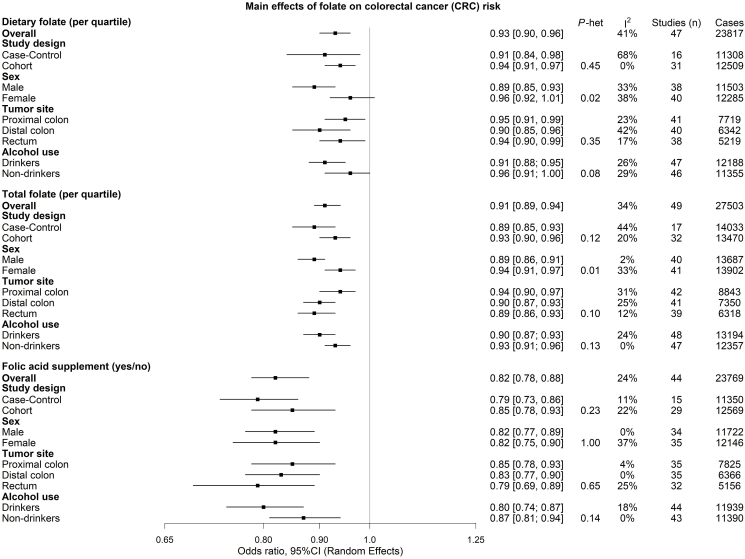
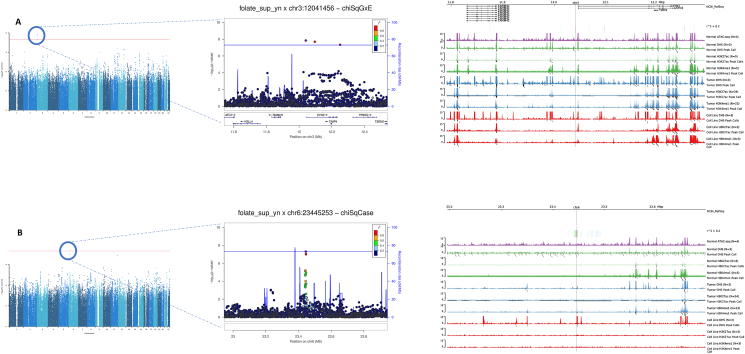
Inverse associations of dietary, total folate, and folic acid supplement with CRC were found (odds ratio [OR]: 0.93; 95% confidence interval [CI]: 0.90, 0.96; and 0.91; 95% CI: 0.89, 0.94 per quartile higher intake, and 0.82 (95% CI: 0.78, 0.88) for users compared with nonusers, respectively). Interactions (P-interaction < 5×10) of folic acid supplement and variants in the 3p25.2 locus (in the region of Synapsin II [SYN2]/tissue inhibitor of metalloproteinase 4 [TIMP4]) were found using traditional interaction analysis, with variant rs150924902 (located upstream to SYN2) showing the strongest interaction. In stratified analyses by rs150924902 genotypes, folate supplementation was associated with decreased CRC risk among those carrying the TT genotype (OR: 0.82; 95% CI: 0.79, 0.86) but increased CRC risk among those carrying the TA genotype (OR: 1.63; 95% CI: 1.29, 2.05), suggesting a qualitative interaction (P-interaction = 1.4×10). No interactions were observed for dietary and total folate.
Variation in 3p25.2 locus may modify the association of folate supplement with CRC risk. Experimental studies and studies incorporating other relevant omics data are warranted to validate this finding.
流行病学和实验证据表明,较高的叶酸摄入量与结直肠癌(CRC)风险降低有关;然而,这种关系的机制尚不完全清楚。可能对叶酸代谢有直接或间接影响的遗传变异可以深入了解叶酸在 CRC 中的作用。
我们旨在进行全基因组交互分析,以确定可能改变叶酸与 CRC 风险关联的遗传变异。
我们应用传统病例对照逻辑回归、联合 3 自由度和两步加权假设方法,检测基因组中常见变异(等位基因频率>1%)与饮食叶酸、叶酸补充剂使用以及总叶酸与 3 个遗传联盟(CCFR、CORECT、GECCO)的 51 项研究中的 30550 例病例和 42336 例对照中 CRC 风险之间的交互作用。
饮食、总叶酸和叶酸补充剂与 CRC 呈负相关(比值比[OR]:0.93;95%置信区间[CI]:0.90,0.96;和 0.91;95%CI:0.89,0.94 每四分位摄入更高,和 0.82(95%CI:0.78,0.88)与非使用者相比)。使用传统的交互分析发现叶酸补充剂和 3p25.2 位点(在突触素 II [SYN2]/金属蛋白酶组织抑制剂 4 [TIMP4]区域)变异之间的相互作用(P-交互<5×10),其中变异 rs150924902(位于 SYN2 上游)显示出最强的相互作用。在 rs150924902 基因型的分层分析中,叶酸补充与 TT 基因型携带者的 CRC 风险降低相关(OR:0.82;95%CI:0.79,0.86),但与 TA 基因型携带者的 CRC 风险增加相关(OR:1.63;95%CI:1.29,2.05),提示存在定性相互作用(P-交互=1.4×10)。未观察到饮食和总叶酸的相互作用。
3p25.2 位点的变异可能改变叶酸补充与 CRC 风险的关联。需要进行实验研究和纳入其他相关组学数据的研究来验证这一发现。