FHI 360, Durham, NC, USA.
Programme National de Santé de la Mère et de l'Enfant, Ministère de la Sante, de l'Hygiène Publique et de la Couverture Maladie Universelle, Abidjan, Côte d'Ivoire.
Glob Health Sci Pract. 2023 Aug 28;11(4). doi: 10.9745/GHSP-D-22-00469.
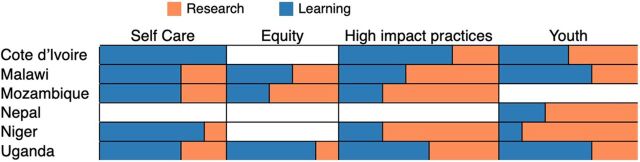
Evidence should be the foundation for a well-designed family planning (FP) program, but existing evidence is rarely aligned with and/or synthesized to speak directly to FP programmatic needs. Based on our experience cocreating FP research and learning agendas (FP RLAs) in Côte d'Ivoire, Malawi, Mozambique, Nepal, Niger, and Uganda, we argue that FP RLAs can drive the production of coordinated research that aligns with national priorities.To cocreate FP RLAs, stakeholders across 6 countries conducted desk reviews of 349 documents and 106 key informant interviews, organized consultation meetings in each country to prioritize evidence gaps and generate research and learning questions, and, ultimately, formed 6 FP RLAs comprising 190 unique questions. We outline the process for consensus-driven development of FP RLAs and communicate the results of an analysis of the questions in each FP RLA across 4 technical areas: self-care, equity, high impact practices, and youth. Each question was categorized as a learning versus research question, the former indicating an opportunity to synthesize existing evidence and the latter to conduct new research to answer the question. Themes emerging from the data shed light on shared evidence gaps across the 6 countries. We argue that similarities and differences in the questions in each FP RLA reflect the unique implementation experience and context, as well as each country's placement on the FP S-curve. Early uses of the FP RLAs include informing the development of FP costed implementation plans and FP2030 commitments. FP RLAs have also been discussed in multiple thematic working groups. For FP stakeholders, these FP RLAs represent a consensus-based agenda that can guide the generation and synthesis of evidence to answer each country's most pressing questions, ultimately driving progress toward increasingly evidence-based programming and policy.
证据应该是一个精心设计的计划生育(FP)项目的基础,但现有的证据很少与 FP 项目的需求直接对齐和/或综合。基于我们在科特迪瓦、马拉维、莫桑比克、尼泊尔、尼日尔和乌干达共同创建 FP 研究和学习议程(FP RLAs)的经验,我们认为 FP RLAs 可以推动协调研究的产生,使研究与国家优先事项保持一致。为了共同创建 FP RLAs,来自 6 个国家的利益攸关方对 349 份文件和 106 名关键知情人进行了桌面审查,在每个国家组织了协商会议,以确定优先考虑的证据差距,并提出研究和学习问题,最终形成了 6 个 FP RLAs,其中包含 190 个独特的问题。我们概述了基于共识的 FP RLAs 开发过程,并传达了对每个 FP RLA 中 4 个技术领域(自我保健、公平、高影响力实践和青年)的问题进行分析的结果。每个问题都被归类为学习问题还是研究问题,前者表示有机会综合现有证据,后者表示需要进行新的研究来回答问题。从数据中提取的主题揭示了 6 个国家之间共同的证据差距。我们认为,每个 FP RLA 中的问题的相似之处和不同之处反映了独特的实施经验和背景,以及每个国家在 FP S 曲线上的位置。FP RLAs 的早期用途包括为 FP 成本实施计划和 FP2030 承诺的制定提供信息。FP RLAs 也在多个专题工作组中进行了讨论。对于 FP 利益攸关方而言,这些 FP RLAs 代表了一个基于共识的议程,可以指导证据的产生和综合,以回答每个国家最紧迫的问题,最终推动朝着越来越基于证据的规划和政策方向发展。