Department of Epidemiology & Biostatistics, School of Public Health, Peking University, Beijing, China.
Department of Dermatology, Xiangya Hospital, Central South University, Changsha, Hunan, China.
Stroke Vasc Neurol. 2024 Aug 27;9(4):399-406. doi: 10.1136/svn-2023-002428.
Previous studies, mostly focusing on the European population, have reported polygenic risk scores (PRSs) might achieve risk stratification of stroke. We aimed to examine the association strengths of PRSs with risks of stroke and its subtypes in the Chinese population.
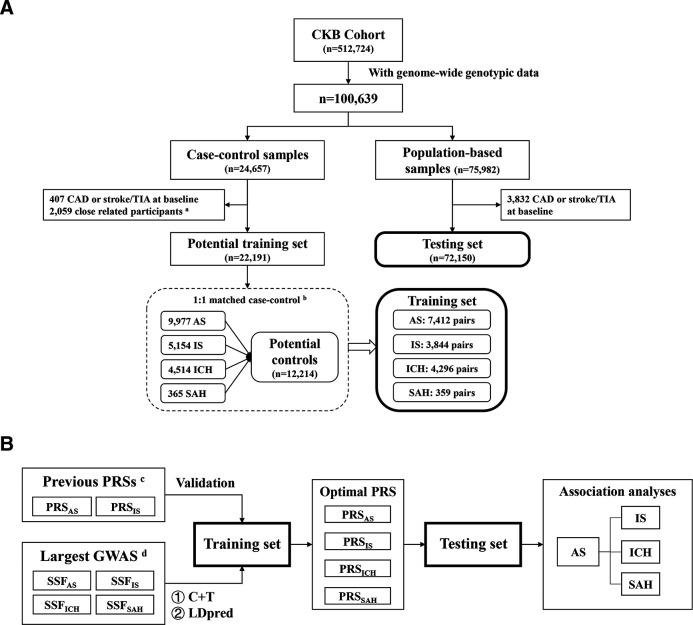
Participants with genome-wide genotypic data in China Kadoorie Biobank were split into a potential training set (n=22 191) and a population-based testing set (n=72 150). Four previously developed PRSs were included, and new PRSs for stroke and its subtypes were developed. The PRSs showing the strongest association with risks of stroke or its subtypes in the training set were further evaluated in the testing set. Cox proportional hazards regression models were used to estimate the association strengths of different PRSs with risks of stroke and its subtypes (ischaemic stroke (IS), intracerebral haemorrhage (ICH) and subarachnoid haemorrhage (SAH)).
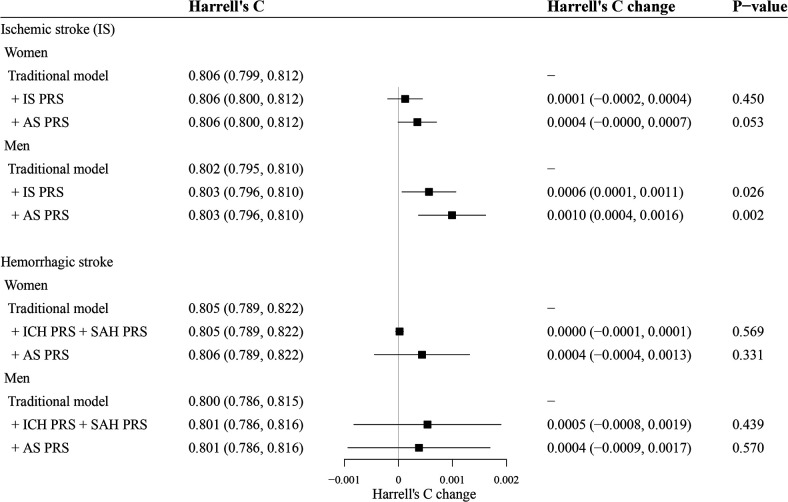
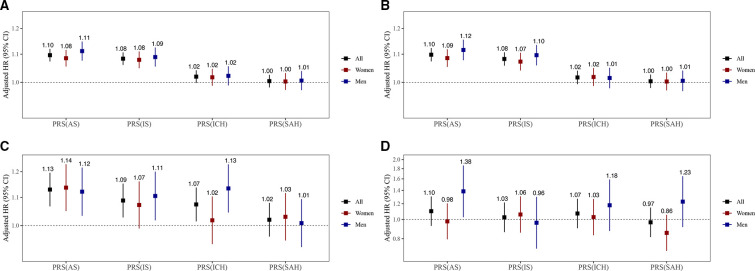
In the testing set, during 872 919 person-years of follow-up, 8514 incident stroke events were documented. The PRSs of any stroke (AS) and IS were both positively associated with risks of AS, IS and ICH (p<0.05). The HR for per SD increment (HR) of PRS was 1.10 (95% CI 1.07 to 1.12), 1.10 (95% CI 1.07 to 1.12) and 1.13 (95% CI 1.07 to 1.20) for AS, IS and ICH, respectively. The corresponding HR of PRS was 1.08 (95% CI 1.06 to 1.11), 1.08 (95% CI 1.06 to 1.11) and 1.09 (95% CI 1.03 to 1.15). PRS was positively associated with the risk of ICH (HR=1.07, 95% CI 1.01 to 1.14). PRS was not associated with risks of stroke and its subtypes. The addition of current PRSs offered little to no improvement in stroke risk prediction and risk stratification.
In this Chinese population, the association strengths of current PRSs with risks of stroke and its subtypes were moderate, suggesting a limited value for improving risk prediction over traditional risk factors in the context of current genome-wide association study under-representing the East Asian population.
既往研究主要聚焦于欧洲人群,报道称多基因风险评分(PRS)可能实现对卒中的风险分层。本研究旨在探讨 PRS 与中国人群卒中及其亚型风险之间的关联强度。
在中国科克伦协作网生物库中纳入有全基因组基因型数据的参与者,将其分为潜在训练集(n=22191)和基于人群的检验集(n=72150)。纳入了 4 种先前开发的 PRS,并开发了新的卒中及其亚型的 PRS。在训练集中与卒中或其亚型风险关联最强的 PRS 将进一步在检验集中进行评估。使用 Cox 比例风险回归模型来估计不同 PRS 与卒中及其亚型(缺血性卒中(IS)、颅内出血(ICH)和蛛网膜下腔出血(SAH))风险之间的关联强度。
在检验集中,872919 人年的随访期间共记录到 8514 例卒中事件。任何卒中(AS)和 IS 的 PRS 均与 AS、IS 和 ICH 的风险呈正相关(p<0.05)。PRS 每增加 1 个标准差的 HR(HR)分别为 1.10(95%CI 1.07 至 1.12)、1.10(95%CI 1.07 至 1.12)和 1.13(95%CI 1.07 至 1.20)。相应的 AS、IS 和 ICH 的 PRS HR 分别为 1.08(95%CI 1.06 至 1.11)、1.08(95%CI 1.06 至 1.11)和 1.09(95%CI 1.03 至 1.15)。PRS 与 ICH 风险呈正相关(HR=1.07,95%CI 1.01 至 1.14)。PRS 与卒中及其亚型风险无关。目前 PRS 的增加对卒中风险预测和分层几乎没有改善。
在本中国人群中,当前 PRS 与卒中及其亚型风险之间的关联强度为中等,表明在当前全基因组关联研究代表性不足的东亚人群背景下,与传统危险因素相比,PRS 对风险预测的改善作用有限。