Department of Neonatology and Pediatric Intensive Care Medicine, University Children's Hospital, University Medical Center Hamburg-Eppendorf, Martinistr. 52, Hamburg, 20246, Germany.
Department of Anesthesiology, University Medical Center Hamburg-Eppendorf, Hamburg, Germany.
BMC Med Educ. 2023 Aug 28;23(1):610. doi: 10.1186/s12909-023-04599-1.
Inappropriate ventilator settings, non-adherence to a lung-protective ventilation strategy, and inadequate patient monitoring during mechanical ventilation can potentially expose critically ill children to additional risks. We set out to improve team theoretical knowledge and practical skills regarding pediatric mechanical ventilation and to increase compliance with treatment goals.
An educational initiative was conducted from August 2019 to July 2021 in a neonatal and pediatric intensive care unit of the University Children's Hospital, Hamburg-Eppendorf, Germany. We tested baseline theoretical knowledge using a multiple choice theory test (TT) and practical skills using a practical skill test (PST), consisting of four sequential Objective Structured Clinical Examinations of physicians and nurses. We then implemented an educational bundle that included video self-training, checklists, pocket cards, and reevaluated team performance. Ventilators and monitor settings were randomly checked in all ventilated patients. We used a process control chart and a mixed-effects model to analyze the primary outcome.
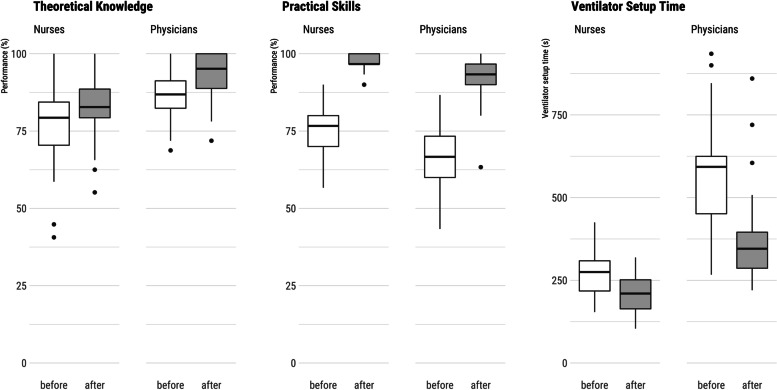
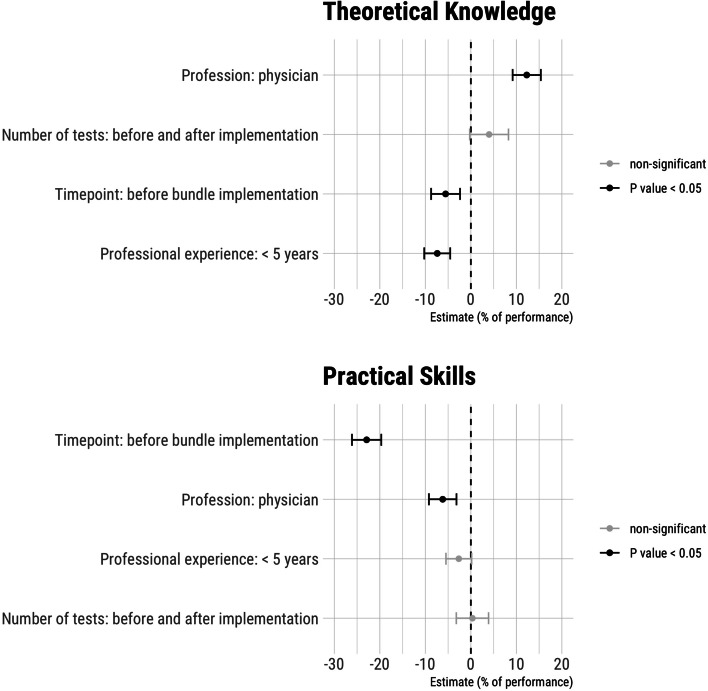
A total of 47 nurses and 20 physicians underwent assessment both before and after the implementation of the initiative using TT. Additionally, 34 nurses and 20 physicians were evaluated using the PST component of the initiative. The findings revealed a significant improvement in staff performance for both TT and PST (TT: 80% [confidence interval (CI): 77.2-82.9] vs. 86% [CI: 83.1-88.0]; PST: 73% [CI: 69.7-75.5] vs. 95% [CI: 93.8-97.1]). Additionally, there was a notable increase in self-confidence among participants, and compliance with mechanical ventilation treatment goals also saw a substantial rise, increasing from 87.8% to 94.5%.
Implementing a pediatric mechanical ventilation education bundle improved theoretical knowledge and practical skills among interprofessional pediatric intensive care staff and increased treatment goal compliance in ventilated children.
在机械通气过程中,不适当的呼吸机设置、不遵守肺保护性通气策略以及对患者的监测不足,可能会使危重症患儿面临更多风险。我们旨在提高团队在小儿机械通气方面的理论知识和实践技能,并提高治疗目标的依从性。
2019 年 8 月至 2021 年 7 月,在德国汉堡-埃彭多夫大学儿童医院的新生儿和儿科重症监护病房开展了一项教育计划。我们使用多项选择题理论测试(TT)测试了基线理论知识,使用由医生和护士进行的四个连续的客观结构化临床考试组成的实践技能测试(PST)来测试实践技能。然后,我们实施了一个教育捆绑包,其中包括视频自我培训、检查表、袖珍卡,并重新评估了团队的表现。对所有接受通气治疗的患者,我们都随机检查了呼吸机和监护仪的设置。我们使用过程控制图和混合效应模型来分析主要结果。
共有 47 名护士和 20 名医生在该计划实施前后接受了 TT 的评估。此外,还有 34 名护士和 20 名医生接受了该计划的 PST 评估。结果显示,TT 和 PST 的员工表现都有显著提高(TT:80%[置信区间(CI):77.2-82.9]vs.86%[CI:83.1-88.0];PST:73%[CI:69.7-75.5]vs.95%[CI:93.8-97.1])。此外,参与者的自我信心显著增强,机械通气治疗目标的依从性也大幅提高,从 87.8%提高到 94.5%。
实施小儿机械通气教育捆绑包提高了小儿重症监护跨专业团队的理论知识和实践技能,并提高了接受通气治疗的儿童的治疗目标依从性。