Lin Shanshan, Yang Zhihua, Liu Yangxi, Bi Yingfei, Liu Yu, Zhang Zeyu, Zhang Xuan, Jia Zhuangzhuang, Wang Xianliang, Mao Jingyuan
Department of Cardiovascular, First Teaching Hospital of Tianjin University of Traditional Chinese Medicine/National Clinical Research Center for Chinese Medicine Acupuncture and Moxibustion, No. 88, Changling Road, Xiqing District, Tianjin 300381, China.
Tianjin University of Traditional Chinese Medicine, No. 10, Poyang Lake Road, West Tuanpo New Town, Jinghai District, Tianjin 301617, China.
Curr Pharm Des. 2023;29(25):1992-2008. doi: 10.2174/1381612829666230830105740.
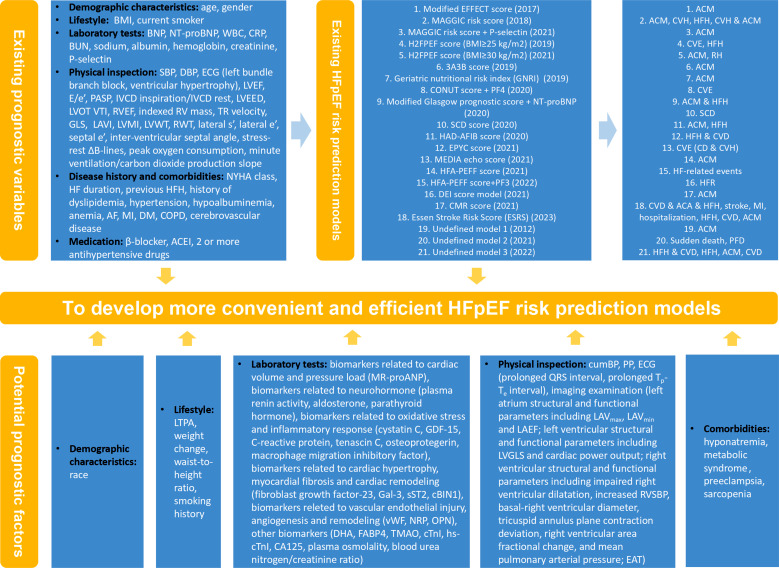
Patients with heart failure with preserved ejection fraction (HFpEF) have large individual differences, unclear risk stratification, and imperfect treatment plans. Risk prediction models are helpful for the dynamic assessment of patients' prognostic risk and early intensive therapy of high-risk patients. The purpose of this study is to systematically summarize the existing risk prediction models and novel prognostic factors for HFpEF, to provide a reference for the construction of convenient and efficient HFpEF risk prediction models.
Studies on risk prediction models and prognostic factors for HFpEF were systematically searched in relevant databases including PubMed and Embase. The retrieval time was from inception to February 1, 2023. The Quality in Prognosis Studies (QUIPS) tool was used to assess the risk of bias in included studies. The predictive value of risk prediction models for end outcomes was evaluated by sensitivity, specificity, the area under the curve, C-statistic, C-index, etc. In the literature screening process, potential novel prognostic factors with high value were explored.
A total of 21 eligible HFpEF risk prediction models and 22 relevant studies were included. Except for 2 studies with a high risk of bias and 2 studies with a moderate risk of bias, other studies that proposed risk prediction models had a low risk of bias overall. Potential novel prognostic factors for HFpEF were classified and described in terms of demographic characteristics (age, sex, and race), lifestyle (physical activity, body mass index, weight change, and smoking history), laboratory tests (biomarkers), physical inspection (blood pressure, electrocardiogram, imaging examination), and comorbidities.
It is of great significance to explore the potential novel prognostic factors of HFpEF and build a more convenient and efficient risk prediction model for improving the overall prognosis of patients. This review can provide a substantial reference for further research.
射血分数保留的心力衰竭(HFpEF)患者个体差异大,风险分层不明确,治疗方案不完善。风险预测模型有助于动态评估患者的预后风险,并对高危患者进行早期强化治疗。本研究旨在系统总结现有的HFpEF风险预测模型和新的预后因素,为构建方便、高效的HFpEF风险预测模型提供参考。
在PubMed和Embase等相关数据库中系统检索关于HFpEF风险预测模型和预后因素的研究。检索时间从数据库建库至2023年2月1日。采用预后研究质量(QUIPS)工具评估纳入研究的偏倚风险。通过敏感性、特异性、曲线下面积、C统计量、C指数等评估风险预测模型对最终结局的预测价值。在文献筛选过程中,探索具有高价值的潜在新预后因素。
共纳入21个符合条件的HFpEF风险预测模型和22项相关研究。除2项偏倚风险高的研究和2项偏倚风险中等的研究外,其他提出风险预测模型的研究总体偏倚风险较低。从人口统计学特征(年龄、性别和种族)、生活方式(体力活动、体重指数、体重变化和吸烟史)、实验室检查(生物标志物)、体格检查(血压、心电图、影像学检查)和合并症等方面对HFpEF潜在的新预后因素进行了分类和描述。
探索HFpEF潜在的新预后因素并构建更方便、高效的风险预测模型对改善患者的总体预后具有重要意义。本综述可为进一步研究提供重要参考。