Vector Control Product Testing Unit, Environmental Health and Ecological Science Department, Ifakara Health Institute, Bagamoyo, Tanzania.
Department of Epidemiology and Public, Health Swiss Tropical and Public Health Institute, Allschwil, Switzerland.
Malar J. 2023 Aug 30;22(1):249. doi: 10.1186/s12936-023-04674-4.
Spatial repellents that create airborne concentrations of an active ingredient (AI) within a space offer a scalable solution to further reduce transmission of malaria, by disrupting mosquito behaviours in ways that ultimately lead to reduced human-vector contact. Passive emanator spatial repellents can protect multiple people within the treated space and can last for multiple weeks without the need for daily user touchpoints, making them less intrusive interventions. They may be particularly advantageous in certain use cases where implementation of core tools may be constrained, such as in humanitarian emergencies and among mobile at-risk populations. The purpose of this study was to assess the efficacy of Mosquito Shield™ deployed in experimental huts against wild, free-flying, pyrethroid-resistant Anopheles arabiensis mosquitoes in Tanzania over 1 month.
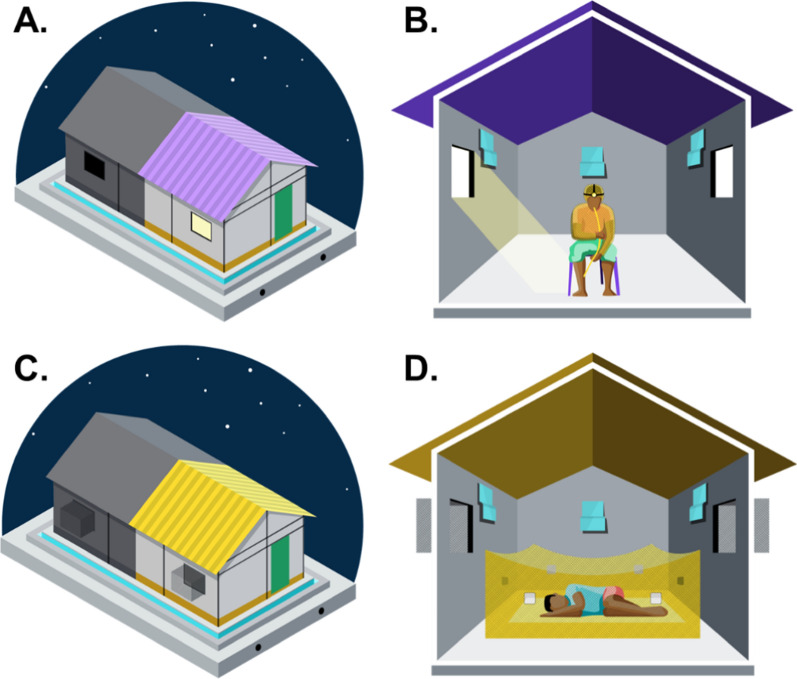
The efficacy of Mosquito Shield™ transfluthrin spatial repellent in reducing mosquito lands and blood-feeding was evaluated using 24 huts: sixteen huts were allocated to Human Landing Catch (HLC) collections and eight huts to estimating blood-feeding. In both experiments, half of the huts received no intervention (control) while the remaining received the intervention randomly allocated to huts and remained fixed for the study duration. Outcomes measured were mosquito landings, blood-fed, resting and dead mosquitoes. Data were analysed by multilevel mixed effects regression with appropriate dispersion and link function accounting for volunteer, hut and day.
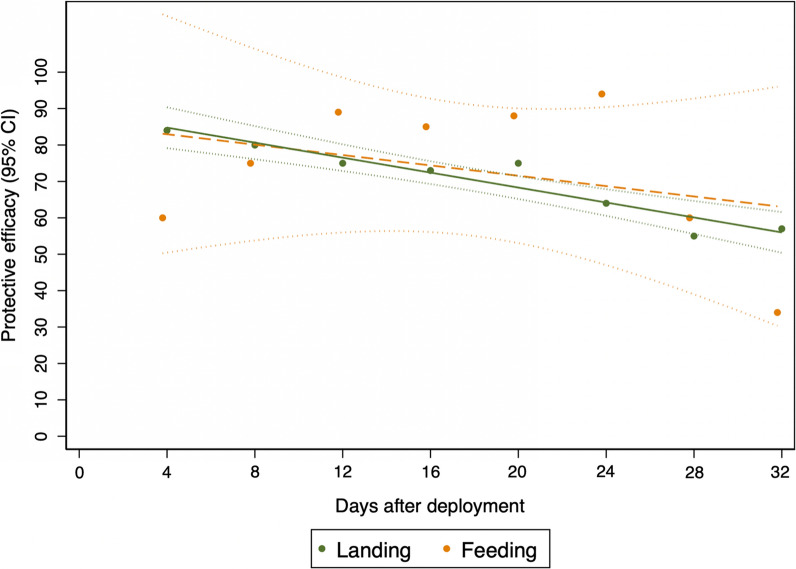
Landing inhibition was estimated to be 70% (57-78%) [IRR 0.30 (95% CI 0.22-0.43); p < 0.0001] and blood-feeding inhibition was estimated to be 69% (56-79%) [IRR 0.31 (95% CI 0.21-0.44; p < 0.0001] There was no difference in the protective efficacy estimates of landing and blood-feeding inhibition [IRR 0.98 (95% CI 0.53-1.82; p = 0.958].
This study demonstrated that Mosquito Shield™ was efficacious against a wild pyrethroid-resistant strain of An. arabiensis mosquitoes in Tanzania for up to 1 month and could be used as a complementary or stand-alone tool where gaps in protection offered by core malaria vector control tools exist. HLC is a suitable technique for estimating bite reductions conferred by spatial repellents especially where direct blood-feeding measurements are not practical or are ethically limited.
在空间内产生活性成分(AI)的空气传播浓度的空间驱避剂通过以最终导致减少人与蚊子接触的方式扰乱蚊子行为,为进一步减少疟疾传播提供了可扩展的解决方案。被动散发空间驱避剂可以保护处理空间内的多个人,并且可以持续数周而无需每天接触使用者,因此它们的侵入性较小。它们在某些情况下可能特别有利,例如在核心工具的实施可能受到限制的人道主义紧急情况和流动人口中。本研究的目的是评估在坦桑尼亚的实验棚内使用 Mosquito Shield™对野外自由飞行的拟除虫菊酯抗性疟蚊的功效,为期一个月。
使用 24 个棚屋评估 Mosquito Shield™ 顺式氯菊酯空间驱避剂减少蚊子降落和吸血的功效:16 个棚屋分配给人类着陆捕获(HLC)收集,8 个棚屋用于估计吸血。在这两个实验中,一半的棚屋不接受干预(对照),而其余的棚屋则随机分配接受干预,并在整个研究期间保持不变。测量的结果是蚊子降落、吸血、休息和死亡的蚊子。数据通过多级混合效应回归进行分析,适当的分散和链接函数考虑了志愿者、棚屋和天。
降落抑制估计为 70%(57-78%)[IRR 0.30(95% CI 0.22-0.43);p<0.0001],吸血抑制估计为 69%(56-79%)[IRR 0.31(95% CI 0.21-0.44;p<0.0001]。降落和吸血抑制的保护效果估计没有差异[IRR 0.98(95% CI 0.53-1.82;p=0.958]。
这项研究表明,Mosquito Shield™在坦桑尼亚对野外抗拟除虫菊酯的 An. arabiensis 蚊子有效,长达 1 个月,并且可以作为核心疟疾媒介控制工具提供的保护存在差距的补充或独立工具使用。HLC 是一种适合估计空间驱避剂赋予的叮咬减少的技术,特别是在直接吸血测量不实际或在伦理上受到限制的情况下。