Zhang Yili, Liu Rong-Yu, Smolen Paul, Cleary Leonard J, Byrne John H
Department of Neurobiology and Anatomy, W.M. Keck Center for the Neurobiology of Learning and Memory, McGovern Medical School at the University of Texas Health Science Center at Houston, 6431 Fannin Street, Suite MSB 7.046, Houston, TX 77030, United States.
Oxf Open Neurosci. 2022 Oct 18;2:kvac014. doi: 10.1093/oons/kvac014. eCollection 2023.
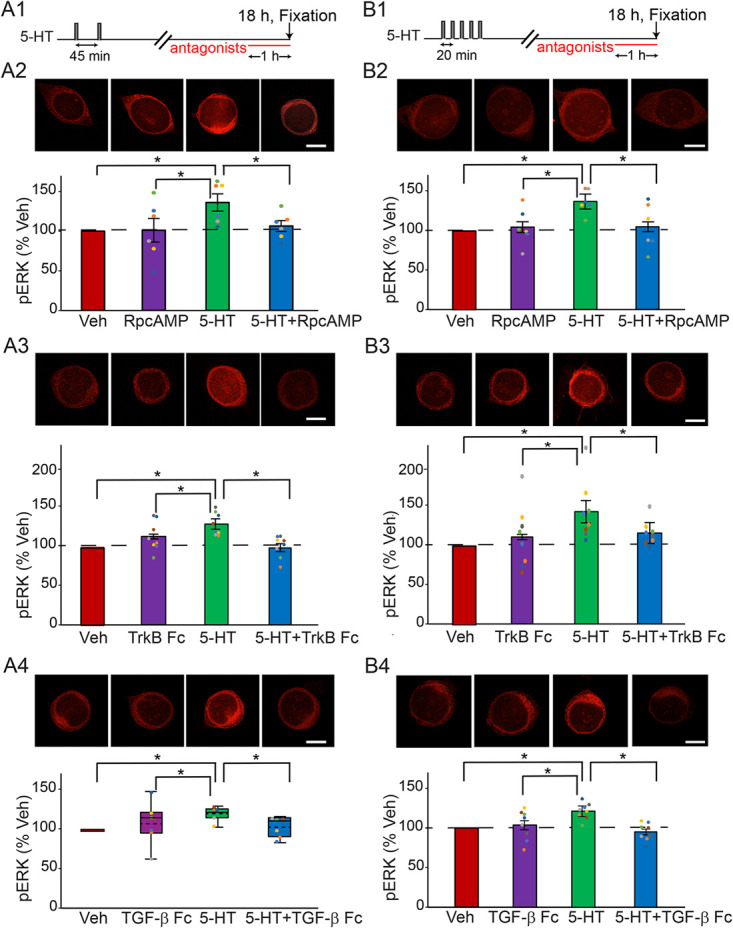
Phosphorylation of the MAPK family member extracellular signal-regulated kinase (ERK) is required to induce long-term synaptic plasticity, but little is known about its persistence. We examined ERK activation by three protocols that induce long-term synaptic facilitation (LTF) of the sensorimotor synapse - the standard protocol (five 5-min pulses of 5-HT with interstimulus intervals (ISIs) of 20 min), the enhanced protocol (five pulses with irregular ISIs, which induces greater and longer-lasting LTF) and the two-pulse protocol (two pulses with ISI 45 min). Immunofluorescence revealed complex ERK activation. The standard and two-pulse protocols immediately increased active, phosphorylated ERK (pERK), which decayed within 5 h. A second wave of increased pERK was detected 18 h post-treatment for all protocols. This late phase was blocked by inhibitors of protein kinase A, TrkB and TGF-β. These results suggest that complex interactions among kinase pathways and growth factors contribute to the late increase of pERK. ERK activity returned to basal 24 h after the standard or two-pulse protocols, but remained elevated 24 h for the enhanced protocol. This 24-h elevation was also dependent on PKA and TGF-β, and partly on TrkB. These results begin to characterize long-lasting ERK activation, plausibly maintained by positive feedback involving growth factors and PKA, that appears essential to maintain LTF and LTM. Because many processes involved in LTF and late LTP are conserved among and mammals, these findings highlight the importance of examining the dynamics of kinase cascades involved in vertebrate long-term memory.
丝裂原活化蛋白激酶(MAPK)家族成员细胞外信号调节激酶(ERK)的磷酸化是诱导长期突触可塑性所必需的,但对其持续性了解甚少。我们通过三种诱导感觉运动突触长期突触易化(LTF)的方案检测了ERK的激活情况——标准方案(5次5分钟的5-羟色胺脉冲,刺激间隔(ISI)为20分钟)、增强方案(5次脉冲,ISI不规则,可诱导更强且更持久的LTF)和双脉冲方案(2次脉冲,ISI为45分钟)。免疫荧光显示ERK激活情况复杂。标准方案和双脉冲方案立即增加了活性磷酸化ERK(pERK),其在5小时内衰减。所有方案在处理后18小时均检测到第二波pERK增加。这一后期阶段被蛋白激酶A、TrkB和转化生长因子-β(TGF-β)的抑制剂阻断。这些结果表明激酶途径和生长因子之间的复杂相互作用导致了pERK的后期增加。标准方案或双脉冲方案处理24小时后ERK活性恢复到基础水平,但增强方案处理24小时后仍保持升高。这24小时的升高也依赖于蛋白激酶A和TGF-β,部分依赖于TrkB。这些结果开始描述持久的ERK激活特征,可能是由涉及生长因子和蛋白激酶A的正反馈维持的,这似乎对维持LTF和长期记忆(LTM)至关重要。由于LTF和晚期长时程增强(LTP)中涉及的许多过程在人和哺乳动物中是保守的,这些发现凸显了研究脊椎动物长期记忆中涉及的激酶级联反应动态的重要性。