Lam Christie Hang-I, Zou Bing, Chan Henry Ho-Lung, Tse Dennis Yan-Yin
School of Optometry, The Hong Kong Polytechnic University, Hong Kong, SAR, China.
Centre for Eye and Vision Research Limited (CEVR), Hong Kong, SAR, China.
Eye Vis (Lond). 2023 Sep 1;10(1):37. doi: 10.1186/s40662-023-00353-2.
Diabetic retinopathy (DR), one of the leading causes of blindness and vision impairment, is suggested to exhibit functional and structural changes in retinal neurons as the earliest manifestation, which could be used to predict the progression of related angiopathy. While neural function and survival rely on proper mitochondrial function, and a growing body of literature has supported the role of mitochondrial dysfunction in the development of DR, how diabetes affects mitochondrial function in retinal tissue remains elusive. This study primarily aimed to investigate mitochondrial functional changes in a diabetic rodent model. We also characterized the early DR phenotype, in particular, neurodegeneration.
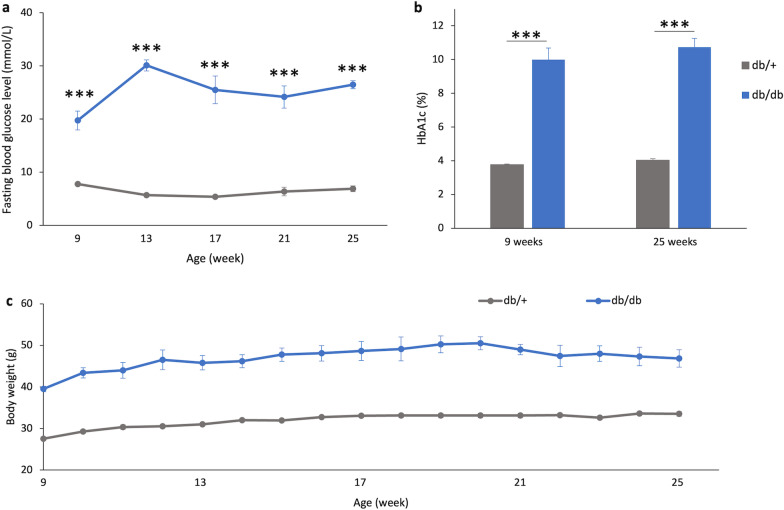
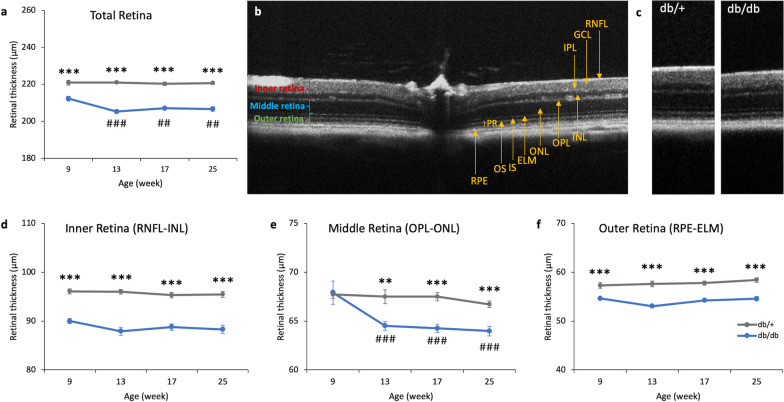
C57BLKsJ-db/db (db/db) mice (a type 2 diabetic mouse model) were used with their normoglycemic heterozygous littermates (db/+) serving as controls. Longitudinal changes in retinal function and morphology were assessed with electroretinography (ERG) and optical coherence tomography (OCT), respectively, at 9, 13, 17, and 25 weeks of age. At 25 weeks, the retinas were harvested for immunohistochemistry and ex vivo mitochondrial bioenergetics.
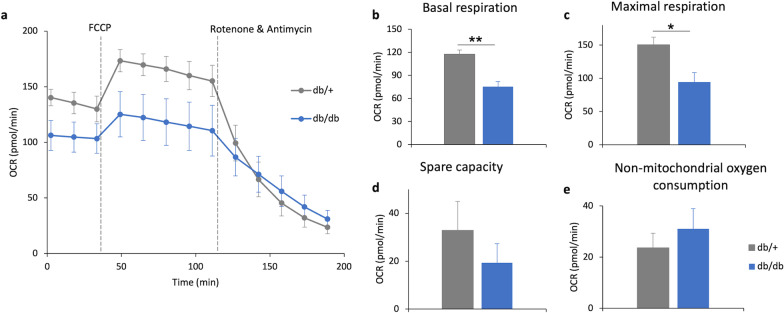
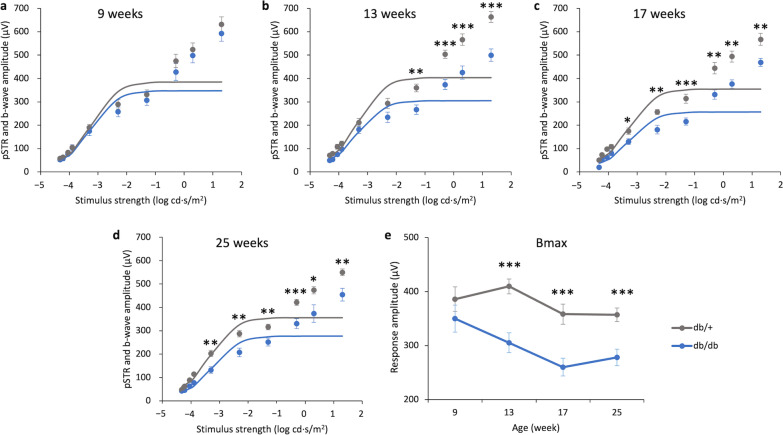
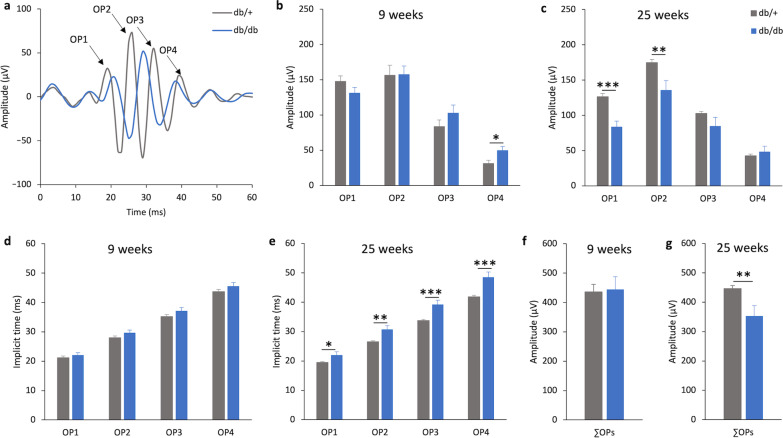
Decreased ERG responses were observed in db/db mice as early as 13 weeks of age. OCT revealed that db/db mice had significantly thinner retinas than the controls. Immunohistochemistry showed that the retinas of the db/db mice at 25 weeks were thinner at the outer and inner nuclear layers, with lower photoreceptor and cone cell densities compared with the db/+ mice. The number of rod-bipolar cell dendritic boutons and axon terminals was significantly reduced in db/db mice relative to the db/+ mice, suggesting that diabetes may lead to compromised synaptic connectivity. More importantly, the retinas of db/db mice had weaker mitochondrial functions than the controls.
Our longitudinal data suggest that diabetes-induced functional deterioration and morphological changes were accompanied by reduced mitochondrial function in the retina of db/db mice. These findings suggest that mitochondrial dysfunction may be a contributing factor triggering the development of DR. While the underlying mechanistic cause remains elusive, the db/db mice could be a useful animal model for testing potential treatment regimens targeting neurodegeneration in DR.
糖尿病视网膜病变(DR)是导致失明和视力损害的主要原因之一,有研究表明,视网膜神经元的功能和结构变化是其最早的表现,可用于预测相关血管病变的进展。虽然神经功能和存活依赖于正常的线粒体功能,且越来越多的文献支持线粒体功能障碍在DR发生发展中的作用,但糖尿病如何影响视网膜组织中的线粒体功能仍不清楚。本研究主要旨在调查糖尿病啮齿动物模型中的线粒体功能变化。我们还对早期DR表型进行了特征描述,尤其是神经退行性变。
使用C57BLKsJ-db/db(db/db)小鼠(一种2型糖尿病小鼠模型),其血糖正常的杂合子同窝小鼠(db/+)作为对照。分别在9、13、17和25周龄时,通过视网膜电图(ERG)和光学相干断层扫描(OCT)评估视网膜功能和形态的纵向变化。在25周时,摘取视网膜用于免疫组织化学和离体线粒体生物能量学分析。
早在13周龄时,就观察到db/db小鼠的ERG反应降低。OCT显示,db/db小鼠的视网膜比对照组明显更薄。免疫组织化学显示,与db/+小鼠相比,25周龄db/db小鼠的视网膜在外核层和内核层更薄,光感受器和视锥细胞密度更低。相对于db/+小鼠,db/db小鼠的视杆双极细胞树突终扣和轴突终末数量显著减少,这表明糖尿病可能导致突触连接受损。更重要的是,db/db小鼠的视网膜线粒体功能比对照组弱。
我们的纵向数据表明,糖尿病诱导的功能恶化和形态变化伴随着db/db小鼠视网膜线粒体功能的降低。这些发现表明,线粒体功能障碍可能是触发DR发生发展的一个因素。虽然潜在的机制原因仍不清楚,但db/db小鼠可能是一种有用的动物模型,用于测试针对DR神经退行性变的潜在治疗方案。