Hynes Denise M, Govier Diana J, Niederhausen Meike, Tuepker Anaïs, Laliberte Avery Z, McCready Holly, Hickok Alex, Rowneki Mazhgan, Waller Dylan, Cordasco Kristina M, Singer Sara J, McDonald Kathryn M, Slatore Christopher G, Thomas Kathleen C, Maciejewski Matthew, Battaglia Catherine, Perla Lisa
Center to Improve Veteran Involvement in Care (CIVIC), VA Portland Health Care System, Portland, OR, United States.
School of Nursing, Oregon Health & Science University, Portland, OR, United States.
Front Health Serv. 2023 Aug 15;3:1211577. doi: 10.3389/frhs.2023.1211577. eCollection 2023.
For patients with complex health and social needs, care coordination is crucial for improving their access to care, clinical outcomes, care experiences, and controlling their healthcare costs. However, evidence is inconsistent regarding the core elements of care coordination interventions, and lack of standardized processes for assessing patients' needs has made it challenging for providers to optimize care coordination based on patient needs and preferences. Further, ensuring providers have reliable and timely means of communicating about care plans, patients' full spectrum of needs, and transitions in care is important for overcoming potential care fragmentation. In the Veterans Health Administration (VA), several initiatives are underway to implement care coordination processes and services. In this paper, we describe our study underway in the VA aimed at building evidence for designing and implementing care coordination practices that enhance care integration and improve health and care outcomes for Veterans with complex care needs.
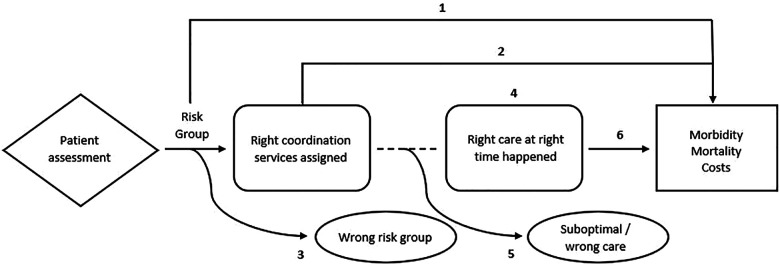
In a prospective observational multiple methods study, for Aim 1 we will use existing data to identify Veterans with complex care needs who have and have not received care coordination services. We will examine the relationship between receipt of care coordination services and their health outcomes. In Aim 2, we will adapt the Patient Perceptions of Integrated Veteran Care questionnaire to survey a sample of Veterans about their experiences regarding coordination, integration, and the extent to which their care needs are being met. For Aim 3, we will interview providers and care teams about their perceptions of the innovation attributes of current care coordination needs assessment tools and processes, including their improvement over other approaches (relative advantage), fit with current practices (compatibility and innovation fit), complexity, and ability to visualize how the steps proceed to impact the right care at the right time (observability). The provider interviews will inform design and deployment of a widescale provider survey.
Taken together, our study will inform development of an enhanced care coordination intervention that seeks to improve care and outcomes for Veterans with complex care needs.
对于有复杂健康和社会需求的患者,护理协调对于改善他们获得护理的机会、临床结果、护理体验以及控制医疗成本至关重要。然而,关于护理协调干预的核心要素的证据并不一致,并且缺乏评估患者需求的标准化流程使得提供者难以根据患者的需求和偏好优化护理协调。此外,确保提供者拥有可靠且及时的方式来沟通护理计划、患者的全面需求以及护理过渡对于克服潜在的护理碎片化很重要。在退伍军人健康管理局(VA),正在开展多项举措来实施护理协调流程和服务。在本文中,我们描述了我们在VA正在进行的研究,旨在为设计和实施护理协调实践提供证据,以加强护理整合并改善有复杂护理需求的退伍军人的健康和护理结果。
在一项前瞻性观察性多方法研究中,对于目标1,我们将使用现有数据来识别有和没有接受过护理协调服务的有复杂护理需求的退伍军人。我们将研究接受护理协调服务与他们的健康结果之间的关系。在目标2中,我们将改编《退伍军人综合护理患者认知问卷》,以调查一部分退伍军人关于他们在协调、整合以及他们的护理需求得到满足程度方面的经历。对于目标3,我们将采访提供者和护理团队,了解他们对当前护理协调需求评估工具和流程的创新属性的看法,包括它们相对于其他方法的改进(相对优势)、与当前实践的契合度(兼容性和创新契合度)、复杂性以及可视化步骤如何在正确的时间对正确的护理产生影响的能力(可观察性)。提供者访谈将为大规模提供者调查的设计和部署提供信息。
总体而言,我们的研究将为开发一种强化护理协调干预提供信息,该干预旨在改善有复杂护理需求的退伍军人的护理和结果。