Klein Marcel, Failla Antonio Virgilio, Hermey Guido
Institute for Molecular and Cellular Cognition, Center for Molecular Neurobiology Hamburg, University Medical Center Hamburg-Eppendorf, Hamburg, Germany.
Microscopy Imaging Facility, University Medical Center Hamburg-Eppendorf, Hamburg, Germany.
J Biol Chem. 2023 Oct;299(10):105216. doi: 10.1016/j.jbc.2023.105216. Epub 2023 Sep 1.
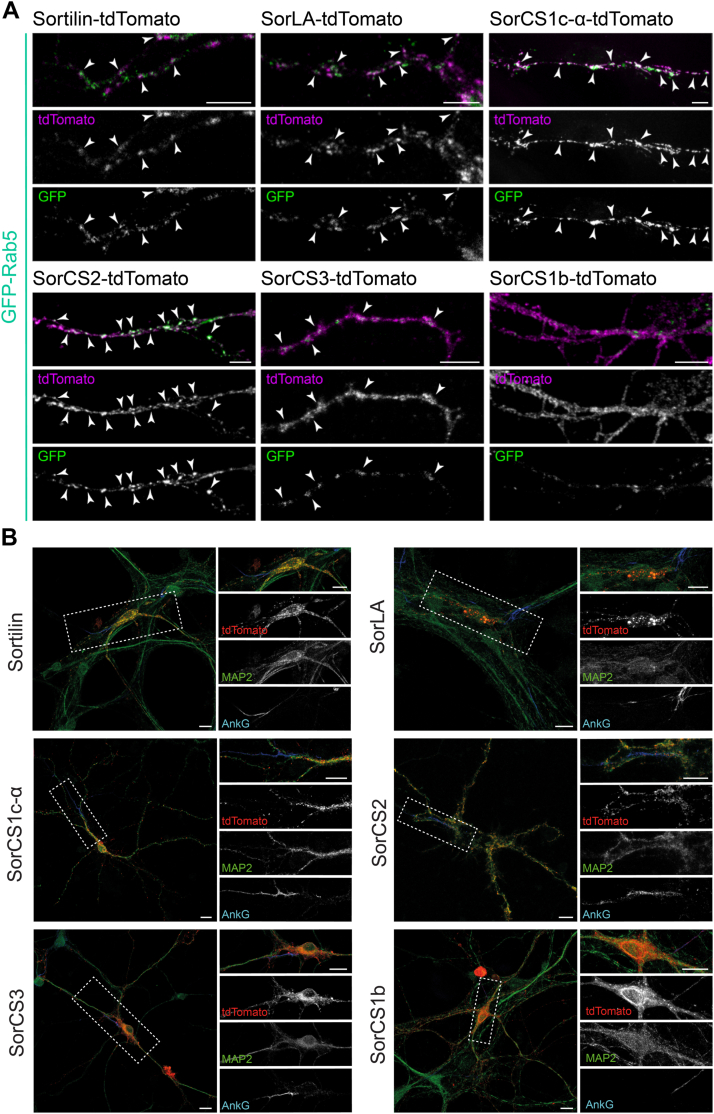
The Vps10p-domain (Vps10p-D) receptor family consists of Sortilin, SorLA, SorCS1, SorCS2, and SorCS3. They mediate internalization and intracellular sorting of specific cargo in various cell types, but underlying molecular determinants are incompletely understood. Deciphering the dynamic intracellular itineraries of Vps10p-D receptors is crucial for understanding their role in physiological and cytopathological processes. However, studying their spatial and temporal dynamics by live imaging has been challenging so far, as terminal tagging with fluorophores presumably impedes several of their protein interactions and thus functions. Here, we addressed the lack of appropriate tools and developed functional versions of all family members internally tagged in their ectodomains. We predict folding of the newly designed receptors by bioinformatics and show their exit from the endoplasmic reticulum. We examined their subcellular localization in immortalized cells and primary cultured neurons by immunocytochemistry and live imaging. This was, as far as known, identical to that of wt counterparts. We observed homodimerization of fluorophore-tagged SorCS2 by coimmunoprecipitation and fluorescence lifetime imaging, suggesting functional leucine-rich domains. Through ligand uptake experiments, live imaging and fluorescence lifetime imaging, we show for the first time that all Vps10p-D receptors interact with the neurotrophin brain-derived neurotrophic factor and mediate its uptake, indicating functionality of the Vps10p-Ds. In summary, we developed versions of all Vps10p-D receptors, with internal fluorophore tags that preserve several functions of the cytoplasmic and extracellular domains. These newly developed fluorophore-tagged receptors are likely to serve as powerful functional tools for accurate live studies of the individual cellular functions of Vps10p-D receptors.
Vps10p结构域(Vps10p-D)受体家族由Sortilin、SorLA、SorCS1、SorCS2和SorCS3组成。它们介导特定货物在各种细胞类型中的内化和细胞内分选,但潜在的分子决定因素尚未完全明确。解析Vps10p-D受体的动态细胞内行程对于理解它们在生理和细胞病理过程中的作用至关重要。然而,迄今为止,通过实时成像研究它们的空间和时间动态一直具有挑战性,因为用荧光团进行末端标记可能会阻碍它们的几种蛋白质相互作用,进而影响其功能。在此,我们解决了缺乏合适工具的问题,并开发了所有家族成员的功能版本,这些版本在其胞外域进行了内部标记。我们通过生物信息学预测新设计受体的折叠情况,并展示它们从内质网的输出。我们通过免疫细胞化学和实时成像检查了它们在永生化细胞和原代培养神经元中的亚细胞定位。据我们所知,这与野生型对应物的定位相同。我们通过共免疫沉淀和荧光寿命成像观察到荧光团标记的SorCS2的同源二聚化,提示富含亮氨酸结构域具有功能。通过配体摄取实验、实时成像和荧光寿命成像,我们首次表明所有Vps10p-D受体都与神经营养因子脑源性神经营养因子相互作用并介导其摄取,表明Vps10p-D具有功能。总之,我们开发了所有Vps10p-D受体的版本,其内部荧光团标签保留了细胞质和细胞外结构域的多种功能。这些新开发的荧光团标记受体可能会成为强大的功能工具,用于准确实时研究Vps10p-D受体的个体细胞功能。