Health Sciences, University of York, York.
Manchester Metropolitan University, Manchester, and University of Leeds, Leeds.
Br J Gen Pract. 2023 Sep 28;73(735):e720-e727. doi: 10.3399/BJGP.2023.0040. Print 2023 Oct.
Primary care for routine healthcare conditions is delivered to thousands of people in the English prison estate every day but the prison environment presents unique challenges to the provision of high-quality health care. Little research has focused on the organisational factors that affect quality of and access to prison health care.
To understand key influences on the quality of primary care in prisons.
This was a qualitative interview study across the North of England from 2019 to 2021.
Interviews were undertaken with 43 participants: 21 prison leavers and 22 prison healthcare professionals. Reflexive thematic analysis was undertaken.
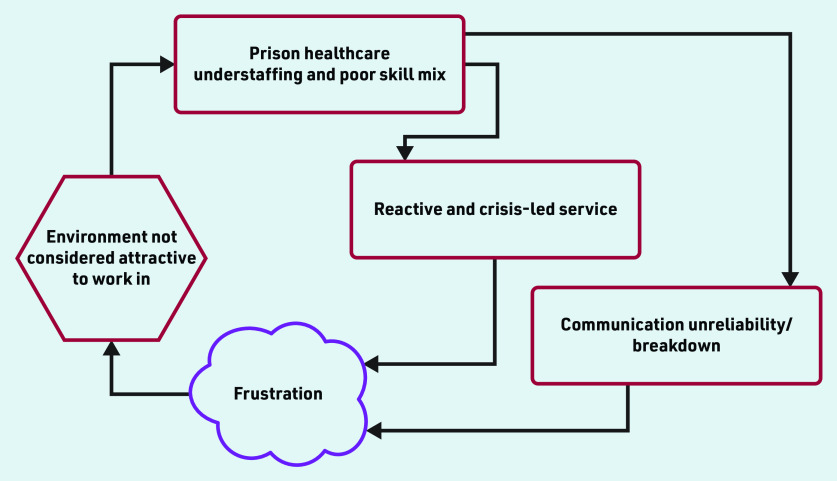
The overarching organisational issue influencing quality and access was that of chronic understaffing coupled with a workforce in flux and dependence on locum staff. This applied across different prisons, roles, and grades of staff, and was vocally discussed by both patient and staff participants. Intricately related to understaffing (and fuelled by it) was the propensity for a reactive and sometimes crisis-led service to develop that was characterised by continual firefighting. A persistent problem exacerbated by the above issues was unreliable communication about healthcare matters within some prisons, creating frustration. Positive commentary focused on the characteristics and actions of individual healthcare professionals.
This study highlights understaffing and its consequences as the most significant threat to the quality of and access to prison primary care. Strategies to address health care affecting prison populations urgently need to consider staffing. This issue should receive high-profile and mainstream attention to address health inequalities.
每天都有成千上万的人在英国监狱系统接受常规医疗保健的初级护理,但监狱环境对高质量医疗保健的提供带来了独特的挑战。很少有研究关注影响监狱医疗保健质量和可及性的组织因素。
了解影响监狱初级保健质量的关键因素。
这是一项在英格兰北部进行的定性访谈研究,时间跨度为 2019 年至 2021 年。
对 43 名参与者进行了访谈:21 名监狱出狱者和 22 名监狱医疗保健专业人员。采用反思性主题分析方法。
影响质量和可及性的首要组织问题是长期人手不足,再加上人员流动和对临时工的依赖。这在不同的监狱、角色和员工级别中都存在,并且受到患者和员工参与者的公开讨论。与人员不足密切相关的是(并受其推动)发展出一种反应性的、有时以危机为导向的服务,其特点是持续的救火。一些监狱内医疗保健事务沟通不可靠,加剧了这个长期存在的问题,造成了挫败感。积极的评论主要集中在个别医疗保健专业人员的特点和行动上。
本研究强调人手不足及其后果是对监狱初级保健质量和可及性的最大威胁。解决影响监狱人口的医疗保健问题的策略迫切需要考虑人员配备。这个问题应该得到高度关注和主流关注,以解决健康不平等问题。