Li Zhaopeng, Bu Deyong, Wang Xiaobin, Zhu Lin, Lei Daoyan, Tang Fengling, Sun Xianghua, Chen Cheng, Ji Xiang, Bai Song
Department of Geriatric General Surgery, the First Affiliated Hospital of Kunming Medical University, Kunming, Yunnan, 650000, People's Republic of China.
Department of Ultrasound, the Affiliated Nanchong Central Hospital of North Sichuan Medical College, Nanchong, Sichuan, 637000, People's Republic of China.
Onco Targets Ther. 2023 Aug 30;16:703-721. doi: 10.2147/OTT.S416824. eCollection 2023.
The present study explored the anti-tumor effects of chidamide plus oxaliplatin on colorectal cancer (CRC) and examined its underlying mechanism.
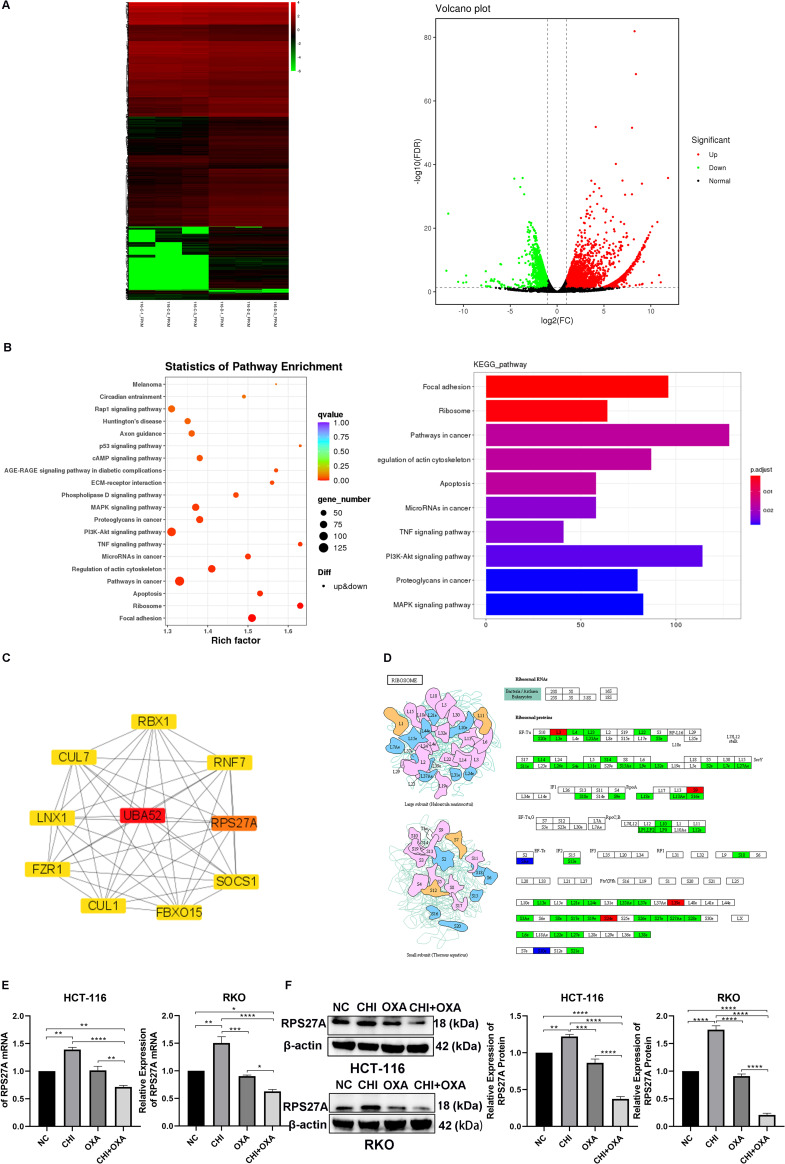
First, the Combination Index (CI) of chidamide and oxaliplatin was evaluated via CCK-8 assay. Second, the effects of chidamide and oxaliplatin monotherapy and the combined treatment on cell proliferation, invasion, migration, and apoptosis were detected. Third, whole-transcriptome RNA sequencing (RNA-seq) was performed to seek the potential targeted gene by which chidamide plus oxaliplatin exerted anti-tumor effects. Fourth, the validation of the targeted gene and the signal pathway it regulated were performed. Finally, the anti-tumor effect of chidamide plus oxaliplatin on mice xenograft was examined.
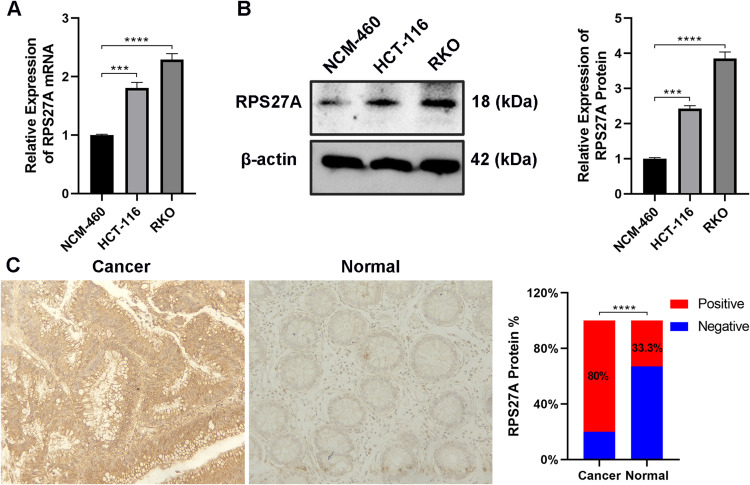
Chidamide and oxaliplatin acted synergistically to inhibit CRC growth in vitro and in vivo (CI<1). Besides, compared with oxaliplatin monotherapy, chidamide could significantly enhance oxaliplatin-induced inhibition in cell proliferation, invasion, and migration, and promotion in HCT-116 and RKO cell apoptosis (<0.05). The RNA-seq displayed that, compared to oxaliplatin monotherapy, RPS27A mRNA was evidently decreased in HCT-116 cells treated with chidamide plus oxaliplatin (<0.001). Then, we found RPS27A was highly expressed in CRC tissues and CRC cell lines (<0.001). Silence of RPS27A attenuated proliferation and induced apoptosis in HCT-116 and RKO cells via downregulation of MDM2 expression and upregulation of P53. Next, RPS27A overexpression could partially reverse chidamide plus oxaliplatin induced growth inhibition and apoptosis in HCT-116 and RKO cells (<0.01). RPS27A overexpression could promote the upregulation of MDM2 and downregulation of P53 after the combined treatment of chidamide with oxaliplatin.
Chidamide and oxaliplatin acted synergistically to suppress CRC growth by the inhibition of the RPS27A-MDM2-p53 axis.
本研究探讨了西达本胺联合奥沙利铂对结直肠癌(CRC)的抗肿瘤作用,并研究其潜在机制。
首先,通过CCK-8法评估西达本胺与奥沙利铂的联合指数(CI)。其次,检测西达本胺和奥沙利铂单药治疗以及联合治疗对细胞增殖、侵袭、迁移和凋亡的影响。第三,进行全转录组RNA测序(RNA-seq)以寻找西达本胺联合奥沙利铂发挥抗肿瘤作用的潜在靶基因。第四,对靶基因及其调控的信号通路进行验证。最后,检测西达本胺联合奥沙利铂对小鼠异种移植瘤的抗肿瘤作用。
西达本胺与奥沙利铂协同作用,在体外和体内均抑制CRC生长(CI<1)。此外,与奥沙利铂单药治疗相比,西达本胺可显著增强奥沙利铂诱导的对细胞增殖、侵袭和迁移的抑制作用,并促进HCT-116和RKO细胞凋亡(<0.05)。RNA测序显示,与奥沙利铂单药治疗相比,西达本胺联合奥沙利铂处理的HCT-116细胞中RPS27A mRNA明显降低(<0.001)。然后,我们发现RPS27A在CRC组织和CRC细胞系中高表达(<0.001)。沉默RPS27A可通过下调MDM2表达和上调P53来减弱HCT-116和RKO细胞的增殖并诱导其凋亡。接下来,RPS27A过表达可部分逆转西达本胺联合奥沙利铂诱导的HCT-116和RKO细胞生长抑制和凋亡(<0.01)。西达本胺与奥沙利铂联合治疗后,RPS27A过表达可促进MDM2上调和P53下调。
西达本胺与奥沙利铂协同作用,通过抑制RPS27A-MDM2-p53轴抑制CRC生长。