Division of Neonatology and Pediatric Intensive Care Medicine, Department of Pediatrics and Adolescent Medicine, University Medical Center Ulm, Ulm, Germany.
Université Paris Cité, Inserm, National Research Institute for Agriculture, Food and the Environment, Centre for Research in Epidemiology and Statistics, Obstetrical Perinatal and Pediatric Epidemiology Research Team, Paris, France.
JAMA Netw Open. 2023 Sep 5;6(9):e2332413. doi: 10.1001/jamanetworkopen.2023.32413.
The Apgar score is used worldwide as an assessment tool to estimate the vitality of newborns in their first minutes of life. Its applicability to estimate neurodevelopmental outcomes in infants born extremely preterm (EPT; <28 weeks' gestation) is not well established.
To investigate the association between the Apgar score and neurodevelopmental outcomes in infants born EPT.
DESIGN, SETTING, AND PARTICIPANTS: This cohort study was conducted using data from the Effective Perinatal Intensive Care in Europe-Screening to Improve Health in Very Preterm Infants in Europe (EPICE-SHIPS) study, a population-based cohort in 19 regions of 11 European countries in 2011 to 2012. Clinical assessments of cognition and motor function at age 5 years were performed in infants born EPT and analyzed in January to July 2023.
Apgar score at 5 minutes of life categorized into 4 groups (0-3, 4-6, 7-8, and 9-10 points).
Cognitive and motor outcomes were assessed using the Wechsler Preschool and Primary Scale of Intelligence test of IQ derived from locally normed versions by country and the Movement Assessment Battery for Children-Second Edition. Parents additionally provided information on communication and problem-solving skills using the Ages and Stages Questionnaire, third edition (ASQ-3). All outcomes were measured as continuous variables.
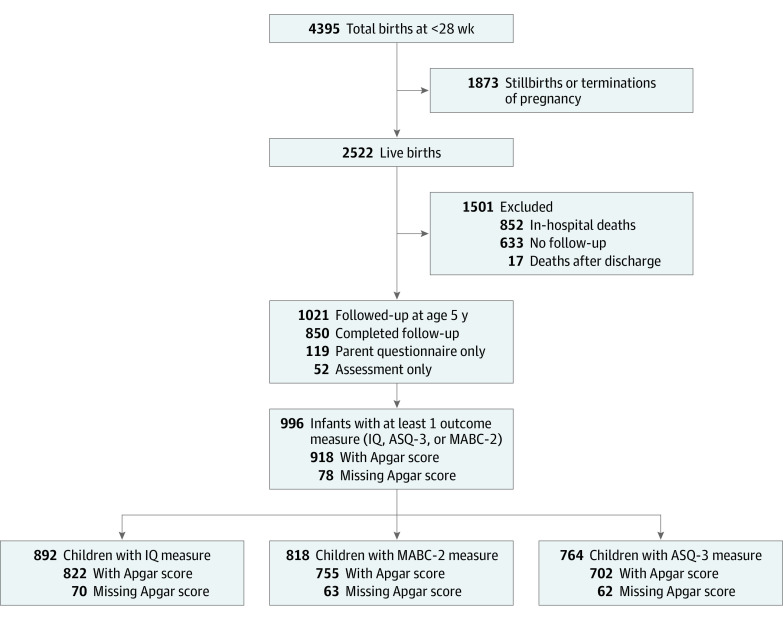
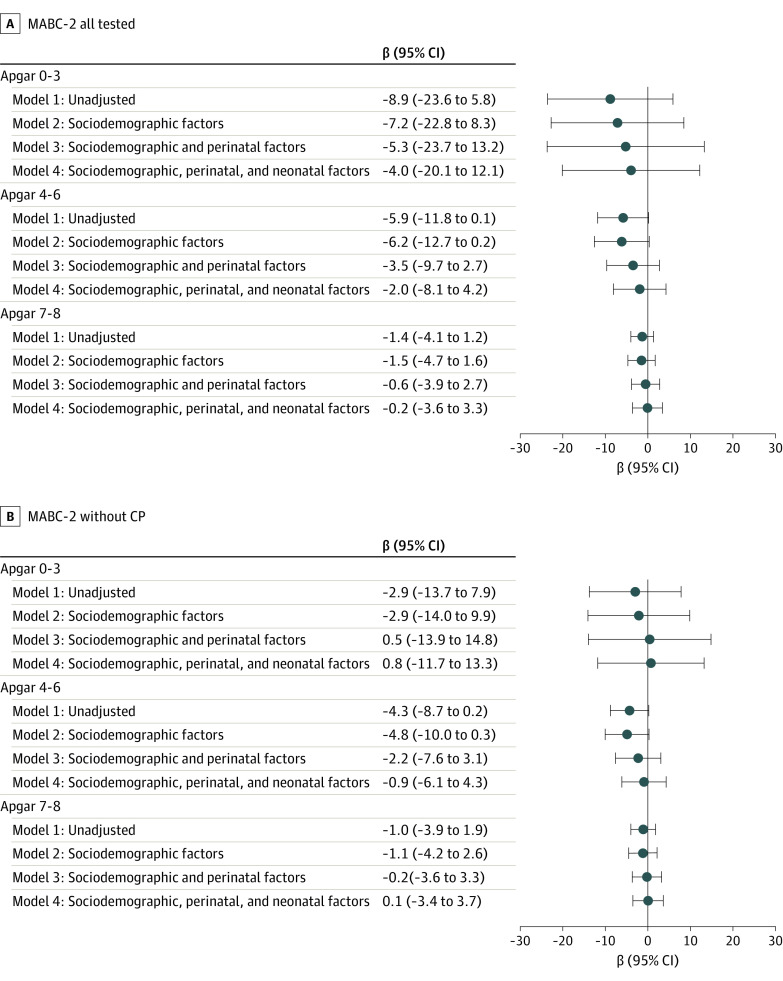
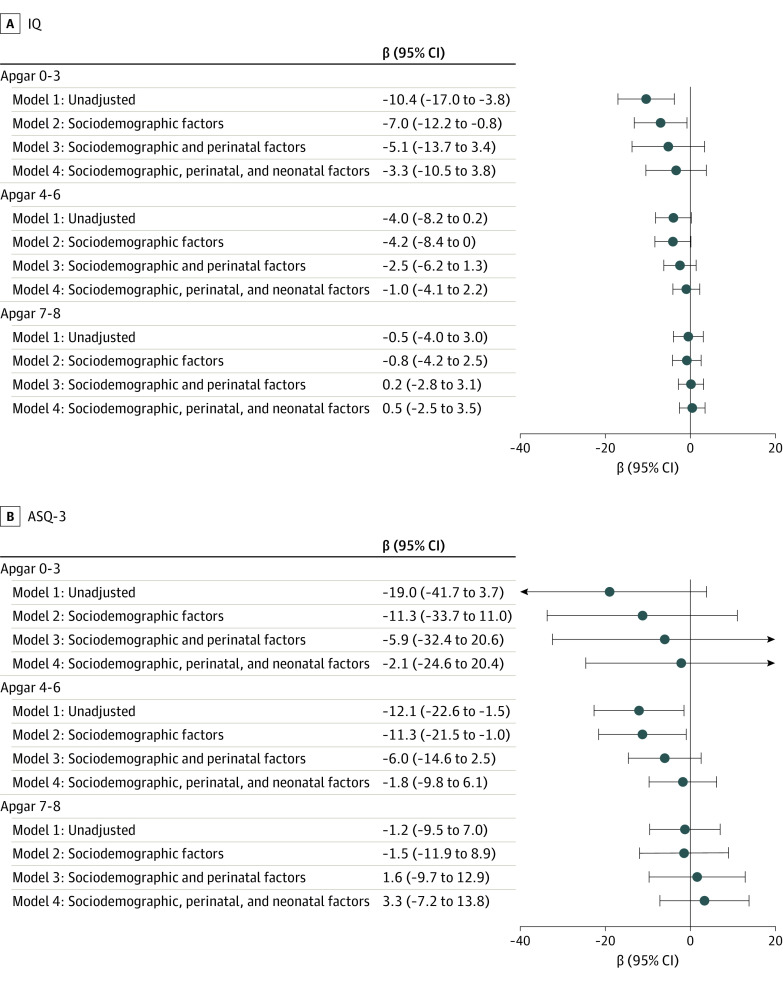
From the total cohort of 4395 infants born EPT, 2522 infants were live born, 1654 infants survived to age 5 years, and 996 infants (478 females [48.0%]) followed up had at least 1 of 3 outcome measures. After adjusting for sociodemographic variables, perinatal factors, and severe neonatal morbidities, there was no association of Apgar score with IQ, even for scores of 3 or less (β = -3.3; 95% CI, -10.5 to 3.8) compared with the score 9 to 10 category. Similarly, no association was found for ASQ-3 (β = -2.1; 95% CI, -24.6 to 20.4). Congruent results for Apgar scores of 3 or less were obtained for motor function scores for all children (β = -4.0; 95% CI, -20.1 to 12.1) and excluding children with a diagnosis of cerebral palsy (β = 0.8, 95% CI -11.7 to 13.3).
This study found that low Apgar scores were not associated with longer-term outcomes in infants born EPT. This finding may be associated with high interobserver variability in Apgar scoring, reduced vitality signs and poorer responses to resuscitation after birth among infants born EPT, and the association of more deleterious exposures in the neonatal intensive care unit or of socioeconomic factors with greater changes in outcomes during the first 5 years of life.
阿普加评分(Apgar score)被全球用作评估新生儿生命最初几分钟活力的工具。其在评估极早早产儿(EPT;<28 周妊娠)神经发育结局方面的适用性尚未得到充分证实。
研究阿普加评分与 EPT 出生婴儿神经发育结局之间的关系。
设计、地点和参与者:这项队列研究使用了 2011 年至 2012 年在欧洲 11 个国家的 19 个地区开展的有效围产期强化护理以改善欧洲极早早产儿健康(EPICE-SHIPS)研究中的数据。对 EPT 出生婴儿进行了 5 岁时认知和运动功能的临床评估,并于 2023 年 1 月至 7 月进行了分析。
5 分钟时的阿普加评分分为 4 组(0-3 分、4-6 分、7-8 分和 9-10 分)。
使用各国通过当地标准化版本得出的韦氏学前和小学智力量表(Wechsler Preschool and Primary Scale of Intelligence)中的智商以及儿童运动评估第二版(Movement Assessment Battery for Children-Second Edition)来评估认知和运动结局。父母还通过第三代年龄与阶段问卷(Ages and Stages Questionnaire,third edition,ASQ-3)提供了关于沟通和解决问题能力的信息。所有结局均以连续变量表示。
在 EPT 出生的 4395 例总队列中,2522 例婴儿存活,1654 例婴儿存活至 5 岁,996 例(478 名女性[48.0%])随访时至少有 1 项 3 种结局测量指标。在调整社会人口学变量、围产期因素和严重新生儿疾病后,阿普加评分与智商之间没有关联,即使评分低至 3 分(β= -3.3;95%CI,-10.5 至 3.8)与评分 9 至 10 分类相比也是如此。同样,ASQ-3 也没有关联(β= -2.1;95%CI,-24.6 至 20.4)。对于所有儿童的运动功能评分(β= -4.0;95%CI,-20.1 至 12.1)和排除脑瘫诊断儿童的评分(β= 0.8,95%CI,-11.7 至 13.3),阿普加评分低至 3 分的结果也一致。
本研究发现,EPT 出生婴儿的低阿普加评分与长期结局之间没有关联。这一发现可能与阿普加评分的观察者间变异性高、EPT 出生婴儿出生后活力体征减少且对复苏的反应较差以及新生儿重症监护病房中更有害的暴露因素或社会经济因素与生命最初 5 年期间结局变化更大有关。