The National Research Centre for the Working Environment, Copenhagen, Denmark.
Division of Solid State Physics and NanoLund, Lund University, Lund, 22 100, Sweden.
J Nanobiotechnology. 2023 Sep 7;21(1):322. doi: 10.1186/s12951-023-02049-0.
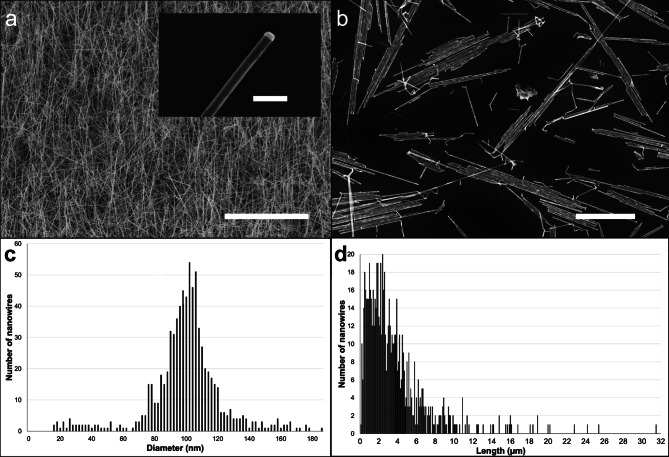
III-V semiconductor nanowires are envisioned as being integrated in optoelectronic devices in the near future. However, the perspective of mass production of these nanowires raises concern for human safety due to their asbestos- and carbon nanotube-like properties, including their high aspect ratio shape. Indeed, III-V nanowires have similar dimensions as Mitsui-7 multi-walled carbon nanotubes, which induce lung cancer by inhalation in rats. It is therefore urgent to investigate the toxicological effects following lung exposure to III-V nanowires prior to their use in industrial production, which entails risk of human exposure. Here, female C57BL/6J mice were exposed to 2, 6, and 18 µg (0.12, 0.35 and 1.1 mg/kg bw) of gallium phosphide (III-V) nanowires (99 nm diameter, 3.7 μm length) by intratracheal instillation and the toxicity was investigated 1, 3, 28 days and 3 months after exposure. Mitsui-7 multi-walled carbon nanotubes and carbon black Printex 90 nanoparticles were used as benchmark nanomaterials.
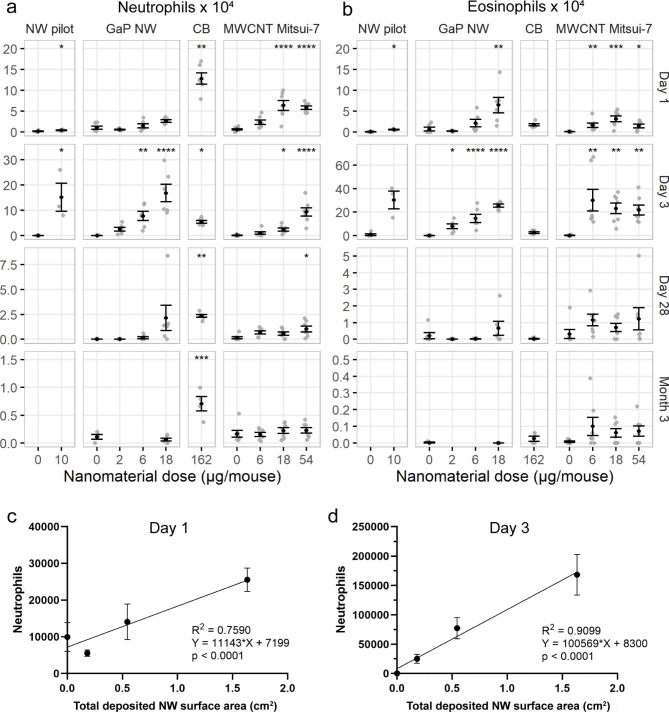
Gallium phosphide nanowires induced genotoxicity in bronchoalveolar lavage cells and acute inflammation with eosinophilia observable both in bronchoalveolar lavage and lung tissue (1 and 3 days post-exposure). The inflammatory response was comparable to the response following exposure to Mitsui-7 multi-walled carbon nanotubes at similar dose levels. The nanowires underwent partial dissolution in the lung resulting in thinner nanowires, with an estimated in vivo half-life of 3 months. Despite the partial dissolution, nanowires were detected in lung, liver, spleen, kidney, uterus and brain 3 months after exposure.
Pulmonary exposure to gallium phosphide nanowires caused similar toxicological effects as the multi-walled carbon nanotube Mitsui-7.
III-V 族半导体纳米线有望在不久的将来集成在光电设备中。然而,由于它们具有类似石棉和碳纳米管的性质,包括其高纵横比形状,这些纳米线的大规模生产引起了人们对人类安全的关注。事实上,III-V 纳米线的尺寸与 Mitsui-7 多壁碳纳米管相似,后者会导致大鼠吸入后患上肺癌。因此,在将它们用于工业生产之前,迫切需要研究它们在肺部暴露后的毒理学效应,因为这存在人类暴露的风险。在这里,雌性 C57BL/6J 小鼠通过气管内滴注暴露于 2、6 和 18μg(0.12、0.35 和 1.1mg/kg bw)的磷化镓(III-V)纳米线(99nm 直径,3.7μm 长度),并在暴露后 1、3、28 天和 3 个月研究毒性。Mitsui-7 多壁碳纳米管和 Printex 90 碳黑纳米颗粒被用作基准纳米材料。
磷化镓纳米线在支气管肺泡灌洗液细胞中诱导了遗传毒性,并且在支气管肺泡灌洗液和肺组织中均可观察到急性炎症伴嗜酸性粒细胞增多(暴露后 1 和 3 天)。炎症反应与在类似剂量水平下暴露于 Mitsui-7 多壁碳纳米管后的反应相当。纳米线在肺部发生部分溶解,导致纳米线变细,体内半衰期估计为 3 个月。尽管发生了部分溶解,但在暴露 3 个月后仍在肺部、肝脏、脾脏、肾脏、子宫和大脑中检测到纳米线。
肺部暴露于磷化镓纳米线会引起与 Mitsui-7 多壁碳纳米管相似的毒理学效应。