Chaniotakis Constantinos, Tsioupros Alexandros, Samartzidis Kosmas, Alpantaki Kalliopi, Stavrakakis Ioannis M
Department of Orthopedics and Traumatology, Venizeleio General Hospital, Heraklion, GRC.
Cureus. 2023 Aug 7;15(8):e43071. doi: 10.7759/cureus.43071. eCollection 2023 Aug.
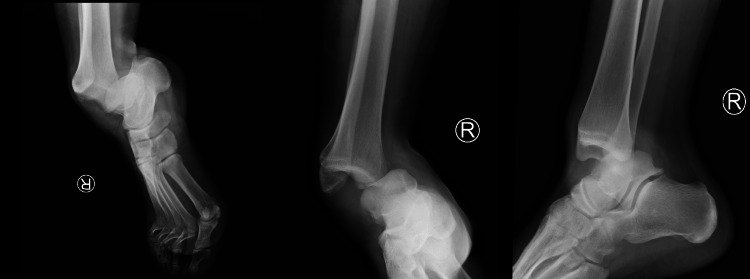
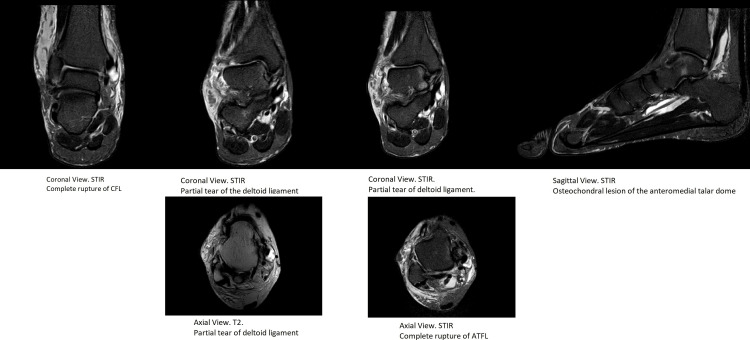
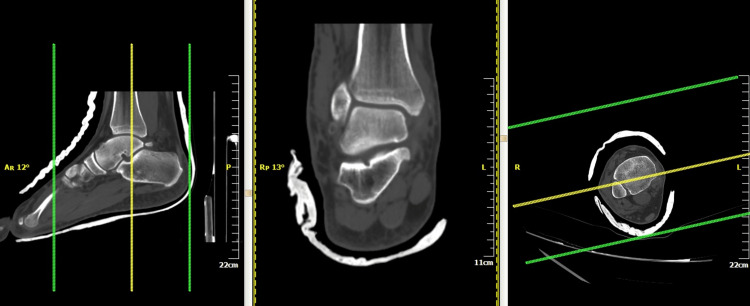
Pure dislocation of the ankle is an extremely rare injury accounting for only 0.065% of all ankle injuries and 0.46% of all ankle dislocations. The mechanism of the injury generally consists of high-energy trauma which is associated with a combination of plantar flexion and inversion or eversion of the foot. We present a case of a 22-year-old male patient who sustained a closed pure ankle dislocation after a fall from a small height. He was treated conservatively with closed reduction and circumferential cast immobilization for six weeks, followed by a functional rehabilitation program. The patient presented to the emergency department with an acutely painful and deformed right ankle after falling from a height of 1 m (stairs). Radiographs showed a posteromedial ankle dislocation without fracture. Urgent closed reduction of the dislocation was performed and a posterior below-knee back slab was applied to immobilize the ankle. Dorsalis pedis and posterior tibial arteries were intact. Check X-rays confirmed proper reduction of the ankle joint. Post reduction computed tomography (CT) scan did not show any associated fractures. Magnetic resonance imaging (MRI) revealed a multiligamentous ankle injury and a small osteochondral lesion of the anteromedial talar dome. The back slab was changed to a below-knee circular cast two weeks later, as soon as the soft tissue swelling subsided. The cast was removed at the six-week follow-up and physiotherapy was initiated in order to gain functional rehabilitation and improve the range of motion. At the final follow-up (12 months), the ankle range of motion (ROM) was the same as the pre-injury status and the patient was able to return to his work. Pure ankle dislocation is a rare injury. A satisfactory outcome can be expected, provided that the appropriate conservative treatment followed by a strict rehabilitation protocol is applied.
单纯性踝关节脱位是一种极为罕见的损伤,仅占所有踝关节损伤的0.065%以及所有踝关节脱位的0.46%。损伤机制通常包括高能创伤,常伴有足跖屈并内翻或外翻。我们报告一例22岁男性患者,其从较小高度坠落导致闭合性单纯踝关节脱位。对其进行了保守治疗,即闭合复位并环形石膏固定六周,随后进行功能康复计划。该患者从1米高处(楼梯)坠落,右踝剧痛且畸形,遂就诊于急诊科。X线片显示后内侧踝关节脱位,无骨折。紧急进行了脱位的闭合复位,并应用了膝下后侧支具固定踝关节。足背动脉和胫后动脉完好。复查X线片确认踝关节复位良好。复位后计算机断层扫描(CT)未显示任何相关骨折。磁共振成像(MRI)显示踝关节多韧带损伤以及距骨穹窿前内侧小的骨软骨损伤。两周后,一旦软组织肿胀消退,将支具更换为膝下环形石膏。六周随访时拆除石膏,并开始物理治疗以实现功能康复并改善活动范围。在最终随访(12个月)时,踝关节活动范围(ROM)与伤前状态相同,患者能够重返工作岗位。单纯踝关节脱位是一种罕见损伤。若采用适当的保守治疗并遵循严格的康复方案,有望获得满意的结果。