Foundation Medicine, Cambridge, MA, USA.
University of California Davis Comprehensive Cancer Center, Sacramento, CA, USA.
Oncologist. 2024 Feb 2;29(2):e224-e236. doi: 10.1093/oncolo/oyad251.
FoundationOneCDx is approved in the US and Japan as a companion diagnostic test to identify patients with cancer who may benefit from treatment with 30 drug therapies in the US and 23 in Japan. Tumor profiling with FoundationOneCDx also detects genomic findings with evidence of clinical significance that may inform clinical care decisions beyond companion diagnostic claims. This observational study reports the breadth and impact of clinical decision insights from FoundationOneCDx solid tumor profiles.
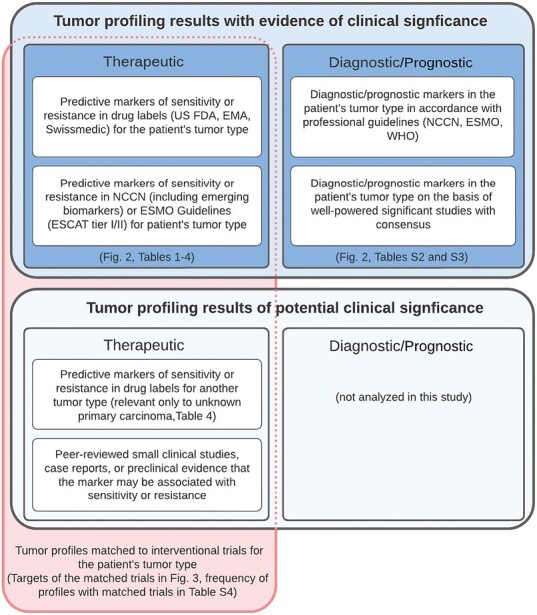
Consecutive test result reports for patients with solid tumor diagnoses (n = 109 695) were retrospectively analyzed for clinically significant predictive, prognostic, and diagnostic genomic alterations and signatures, determined in accordance with professional guidelines. Interventional clinical trials with targeted therapies or immune checkpoint inhibitors were matched to tumor profiles based on evidence that the genomic finding may be an actionable, investigational, or hypothetical target in the patient's tumor type.
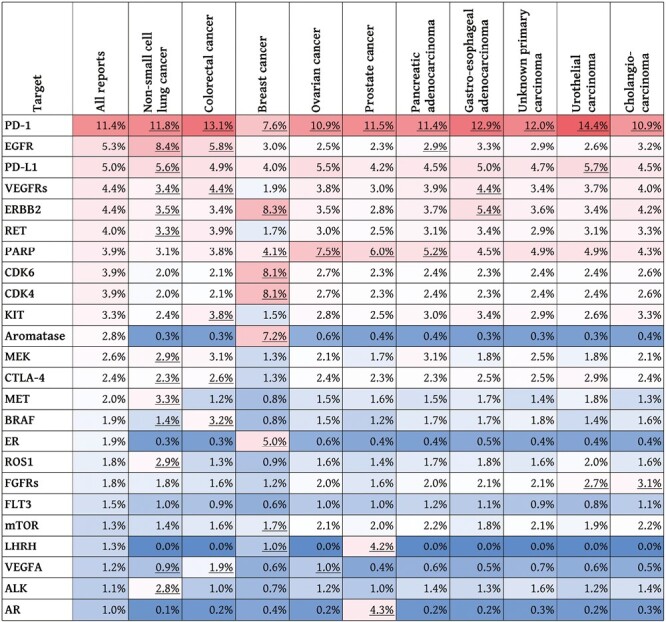
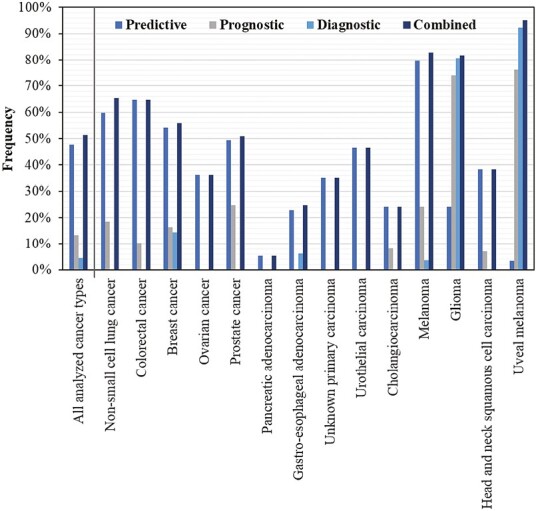
In 14 predefined cancer types (80.7% of analyzed solid tumors), predictive, prognostic, and diagnostic markers were reported in 47.6%, 13.2%, and 4.5% of samples, respectively, accounting for a total of 51.2% of tumor profiles. Pan-cancer predictive markers of tumor mutational burden (TMB) of 10 or more mutations per megabase, high microsatellite instability (MSI), or NTRK1/2/3 fusions were observed in 15.6%, 2.0%, and 0.1% of solid tumors, respectively. Most solid tumor profiles (89.2%) had genomic results that could theoretically inform decisions on the selection of immunotherapy and targeted therapy clinical trials.
For this real-world population of patients with FoundationOneCDx solid tumor profiles in the routine course of clinical care, clinically significant findings were reported for approximately half of patients with genomic results.
FoundationOneCDx 已在美国和日本获得批准,作为一种伴随诊断测试,用于识别可能受益于美国 30 种药物治疗和日本 23 种药物治疗的癌症患者。FoundationOneCDx 的肿瘤分析还检测到具有临床意义的基因组发现,这些发现可能会影响临床护理决策,超出伴随诊断的范围。本观察性研究报告了 FoundationOneCDx 实体瘤分析结果提供的广泛且有影响力的临床决策见解。
对 109695 例实体瘤诊断患者的连续检测结果报告进行回顾性分析,以确定具有临床意义的预测性、预后性和诊断性基因组改变和特征,这些改变和特征是根据专业指南确定的。针对特定治疗或免疫检查点抑制剂的干预性临床试验与肿瘤分析结果相匹配,依据是基因组发现可能是患者肿瘤类型中具有可操作性、研究性或假设性的靶点的证据。
在 14 种预先定义的癌症类型(分析中实体瘤的 80.7%)中,预测性、预后性和诊断性标志物分别在 47.6%、13.2%和 4.5%的样本中报告,占肿瘤分析结果的 51.2%。在 15.6%、2.0%和 0.1%的实体瘤中分别观察到肿瘤突变负荷(TMB)为 10 个或更多突变/兆碱基、高度微卫星不稳定性(MSI)或 NTRK1/2/3 融合的泛癌预测性标志物。大多数实体瘤分析结果(89.2%)具有基因组结果,这些结果理论上可以为选择免疫治疗和靶向治疗临床试验提供信息。
对于在临床常规护理过程中使用 FoundationOneCDx 进行实体瘤分析的这一真实世界的患者人群,约一半患者的基因组结果报告了具有临床意义的发现。