Madison Annelise A, Andridge Rebecca, Kantaras Anthony H, Renna Megan E, Bennett Jeanette M, Alfano Catherine M, Povoski Stephen P, Agnese Doreen M, Lustberg Maryam, Wesolowski Robert, Carson William E, Williams Nicole O, Reinbolt Raquel E, Sardesai Sagar D, Noonan Anne M, Stover Daniel G, Cherian Mathew A, Malarkey William B, Kiecolt-Glaser Janice K
Institute for Behavioral Medicine Research, The Ohio State University College of Medicine, The Ohio State University, Columbus, OH 43210, USA.
Department of Psychology, The Ohio State University, Columbus, OH 43210, USA.
Cancers (Basel). 2023 Sep 4;15(17):4414. doi: 10.3390/cancers15174414.
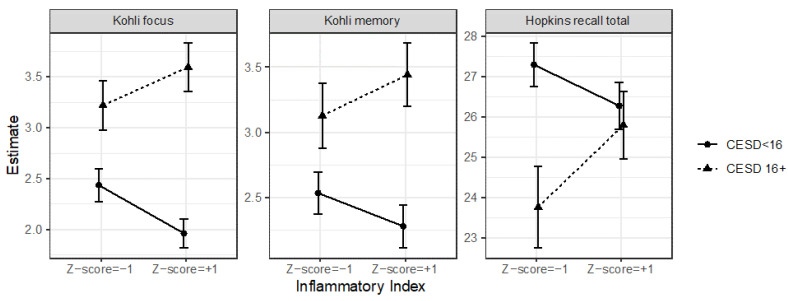
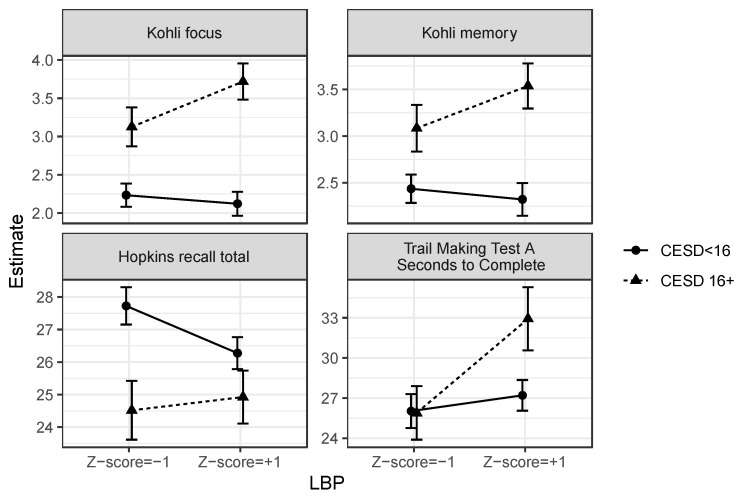
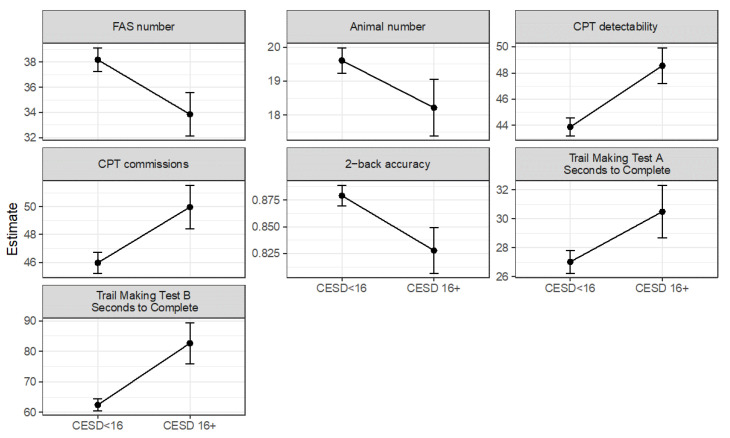
About one-in-three breast cancer survivors have lingering cognitive complaints and objective cognitive impairment. Chronic inflammation and intestinal permeability (i.e., leaky gut), two risk factors for cognitive decline, can also fuel depression-another vulnerability for cognitive decline. The current study tested whether depression accompanied by high levels of inflammation or intestinal permeability predicted lower subjective and objective cognitive function in breast cancer survivors. We combined data from four breast cancer survivor studies ( = 613); some had repeated measurements for a total of 1015 study visits. All participants had a blood draw to obtain baseline measures of lipopolysaccharide binding protein-a measure of intestinal permeability, as well as three inflammatory markers that were incorporated into an inflammatory index: C-reactive protein, interleukin-6, and tumor necrosis factor-α. They reported depressive symptoms on the Center for Epidemiological Studies depression scale (CES-D), and a binary variable indicated clinically significant depressive symptoms (CES-D ≥ 16). The Kohli (749 observations) and the Breast Cancer Prevention Trial (591 observations) scales assessed subjective cognitive function. Objective cognitive function tests included the trail-making test, Hopkins verbal learning test, Conners continuous performance test, n-back test, FAS test, and animal-naming test (239-246 observations). Adjusting for education, age, BMI, cancer treatment type, time since treatment, study visit, and fatigue, women who had clinically elevated depressive symptoms accompanied by heightened inflammation or intestinal permeability reported poorer focus and marginally poorer memory. However, poorer performance across objective cognitive measures was not specific to inflammation-associated depression. Rather, there was some evidence of lower verbal fluency; poorer attention, verbal learning and memory, and working memory; and difficulties with visuospatial search among depressed survivors, regardless of inflammation. By themselves, inflammation and intestinal permeability less consistently predicted subjective or objective cognitive function. Breast cancer survivors with clinically significant depressive symptoms accompanied by either elevated inflammation or intestinal permeability may perceive greater cognitive difficulty, even though depression-related objective cognitive deficits may not be specific to inflammation- or leaky-gut-associated depression.
约三分之一的乳腺癌幸存者存在持续的认知问题和客观认知障碍。慢性炎症和肠道通透性(即肠漏)是认知衰退的两个风险因素,也会引发抑郁症——这是认知衰退的另一个易患因素。当前的研究测试了伴有高水平炎症或肠道通透性的抑郁症是否预示着乳腺癌幸存者的主观和客观认知功能较低。我们合并了四项乳腺癌幸存者研究的数据(n = 613);其中一些进行了重复测量,总共进行了1015次研究访问。所有参与者均进行了血液抽取,以获取脂多糖结合蛋白的基线测量值——一种肠道通透性的测量指标,以及三种炎症标志物,这些标志物被纳入一个炎症指数:C反应蛋白、白细胞介素-6和肿瘤坏死因子-α。他们在流行病学研究中心抑郁量表(CES-D)上报告了抑郁症状,一个二元变量表明存在具有临床意义的抑郁症状(CES-D≥16)。Kohli量表(749次观察)和乳腺癌预防试验量表(591次观察)评估了主观认知功能。客观认知功能测试包括连线测验、霍普金斯言语学习测验、康纳斯持续性操作测验、n-back测验、FAS测验和动物命名测验(239 - 246次观察)。在对教育程度、年龄、体重指数、癌症治疗类型、治疗后的时间、研究访问和疲劳进行调整后,伴有炎症或肠道通透性升高且临床上抑郁症状加重的女性报告称注意力较差,记忆力略差。然而,在客观认知测量中表现较差并不特定于与炎症相关的抑郁症。相反,有一些证据表明言语流畅性较低;注意力、言语学习和记忆以及工作记忆较差;并且在抑郁的幸存者中,无论是否有炎症,在视觉空间搜索方面都存在困难。炎症和肠道通透性本身对主观或客观认知功能的预测不太一致。伴有炎症或肠道通透性升高且具有临床意义的抑郁症状的乳腺癌幸存者可能会感觉到更大的认知困难,尽管与抑郁症相关的客观认知缺陷可能并不特定于与炎症或肠漏相关的抑郁症。