
包覆氧化锌纳米颗粒对番茄植株光系统II的影响
Impact of Coated Zinc Oxide Nanoparticles on Photosystem II of Tomato Plants.
作者信息
Tryfon Panagiota, Sperdouli Ilektra, Adamakis Ioannis-Dimosthenis S, Mourdikoudis Stefanos, Moustakas Michael, Dendrinou-Samara Catherine
机构信息
Laboratory of Inorganic Chemistry, Department of Chemistry, Aristotle University of Thessaloniki, 54124 Thessaloniki, Greece.
Institute of Plant Breeding and Genetic Resources, Hellenic Agricultural Organization-Dimitra, 57001 Thessaloniki, Greece.
出版信息
Materials (Basel). 2023 Aug 26;16(17):5846. doi: 10.3390/ma16175846.
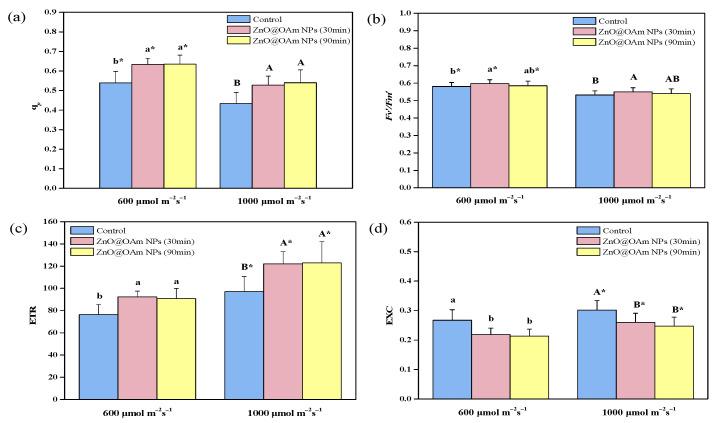
Zinc oxide nanoparticles (ZnO NPs) have emerged as a prominent tool in agriculture. Since photosynthetic function is a significant measurement of phytotoxicity and an assessment tool prior to large-scale agricultural applications, the impact of engineered irregular-shaped ZnO NPs coated with oleylamine (ZnO@OAm NPs) were tested. The ZnO@OAm NPs (crystalline size 19 nm) were solvothermally prepared in the sole presence of oleylamine (OAm) and evaluated on tomato ( Mill.) photosystem II (PSII) photochemistry. Foliar-sprayed 15 mg L ZnO@OAm NPs on tomato leaflets increased chlorophyll content that initiated a higher amount of light energy capture, which resulted in about a 20% increased electron transport rate (ETR) and a quantum yield of PSII photochemistry (Φ) at the growth light (GL, 600 μmol photons m s). However, the ZnO@OAm NPs caused a malfunction in the oxygen-evolving complex (OEC) of PSII, which resulted in photoinhibition and increased ROS accumulation. The ROS accumulation was due to the decreased photoprotective mechanism of non-photochemical quenching (NPQ) and to the donor-side photoinhibition. Despite ROS accumulation, ZnO@OAm NPs decreased the excess excitation energy of the PSII, indicating improved PSII efficiency. Therefore, synthesized ZnO@OAm NPs can potentially be used as photosynthetic biostimulants for enhancing crop yields after being tested on other plant species.
氧化锌纳米颗粒(ZnO NPs)已成为农业领域的一种重要工具。由于光合功能是衡量植物毒性的重要指标,也是大规模农业应用之前的一种评估工具,因此测试了涂有油胺的工程不规则形状的ZnO NPs(ZnO@OAm NPs)的影响。ZnO@OAm NPs(晶体尺寸为19 nm)在仅存在油胺(OAm)的情况下通过溶剂热法制备,并在番茄(Mill.)光系统II(PSII)光化学上进行了评估。在番茄小叶上叶面喷施15 mg L ZnO@OAm NPs可增加叶绿素含量,从而引发更高的光能捕获量,这导致在生长光(GL,600 μmol光子m s)下电子传递速率(ETR)提高约20%,PSII光化学量子产率(Φ)提高。然而,ZnO@OAm NPs导致PSII的放氧复合体(OEC)出现故障,从而导致光抑制和活性氧积累增加。活性氧积累是由于非光化学猝灭(NPQ)的光保护机制降低以及供体侧光抑制所致。尽管活性氧积累,但ZnO@OAm NPs降低了PSII的过剩激发能,表明PSII效率提高。因此,合成的ZnO@OAm NPs在对其他植物物种进行测试后,有可能用作光合生物刺激剂来提高作物产量。


 Zotero 插件