Wu Lei, Zang Xizhe, Ding Guanwen, Wang Chao, Zhang Xuehe, Liu Yubin, Zhao Jie
State Key Laboratory of Robotics and Systems, Harbin Institute of Technology, Harbin 150001, China.
Sensors (Basel). 2023 Aug 26;23(17):7447. doi: 10.3390/s23177447.
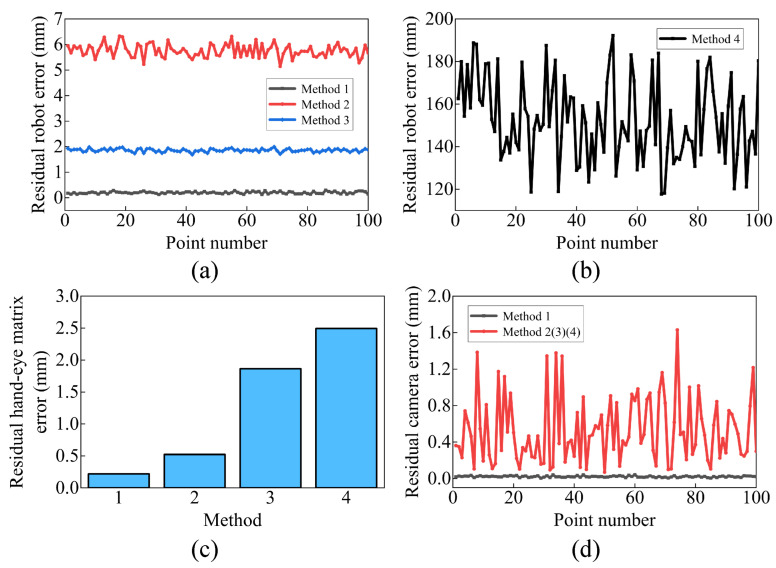
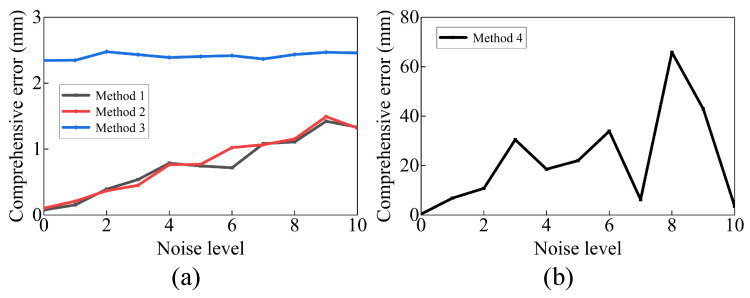
Robot measurement systems with a binocular planar structured light camera (3D camera) installed on a robot end-effector are often used to measure workpieces' shapes and positions. However, the measurement accuracy is jointly influenced by the robot kinematics, camera-to-robot installation, and 3D camera measurement errors. Incomplete calibration of these errors can result in inaccurate measurements. This paper proposes a joint calibration method considering these three error types to achieve overall calibration. In this method, error models of the robot kinematics and camera-to-robot installation are formulated using Lie algebra. Then, a pillow error model is proposed for the 3D camera based on its error distribution and measurement principle. These error models are combined to construct a joint model based on homogeneous transformation. Finally, the calibration problem is transformed into a stepwise optimization problem that minimizes the sum of the relative position error between the calibrator and robot, and analytical solutions for the calibration parameters are derived. Simulation and experiment results demonstrate that the joint calibration method effectively improves the measurement accuracy, reducing the mean positioning error from over 2.5228 mm to 0.2629 mm and the mean distance error from over 0.1488 mm to 0.1232 mm.
安装在机器人末端执行器上的带有双目平面结构光相机(3D相机)的机器人测量系统常被用于测量工件的形状和位置。然而,测量精度受到机器人运动学、相机与机器人的安装以及3D相机测量误差的共同影响。这些误差的校准不完整会导致测量不准确。本文提出一种考虑这三种误差类型的联合校准方法以实现整体校准。在该方法中,利用李代数建立机器人运动学和相机与机器人安装的误差模型。然后,基于3D相机的误差分布和测量原理提出一种枕形误差模型。将这些误差模型相结合,基于齐次变换构建联合模型。最后,将校准问题转化为一个逐步优化问题,使校准器与机器人之间的相对位置误差之和最小,并推导出校准参数的解析解。仿真和实验结果表明,联合校准方法有效提高了测量精度,将平均定位误差从超过2.5228毫米降低到0.2629毫米,将平均距离误差从超过0.1488毫米降低到0.1232毫米。