Key Laboratory of Infection and Immunity of Shandong Province, Department of Immunology, School of Basic Medical Sciences, Cheeloo College of Medicine, Shandong University, Jinan, 250012, China.
Department of Clinical Laboratory, The Second Hospital, Cheeloo College of Medicine, Shandong University, Jinan, 250033, China.
Redox Biol. 2023 Nov;67:102877. doi: 10.1016/j.redox.2023.102877. Epub 2023 Sep 9.
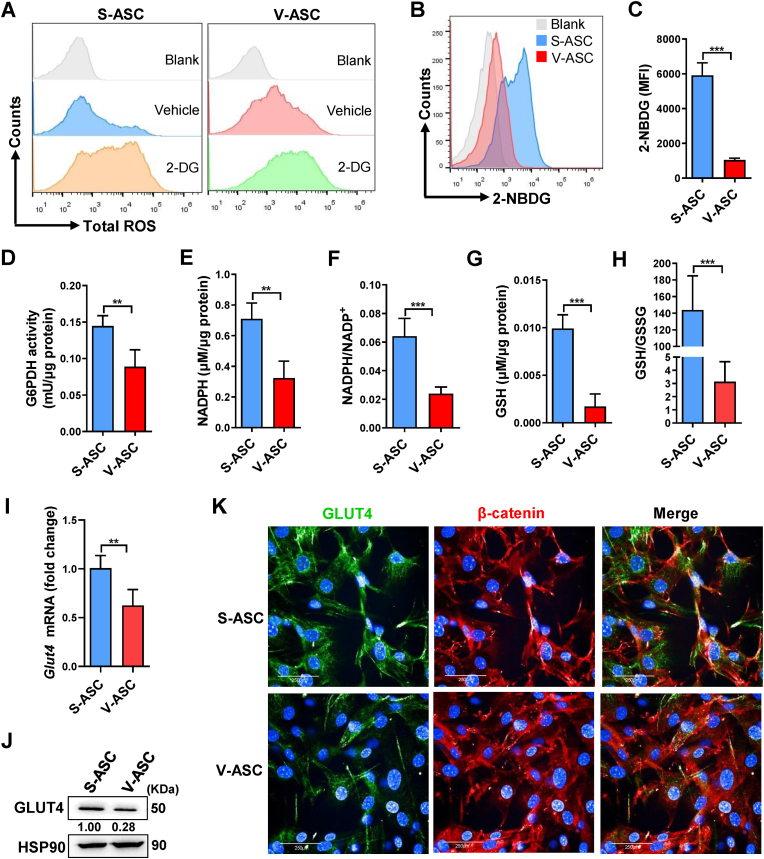
The senescence of adipose stem cells (ASCs) impairs healthy adipose tissue remodeling, causing metabolic maladaptation to energy surplus. The intrinsic molecular pathways and potential therapy targets for ASC senescence are largely unclear. Here, we showed that visceral ASCs were prone to senescence that was caused by reactive oxygen species (ROS) overload, especially mitochondrial ROS. These senescent ASCs failed to sustain efficient glucose influx, pentose phosphate pathway (PPP) and redox homeostasis. We showed that CD90 silence restricted the glucose uptake by ASCs and thus disrupted their PPP and anti-oxidant system, resulting in ASC senescence. Notably, fibroblast growth factor 21 (FGF21) treatment significantly reduced the senescent phenotypes of ASCs by augmenting CD90 protein via glycosylation, which promoted glucose influx via the AKT-GLUT4 axis and therefore mitigated ROS overload. For diet-induced obese mice, chronic administration of low-dose FGF21 relieved their visceral white adipose tissue (VAT) dysfunction and systemic metabolic disorders. In particular, VAT homeostasis was restored in FGF21-treated obese mice, where ASC repertoire was markedly recovered, accompanied by CD90 elevation and anti-senescent phenotypes in these ASCs. Collectively, we reveal a molecular mechanism of ASC senescence by which CD90 downregulation interferes glucose influx into PPP and redox homeostasis. And we propose a FGF21-based strategy for healthy VAT remodeling, which targets CD90 glycosylation to correct ASC senescence and therefore combat obesity-related metabolic dysfunction.
脂肪干细胞(ASCs)衰老会损害健康的脂肪组织重塑,导致代谢适应能量过剩的能力受损。ASCs 衰老的内在分子途径和潜在治疗靶点在很大程度上尚不清楚。在这里,我们发现内脏 ASCs 容易衰老,这是由活性氧(ROS)过载引起的,尤其是线粒体 ROS。这些衰老的 ASCs 无法维持有效的葡萄糖内流、戊糖磷酸途径(PPP)和氧化还原稳态。我们发现 CD90 沉默限制了 ASCs 的葡萄糖摄取,从而破坏了它们的 PPP 和抗氧化系统,导致 ASC 衰老。值得注意的是,成纤维细胞生长因子 21(FGF21)通过糖基化显著增加 CD90 蛋白,从而通过 AKT-GLUT4 轴促进葡萄糖内流,减轻 ROS 过载,从而显著减轻 ASCs 的衰老表型。对于饮食诱导的肥胖小鼠,低剂量 FGF21 的慢性给药缓解了它们的内脏白色脂肪组织(VAT)功能障碍和全身代谢紊乱。特别是,FGF21 治疗的肥胖小鼠中 VAT 稳态得到恢复,ASCs 谱明显恢复,同时这些 ASCs 中 CD90 升高和抗衰老表型。总之,我们揭示了 ASC 衰老的分子机制,即 CD90 下调干扰葡萄糖进入 PPP 和氧化还原稳态。我们提出了一种基于 FGF21 的策略,用于健康的 VAT 重塑,该策略靶向 CD90 糖基化以纠正 ASC 衰老,从而对抗肥胖相关的代谢功能障碍。