Koshimizu Shizuka, Masuda Sachiko, Shibata Arisa, Ishii Takayoshi, Shirasu Ken, Hoshino Atsushi, Arita Masanori
Bioinformation and DDBJ Center, National Institute of Genetics, Mishima 411-8540, Japan.
Graduate Institute for Advanced Studies, SOKENDAI, Mishima 411-8540, Japan.
DNA Res. 2023 Oct 1;30(5). doi: 10.1093/dnares/dsad019.
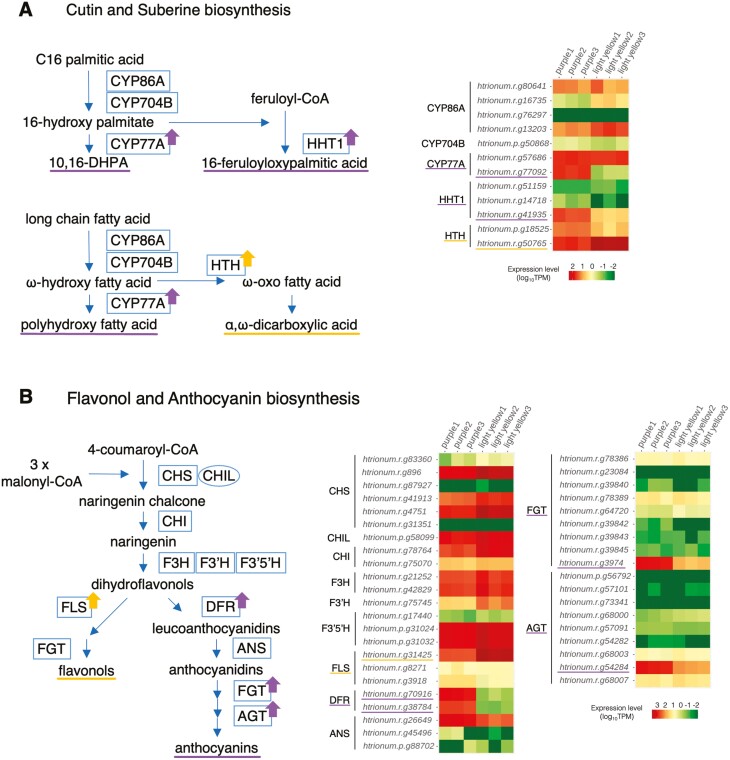
Hibiscus trionum, commonly known as the 'Flower of an Hour', is an easily cultivated plant in the Malvaceae family that is widespread in tropical and temperate regions, including drylands. The purple base part of its petal exhibits structural colour due to the fine ridges on the epidermal cell surface, and the molecular mechanism of ridge formation has been actively investigated. We performed genome sequencing of H. trionum using a long-read sequencing technology with transcriptome and pathway analyses to identify candidate genes for fine structure formation. The ortholog of AtSHINE1, which is involved in the biosynthesis of cuticular wax in Arabidopsis thaliana, was significantly overexpressed in the iridescent tissue. In addition, orthologs of AtCUS2 and AtCYP77A, which contribute to cutin synthesis, were also overexpressed. Our results provide important insights into the formation of fine ridges on epidermal cells in plants using H. trionum as a model.
黄葵,通常被称为“午时花”,是锦葵科一种易于栽培的植物,广泛分布于热带和温带地区,包括旱地。其花瓣的紫色基部由于表皮细胞表面的细微脊状结构而呈现结构色,并且对脊状结构形成的分子机制已进行了积极研究。我们使用长读长测序技术对黄葵进行了基因组测序,并结合转录组和通路分析来鉴定参与精细结构形成的候选基因。拟南芥中参与角质蜡生物合成的AtSHINE1的直系同源基因在虹彩组织中显著过表达。此外,参与角质合成的AtCUS2和AtCYP77A的直系同源基因也过表达。我们的研究结果以黄葵为模型,为植物表皮细胞上细微脊状结构的形成提供了重要见解。