Cortés-Llanos Belén, Jain Vaibhav, Cooper-Volkheimer Alicia, Browne Edward P, Murdoch David M, Allbritton Nancy L
Department of Bioengineering University of Washington Washington USA.
Department of Medicine Duke University North Carolina USA.
Bioeng Transl Med. 2023 Jun 21;8(5):e10551. doi: 10.1002/btm2.10551. eCollection 2023 Sep.
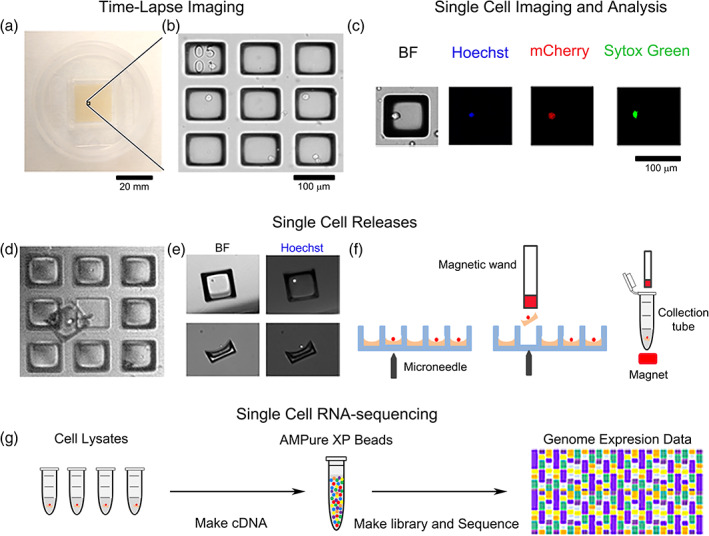
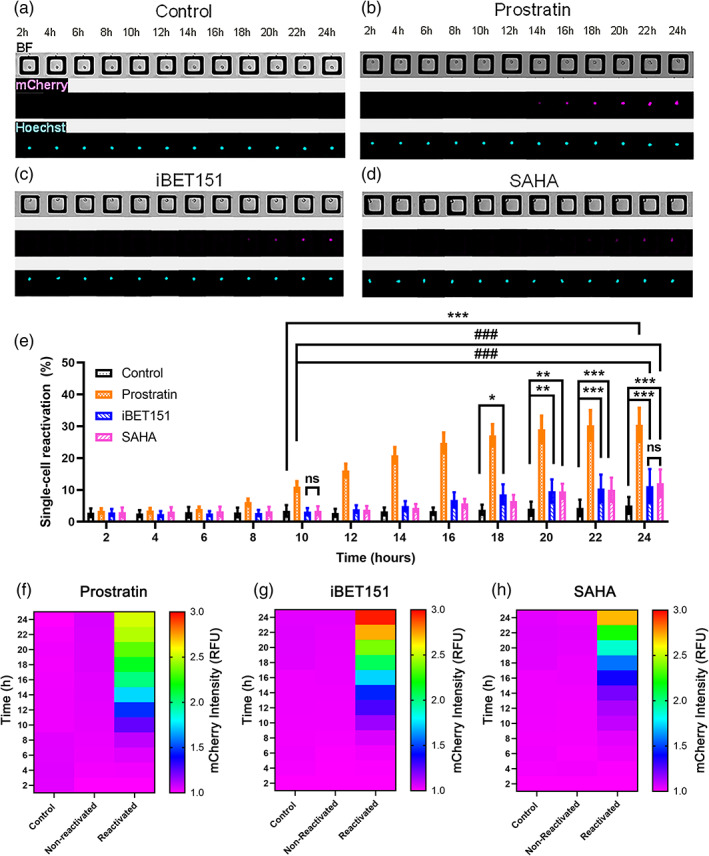
A promising strategy to cure HIV-infected individuals is to use latency reversing agents (LRAs) to reactivate latent viruses, followed by host clearance of infected reservoir cells. However, reactivation of latent proviruses within infected cells is heterogeneous and often incomplete. This fact limits strategies to cure HIV which may require complete elimination of viable virus from all cellular reservoirs. For this reason, understanding the mechanism(s) of reactivation of HIV within cellular reservoirs is critical to achieve therapeutic success. Methodologies enabling temporal tracking of single cells as they reactivate followed by sorting and molecular analysis of those cells are urgently needed. To this end, microraft arrays were adapted to image T-lymphocytes expressing mCherry under the control of the HIV long terminal repeat (LTR) promoter, in response to the application of LRAs (prostratin, iBET151, and SAHA). In response to prostratin, iBET151, and SAHA, 30.5%, 11.2%, and 12.1% percentage of cells, respectively. The arrays enabled large numbers of single cells (>25,000) to be imaged over time. mCherry fluorescence quantification identified cell subpopulations with differing reactivation kinetics. Significant heterogeneity was observed at the single-cell level between different LRAs in terms of time to reactivation, rate of mCherry fluorescence increase upon reactivation, and peak fluorescence attained. In response to prostratin, subpopulations of T lymphocytes with slow and fast reactivation kinetics were identified. Single T-lymphocytes that were either fast or slow reactivators were sorted, and single-cell RNA-sequencing was performed. Different genes associated with inflammation, immune activation, and cellular and viral transcription factors were found.
一种治疗HIV感染者的有前景的策略是使用潜伏逆转剂(LRA)来重新激活潜伏病毒,随后由宿主清除被感染的储存细胞。然而,受感染细胞内潜伏前病毒的重新激活是异质性的,且往往不完全。这一事实限制了可能需要从所有细胞储存库中完全消除活病毒的治愈HIV的策略。因此,了解细胞储存库中HIV重新激活的机制对于实现治疗成功至关重要。迫切需要能够对单个细胞重新激活过程进行时间跟踪,随后对这些细胞进行分选和分子分析的方法。为此,微筏阵列被用于对在HIV长末端重复序列(LTR)启动子控制下表达mCherry的T淋巴细胞进行成像,以响应LRA(原卟啉、iBET151和SAHA)的应用。分别响应原卟啉、iBET151和SAHA时,细胞百分比分别为30.5%、11.2%和12.1%。这些阵列能够随着时间对大量单个细胞(>25,000个)进行成像。mCherry荧光定量分析确定了具有不同重新激活动力学的细胞亚群。在不同LRA之间,在单细胞水平上观察到了重新激活时间、重新激活后mCherry荧光增加速率以及达到的峰值荧光方面的显著异质性。响应原卟啉时,鉴定出了具有缓慢和快速重新激活动力学的T淋巴细胞亚群。对快速或缓慢重新激活的单个T淋巴细胞进行分选,并进行单细胞RNA测序。发现了与炎症、免疫激活以及细胞和病毒转录因子相关的不同基因。