Balzer Christopher, Wang Zhen-Gang
Division of Chemistry and Chemical Engineering, California Institute of Technology, 1200 E California Blvd, Pasadena, CA, 91125, USA.
Eur Phys J E Soft Matter. 2023 Sep 14;46(9):82. doi: 10.1140/epje/s10189-023-00341-3.
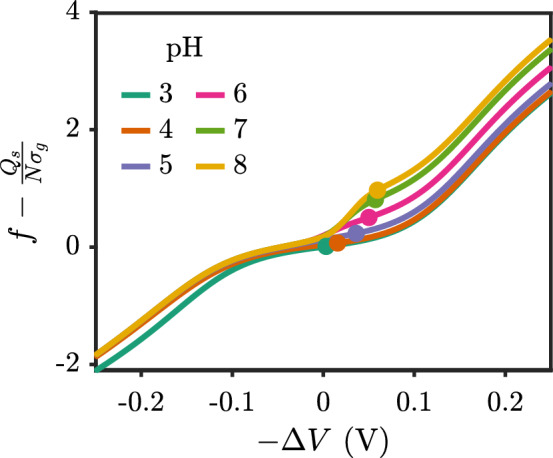
End-tethered polyelectrolytes are widely used to modify substrate properties, particularly for lubrication or wetting. External stimuli, such as pH, salt concentration, or an electric field, can induce profound structural responses in weak polyelectrolyte brushes, which can be utilized to further tune substrate properties. We study the structure and electroresponsiveness of weak polyacid brushes using an inhomogeneous theory that incorporates both electrostatic and chain connectivity correlations at the Debye-Hückel level. Our calculation shows that a weak polyacid brush swells under the application of a negative applied potential, in agreement with recent experimental observation. We rationalize this behavior using a scaling argument that accounts for the effect of the surface charge. We also show that the swelling behavior has a direct influence on the differential capacitance, which can be modulated by the solvent quality, pH, and salt concentration.
末端束缚型聚电解质被广泛用于修饰基底性质,特别是用于润滑或润湿。外部刺激,如pH值、盐浓度或电场,可在弱聚电解质刷中引发深刻的结构响应,这可用于进一步调节基底性质。我们使用一种非均匀理论研究弱聚酸刷的结构和电响应性,该理论在德拜-休克尔水平纳入了静电和链连接相关性。我们的计算表明,在施加负外电势时,弱聚酸刷会膨胀,这与最近的实验观察结果一致。我们使用一个考虑表面电荷效应的标度论证来解释这种行为。我们还表明,膨胀行为对微分电容有直接影响,微分电容可通过溶剂性质、pH值和盐浓度进行调节。