Strong Emma, Mervis Carolyn B, Tam Elaine, Morris Colleen A, Klein-Tasman Bonita P, Velleman Shelley L, Osborne Lucy R
Department of Molecular Genetics, University of Toronto, Toronto, ON, Canada.
Division of Genome Diagnostics, Department of Pathology and Laboratory Medicine, BC Children's and Women's Hospital, Vancouver, BC, Canada.
NPJ Genom Med. 2023 Sep 14;8(1):25. doi: 10.1038/s41525-023-00368-7.
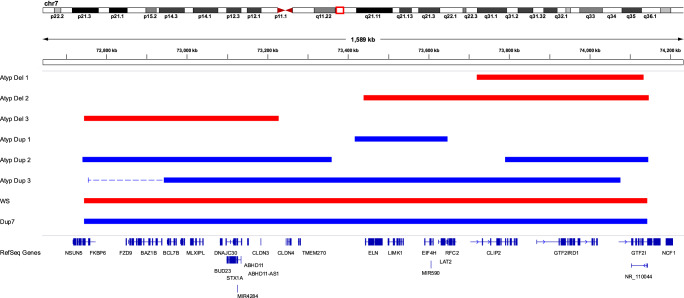
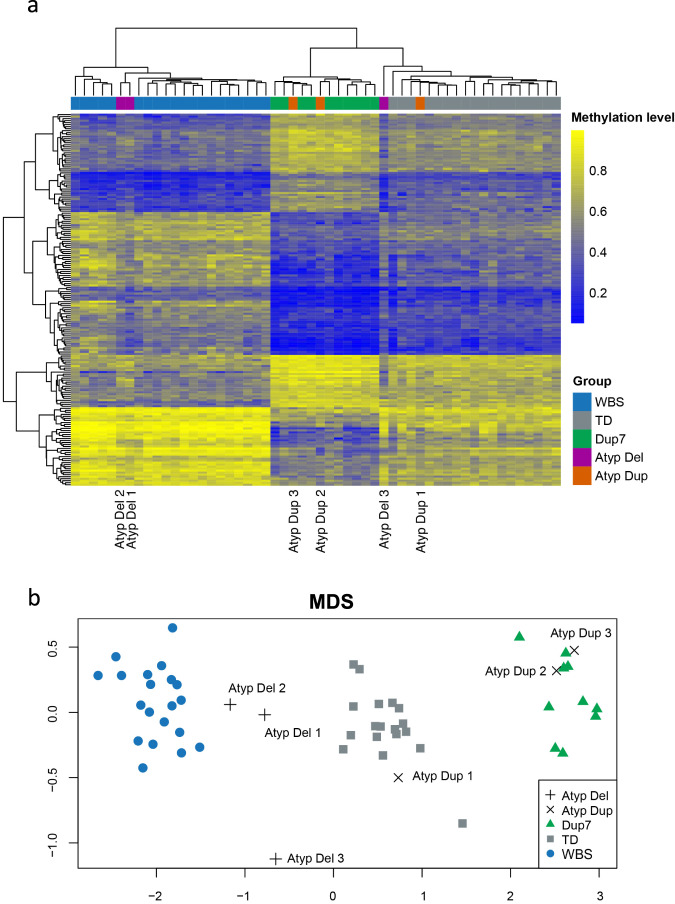
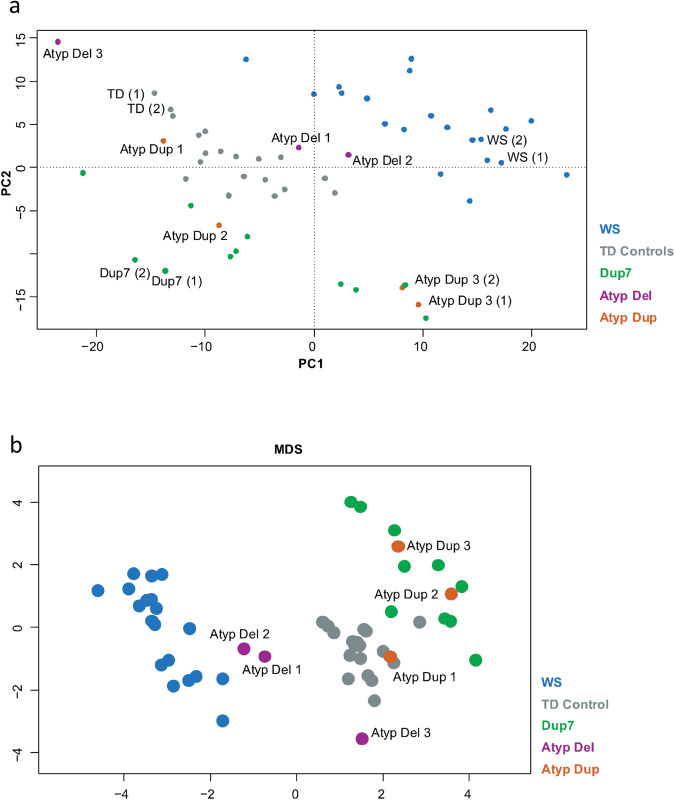
Williams-Beuren syndrome (WBS) and 7q11.23 duplication syndrome (Dup7) are rare neurodevelopmental disorders caused by deletion and duplication of a 1.5 Mb region that includes at least five genes with a known role in epigenetic regulation. We have shown that CNV of this chromosome segment causes dose-dependent, genome-wide changes in DNA methylation, but the specific genes driving these changes are unknown. We measured genome-wide whole blood DNA methylation in six participants with atypical CNV of 7q11.23 (three with deletions and three with duplications) using the Illumina HumanMethylation450k array and compared their profiles with those from groups of individuals with classic WBS or classic Dup7 and with typically developing (TD) controls. Across the top 1000 most variable positions we found that only the atypical rearrangements that changed the copy number of GTF2IRD1 and/or GTF2I (coding for the TFII-IRD1 and TFII-I proteins) clustered with their respective syndromic cohorts. This finding was supported by results from hierarchical clustering across a selection of differentially methylated CpGs, in addition to pyrosequencing validation. These findings suggest that CNV of the GTF2I genes at the telomeric end of the 7q11.23 interval is a key contributor to the large changes in DNA methylation that are seen in blood DNA from our WBS and Dup7 cohorts, compared to TD controls. Our findings suggest that members of the TFII-I protein family are involved in epigenetic processes that alter DNA methylation on a genome-wide level.
威廉姆斯-贝伦综合征(WBS)和7q11.23重复综合征(Dup7)是罕见的神经发育障碍,由一个1.5 Mb区域的缺失和重复引起,该区域至少包含五个在表观遗传调控中具有已知作用的基因。我们已经表明,该染色体片段的拷贝数变异(CNV)会导致全基因组范围内DNA甲基化的剂量依赖性变化,但驱动这些变化的具体基因尚不清楚。我们使用Illumina HumanMethylation450k芯片测量了6名7q11.23非典型CNV参与者(3名缺失者和3名重复者)的全基因组全血DNA甲基化情况,并将他们的图谱与经典WBS或经典Dup7个体组以及正常发育(TD)对照组的图谱进行了比较。在最具变异性的前1000个位置上,我们发现只有那些改变了GTF2IRD1和/或GTF2I(编码TFII-IRD1和TFII-I蛋白)拷贝数的非典型重排与各自的综合征队列聚集在一起。除了焦磷酸测序验证外,这一发现还得到了一系列差异甲基化CpG的层次聚类结果的支持。这些发现表明,与TD对照组相比,7q11.23区间端粒末端的GTF2I基因的CNV是导致我们的WBS和Dup7队列血液DNA中出现DNA甲基化巨大变化的关键因素。我们的发现表明,TFII-I蛋白家族成员参与了在全基因组水平上改变DNA甲基化的表观遗传过程。