Department of Orthopedic Surgery, Rijnstate Hospital, Arnhem, The Netherlands.
Department of Orthopedic Surgery, Radboudumc, Nijmegen, The Netherlands.
Antimicrob Resist Infect Control. 2023 Sep 14;12(1):101. doi: 10.1186/s13756-023-01305-0.
Perioperative preventive measures are important to further reduce the rate of periprosthetic joint infections (PJI) in patients undergoing total hip arthroplasty (THA). During THA surgery, joint capsule sutures are commonly placed to optimize exposure and reinsertion of the capsule. Bacterial contamination of these sutures during the procedure poses a potential risk for postoperative infection. In this exploratory study, we assessed the contamination rate of capsule sutures compared to the contamination of the remains of exchanged control sutures at the time of closure.
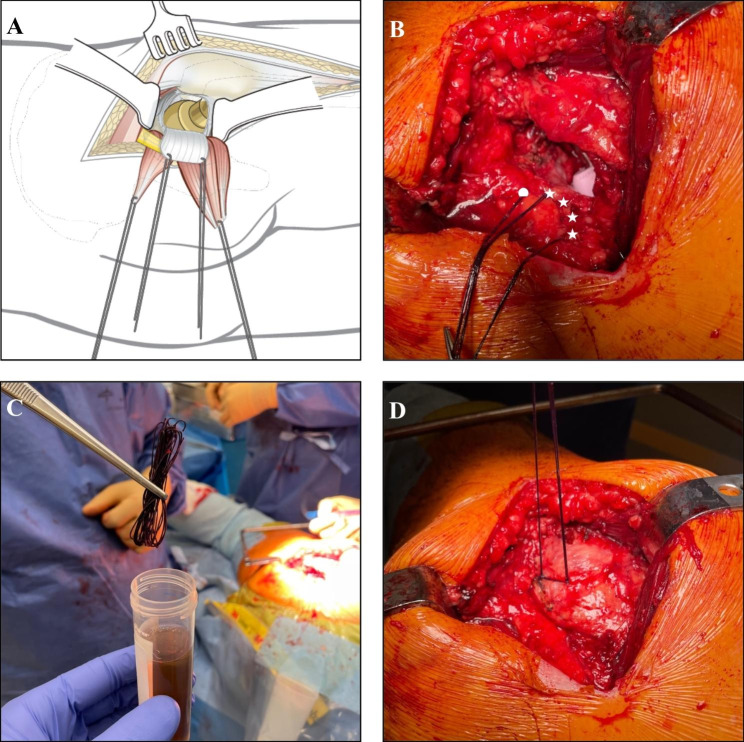
In 100 consecutive patients undergoing primary THA capsule sutures were exchanged by sterile sutures at the time of capsule closure. Both the original sutures and the remainder of the newly placed (control) sutures were retrieved, collected and cultured for ten days. Types of bacterial growth and contamination rates of both sutures were assessed.
Sutures from 98 patients were successfully collected and analyzed. Bacterial growth was observed in 7/98 (7.1%) of the capsule sutures versus 6/98 (6.1%) of the control sutures, with a difference of 1% [CI -6-8]. There was no clear pattern in differences in subtypes of bacteria between groups.
This study showed that around 7% of capsule sutures used in primary THA were contaminated with bacteria and as such exchange by new sutures at the time of capsule closure could be an appealing PJI preventive measure. However, since similar contamination rates were encountered with mainly non-virulent bacteria for both suture groups, the PJI preventive effect of this measure appears to be minimal.
围手术期预防措施对于进一步降低全髋关节置换术(THA)患者假体周围关节感染(PJI)的发生率至关重要。在 THA 手术中,通常会缝合关节囊以优化关节囊的暴露和重新插入。在手术过程中,这些缝线的细菌污染对术后感染构成了潜在风险。在这项探索性研究中,我们评估了与关闭时交换的对照缝线的剩余部分相比,关节囊缝线的污染率。
在 100 例连续接受初次 THA 的患者中,在关节囊关闭时用无菌缝线交换了胶囊缝线。将原始缝线和新放置的(对照)缝线的其余部分取出、收集并培养十天。评估两种缝线的细菌生长类型和污染率。
98 例患者的缝线成功收集并分析。在 98 例胶囊缝线中,有 7/98(7.1%)观察到细菌生长,而在 98 例对照缝线中有 6/98(6.1%),差异为 1%[CI-6-8]。两组之间细菌亚群的差异没有明显模式。
本研究表明,在初次 THA 中使用的胶囊缝线中约有 7%被细菌污染,因此在关闭关节囊时用新缝线交换可能是一种有吸引力的 PJI 预防措施。然而,由于两组缝线都遇到了主要是无毒性细菌的类似污染率,因此该措施的 PJI 预防效果似乎很小。