The MARCS Institute for Brain, Behaviour and Development, Western Sydney University, Sydney, NSW, Australia.
Australian Institute of Health Innovation, Macquarie University, Sydney, NSW, Australia.
Front Public Health. 2023 Aug 30;11:1205001. doi: 10.3389/fpubh.2023.1205001. eCollection 2023.
It is unknown how the impact of COVID-19 restrictions has affected brain healthy behaviors that contribute to dementia risk reduction in older adults. Our aim was to explore perspectives of older adults on lifestyle behaviors that support positive brain health and dementia risk reduction during and following COVID-19 restrictions.
Community-dwelling older Australians ( = 159) during June to October 2021 (the second wave of COVID-19 restrictions) who had taken part in a pre-post dementia risk reduction intervention program were invited to discuss the impact of COVID-19 on their lifestyle behaviors. Semi-structured interviews explored individual's adaptability to pandemic restrictions, intended behavior changes following restrictions easing, and feedback on the effectiveness of ongoing intervention programs for sustaining brain health. Thematic data analysis was performed using a deductive approach.
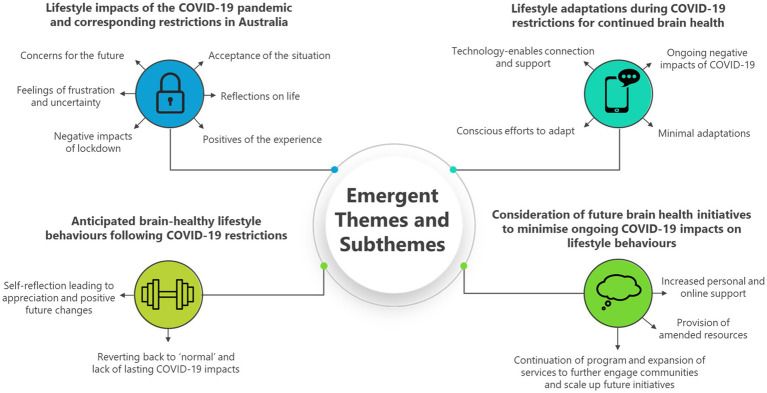
Participants had an average age of 73.1 years (SD = 5.6; range: 65-90), majority were female (74.7%), lived in a major city (82.2%) and mean 9.5 years (SD = 1.7) of education. Older adults' views about lifestyle prevention strategies during the pandemic were both positive (e.g., more spare time and adaptive leisure activities) and negative (e.g., social isolation, lack of motivation, adverse emotions). Participants highlighted a continuous conscious effort to adapt certain brain healthy behaviors despite the persistence of adverse impacts of COVID-19 restrictions. Participants also expressed the intention and desire to revert to their previous lifestyle before the COVID-19 pandemic or a sense of the 'new normal'.
This formative research will inform future interventions targeting dementia risk reduction to consider the immediate and lasting effects of COVID-19 restrictions on older adult's lifestyle behavior.
目前尚不清楚 COVID-19 限制措施的实施如何影响有助于降低老年人痴呆风险的大脑健康行为。我们旨在探讨老年人在 COVID-19 限制期间和之后,对支持大脑健康和降低痴呆风险的生活方式行为的看法。
2021 年 6 月至 10 月(第二波 COVID-19 限制期间),邀请参加过预防痴呆风险降低干预计划的澳大利亚社区居住的老年人(n=159)讨论 COVID-19 对他们生活方式行为的影响。半结构化访谈探讨了个人对大流行限制的适应能力、限制放宽后预期的行为改变,以及对正在进行的维持大脑健康的干预计划的有效性的反馈。使用演绎方法对主题数据进行分析。
参与者的平均年龄为 73.1 岁(标准差=5.6;范围:65-90),大多数为女性(74.7%),居住在大城市(82.2%),平均受教育 9.5 年(标准差=1.7)。老年人对大流行期间生活方式预防策略的看法既有积极的一面(例如,有更多的业余时间和适应性休闲活动),也有消极的一面(例如,社会隔离、缺乏动力、不良情绪)。参与者强调尽管 COVID-19 限制的不利影响持续存在,但他们仍会不断有意识地努力适应某些大脑健康行为。参与者还表示打算并希望恢复 COVID-19 大流行前的生活方式,或有一种“新常态”的感觉。
这项探索性研究将为针对降低痴呆风险的未来干预措施提供信息,以考虑 COVID-19 限制对老年人生活方式行为的直接和持久影响。