Zunyi Medical University, Zunyi, 563000, China.
Institute of Chinese Medical Sciences, University of Macau, Taipa, Macau SAR, China.
BMC Pulm Med. 2023 Sep 15;23(1):350. doi: 10.1186/s12890-023-02648-5.
Respiratory syncytial virus (RSV) infection in adults remains less recognized and understood, both socially and clinically, compared to influenza virus infection. This retrospective study aims to delineate and compare the clinical manifestations of adult RSV and influenza virus infections in the lower respiratory tract, thereby enhancing awareness of RSV lower respiratory tract infection and providing strategic insights for its prevention and treatment.
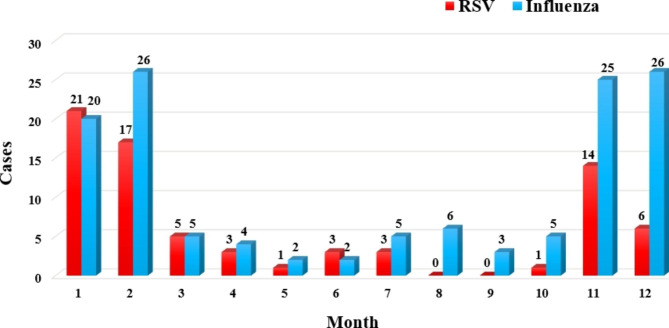
Clinical data from January 2019 to December 2020 were analyzed for 74 patients with RSV and 129 patients with influenza A/B virus lower respiratory tract infections who were admitted to respiratory or intensive care units. All patients had complete clinical data with positive IgM and negative IgG viral antibodies. Comparison parameters included onset timing, baseline data, clinical manifestations, supplementary examination results, treatment methods, and prognosis, while logistic regression was employed to ascertain the correlation of clinical features between the two patient groups.
In comparison to the influenza group, the RSV group presented less frequently with fever at admission but exhibited a higher incidence of dyspnea and wheezing on pulmonary auscultation (P < 0.01). RSV infection was more prevalent among patients with underlying diseases, particularly chronic obstructive pulmonary disease (COPD) and demonstrated a higher probability of co-infections, most notably with Mycoplasma (P < 0.01). The RSV group had significantly higher lymphocyte counts (P < 0.01) and exhibited more incidences of pleural thickening, pulmonary fibrosis, and emphysema (P < 0.05). The use of non-invasive mechanical ventilation was more common, and hospital stays were longer in the RSV group compared to the influenza group (P < 0.05). Logistic multivariate regression analysis further revealed that age and tachypnea incidence were significantly higher in the RSV group (P < 0.05).
Compared to influenza virus infection, adults with COPD are more susceptible to RSV infection. Moreover, RSV infection elevates the risk of co-infection with Mycoplasma and may lead to conditions such as pleural thickening, pulmonary fibrosis, and emphysema. The requirement for non-invasive mechanical ventilation is higher in RSV-infected patients, who also tend to have longer hospital stays. Therefore, greater awareness and preventive strategies against RSV infection are imperative.
与流感病毒感染相比,成人呼吸道合胞病毒(RSV)感染在社会和临床方面的认识和理解都较少。本回顾性研究旨在描绘和比较成人 RSV 和流感 A/B 病毒下呼吸道感染的临床表现,从而提高对 RSV 下呼吸道感染的认识,并为其预防和治疗提供策略性见解。
分析了 2019 年 1 月至 2020 年 12 月期间因 RSV 和流感 A/B 病毒下呼吸道感染而入住呼吸或重症监护病房的 74 例患者和 129 例患者的临床数据。所有患者均具有完整的临床数据,IgM 阳性且 IgG 病毒抗体阴性。比较参数包括发病时间、基线数据、临床表现、补充检查结果、治疗方法和预后,同时采用逻辑回归确定两组患者的临床特征相关性。
与流感组相比,RSV 组入院时发热频率较低,但肺部听诊时呼吸困难和喘息的发生率较高(P<0.01)。RSV 感染更常见于患有基础疾病的患者,尤其是慢性阻塞性肺疾病(COPD),且合并感染的概率更高,尤其是合并支原体感染(P<0.01)。RSV 组的淋巴细胞计数明显更高(P<0.01),且更常出现胸腔增厚、肺纤维化和肺气肿(P<0.05)。与流感组相比,RSV 组更常使用无创机械通气,住院时间也更长(P<0.05)。逻辑多元回归分析进一步显示,RSV 组的年龄和呼吸急促发生率显著更高(P<0.05)。
与流感病毒感染相比,COPD 成人更易感染 RSV。此外,RSV 感染会增加合并支原体感染的风险,并且可能导致胸腔增厚、肺纤维化和肺气肿等情况。RSV 感染患者需要更多的无创机械通气,且住院时间也更长。因此,必须提高对 RSV 感染的认识并采取预防策略。