Janssen Research & Development, Beerse, Belgium.
MnS Modeling and Simulation, Dinant, Belgium.
CPT Pharmacometrics Syst Pharmacol. 2023 Oct;12(10):1485-1498. doi: 10.1002/psp4.13025. Epub 2023 Sep 15.
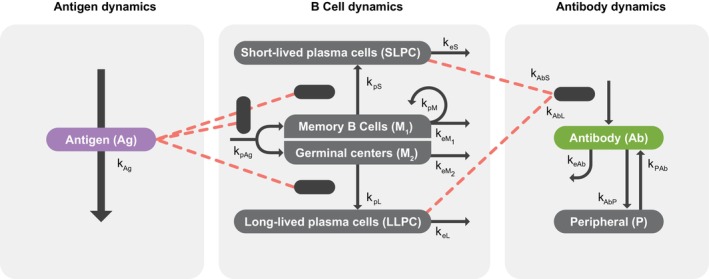
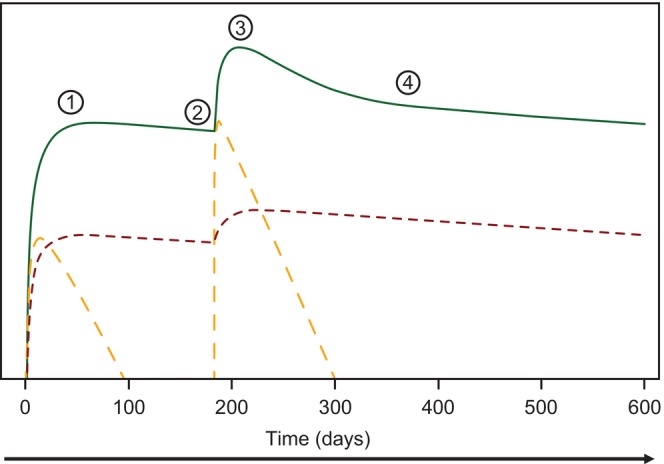
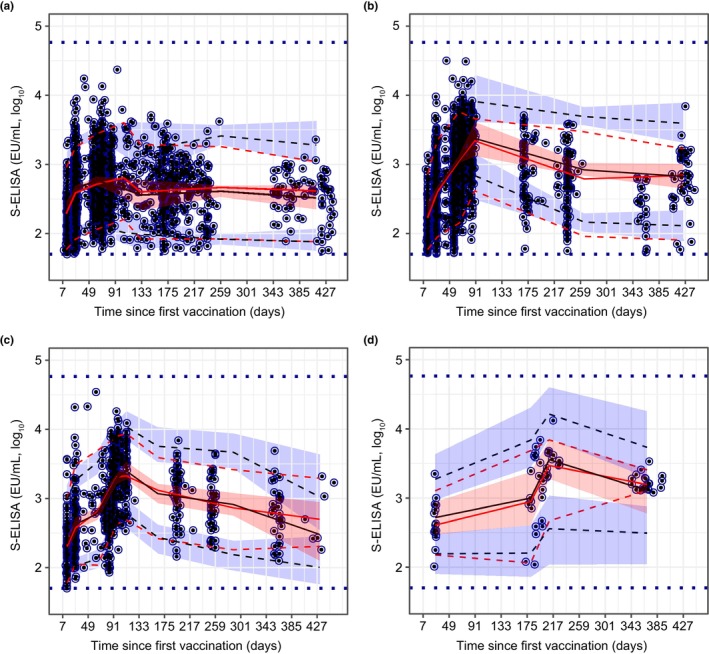
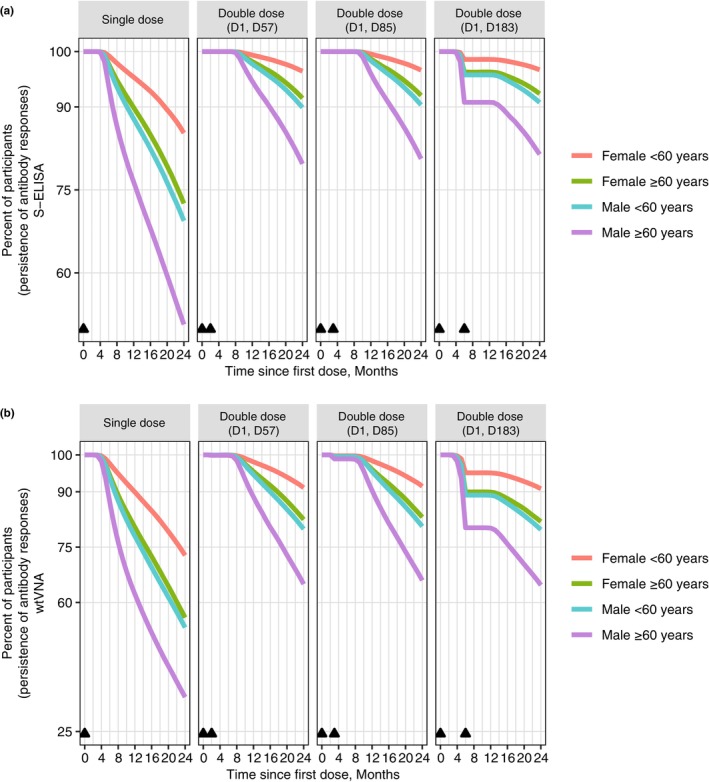
Mechanistic model-based simulations can be deployed to project the persistence of humoral immune response following vaccination. We used this approach to project the antibody persistence through 24 months from the data pooled across five clinical trials in severe acute respiratory syndrome coronavirus-2 (SARS-CoV-2)-seronegative participants following vaccination with Ad26.COV2.S (5 × 10 viral particles), given either as a single-dose or a homologous booster regimen at an interval of 2, 3, or 6 months. Antibody persistence was quantified as the percentage of participants with detectable anti-spike binding and wild-type virus neutralizing antibodies. The projected overall 24-month persistence after single-dose Ad26.COV2.S was 70.5% for binding antibodies and 55.2% for neutralizing antibodies, and increased after any homologous booster regimen to greater than or equal to 89.9% for binding and greater than or equal to 80.0% for neutralizing antibodies. The estimated model parameters quantifying the rates of antibody production attributed to short-lived and long-lived plasma cells decreased with increasing age, whereas the rate of antibody production mediated by long-lived plasma cells was higher in women relative to men. Accordingly, a more pronounced waning of antibody responses was predicted in men aged greater than or equal to 60 years and was markedly attenuated following any homologous boosting regimen. The findings suggest that homologous boosting might be a viable strategy for maintaining protective effects of Ad26.COV2.S for up to 24 months following prime vaccination. The estimation of mechanistic modeling parameters identified the long-lived plasma cell pathway as a key contributor mediating antibody persistence following single-dose and homologous booster vaccination with Ad26.COV2.S in different subgroups of recipients stratified by age and sex.
基于机制模型的模拟可用于预测接种疫苗后体液免疫反应的持久性。我们使用这种方法,根据 5 项在严重急性呼吸综合征冠状病毒 2(SARS-CoV-2)血清阴性参与者中进行的临床试验的数据,对 Ad26.COV2.S(5×10 个病毒颗粒)接种后 24 个月的抗体持久性进行了预测,这些参与者要么接受单剂量接种,要么在 2、3 或 6 个月的间隔内接受同源加强针接种。抗体持久性的量化方法是检测到具有 Spike 结合和野生型病毒中和抗体的参与者百分比。单剂量 Ad26.COV2.S 后的 24 个月总体持久性预计为结合抗体的 70.5%和中和抗体的 55.2%,而任何同源加强针方案后都会增加到结合抗体的大于或等于 89.9%和中和抗体的大于或等于 80.0%。定量归因于短期和长期浆细胞的抗体产生率的估计模型参数随着年龄的增长而降低,而长期浆细胞介导的抗体产生率在女性中高于男性。因此,在年龄大于或等于 60 岁的男性中,预计抗体反应的衰减更为明显,并且在任何同源加强接种方案后,这种衰减都会明显减弱。这些发现表明,同源加强接种可能是一种可行的策略,可在 Ad26.COV2.S 基础免疫接种后长达 24 个月维持其保护作用。机制模型参数的估计确定了长期浆细胞途径是介导单剂量和同源加强接种 Ad26.COV2.S 后抗体持久性的关键因素,这种作用在按年龄和性别分层的不同接受者亚组中均存在。