Faculty of Pharmaceutical Management and Economics, Hanoi University of Pharmacy, 13-15 Le Thanh Tong, Hoan Kiem District, Hanoi City, 111000, Vietnam.
Harm Reduct J. 2023 Sep 16;20(1):136. doi: 10.1186/s12954-023-00872-0.
Opioid relapse, one of the common and severe problems during methadone maintenance treatment, can give rise to poor treatment outcomes. This study measured the opioid relapse rate and its associated factors among methadone maintenance patients in Vietnam.
Information about the demographic characteristics and social support of 655 patients was collected through direct interviews. Medical records were used to gather data on treatment characteristics. Relapse was determined via urine opioid test results.
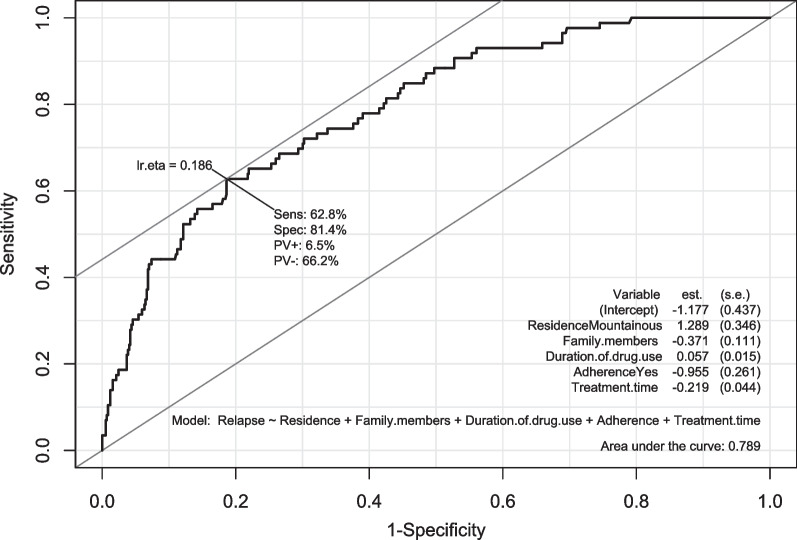
The overall relapse rate of patients during treatment was 13.1%. According to the multivariate logistic regression model, living in mountainous areas (adjusted odds ratio (aOR) = 3.63, 95% CI 1.90-7.46) and long duration of drug use in the past (aOR = 1.06, 95% CI 1.03-1.09) were associated with an increase in the odds of opioid relapse. By contrast, living with many family members (aOR = 0.69, 95% CI 0.55-0.85), having longer treatment time (aOR = 0.80, 95% CI 0.73-0.87), and completely adhering to treatment (aOR = 0.38, 95% CI 0.23-0.64) were protective for opioid relapse. As per the univariate analyses, the odds of opioid relapse declined by 25% for each increase of one close friend or relative (OR = 0.75, 95% CI 0.66-0.86). Regarding social support (range score: 0-100), each additional increase of one score was associated with a 1% decrease in the odds of opioid relapse (OR = 0.99, 95% CI 0.98-0.99). Patient sex, education level, occupation type, patient's monthly income, family's monthly income, the number of previous treatments, daily methadone dose, comorbidity, and received antiretroviral therapy were not associated with opioid relapse among patients (p > 0.05).
Residence, the role of family and social support, and treatment adherence should be paid more attention to guarantee and enhance the success of methadone maintenance treatment.
阿片类药物复吸是美沙酮维持治疗中常见且严重的问题之一,可导致治疗效果不佳。本研究旨在评估越南美沙酮维持治疗患者的阿片类药物复吸率及其相关因素。
通过直接访谈收集 655 名患者的人口统计学特征和社会支持信息,使用病历收集治疗特征数据。通过尿液阿片类药物检测结果确定复吸情况。
治疗期间患者的总体复吸率为 13.1%。多因素逻辑回归模型显示,居住在山区(调整后的优势比(aOR)=3.63,95%CI 1.90-7.46)和过去吸毒时间较长(aOR=1.06,95%CI 1.03-1.09)与阿片类药物复吸的几率增加相关。相反,与较多家庭成员同住(aOR=0.69,95%CI 0.55-0.85)、治疗时间较长(aOR=0.80,95%CI 0.73-0.87)和完全遵医嘱治疗(aOR=0.38,95%CI 0.23-0.64)与阿片类药物复吸呈负相关。根据单因素分析,每个亲密朋友或亲戚的增加可使阿片类药物复吸的几率降低 25%(OR=0.75,95%CI 0.66-0.86)。对于社会支持(范围评分:0-100),每增加一个评分与阿片类药物复吸几率降低 1%相关(OR=0.99,95%CI 0.98-0.99)。患者性别、教育程度、职业类型、患者月收入、家庭月收入、既往治疗次数、每日美沙酮剂量、合并症和接受抗逆转录病毒治疗与患者的阿片类药物复吸无关(p>0.05)。
应更加关注居住地、家庭和社会支持的作用以及治疗依从性,以保证和提高美沙酮维持治疗的成功率。