Zhang Mengyu, Wu Tingting, Tan Niandi, Chen Songfeng, Zhuang Qianjun, Luo Yu, Xiao Yinglian
Department of Gastroenterology, The First Affiliated Hospital of Sun Yat-sen University, Guangzhou, Guangdong, P. R. China.
Gastroenterol Rep (Oxf). 2023 Sep 13;11:goad053. doi: 10.1093/gastro/goad053. eCollection 2023.
Gastroesophageal reflux disease (GERD) is heterogeneous with a varied symptom spectrum and reflux profiles. Its definite diagnosis often requires invasive tools including endoscopy or reflux monitoring. The aim of this study was to investigate the clinical relevance of salivary pepsin detection as a non-invasive screening tool to diagnose GERD of different subtypes.
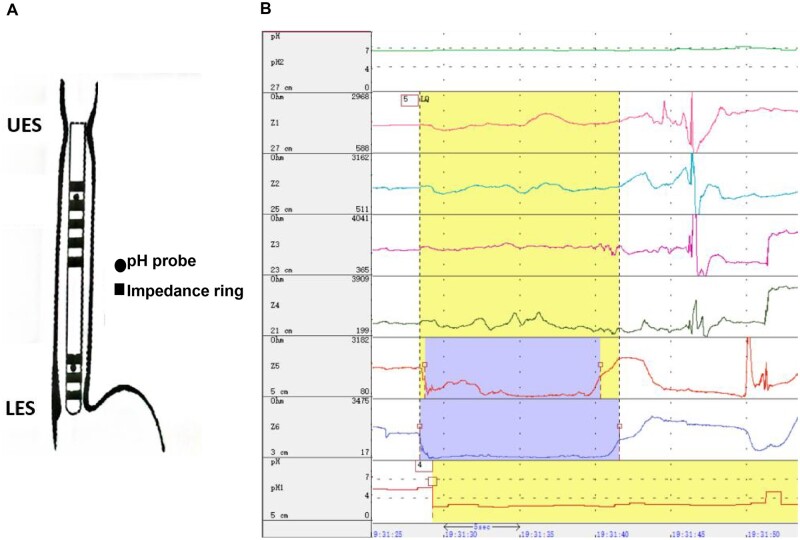
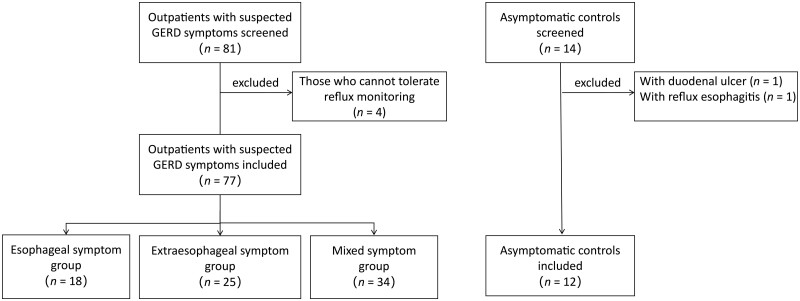
A total of 77 patients with suspected GERD symptoms and 12 asymptomatic controls were analysed. All participants performed symptom evaluation, upper endoscopy, esophageal manometry, and 24-hour multichannel intraluminal impedance-dual pH probe monitoring. Saliva was self-collected across three different time points: at early fasting, postprandially, and at symptom occurrence. Salivary pepsin levels were measured via Peptest. The optimal threshold of salivary pepsin for diagnosing distal or proximal reflux was determined according to a receiver-operating characteristic curve.
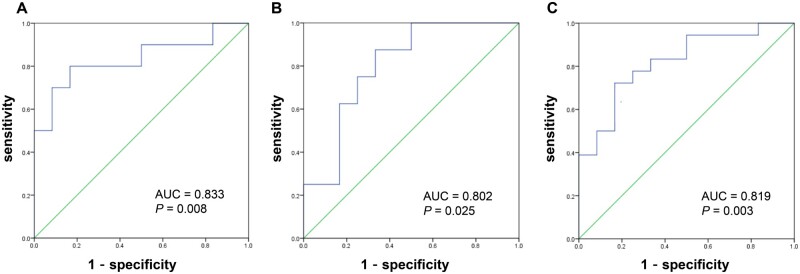
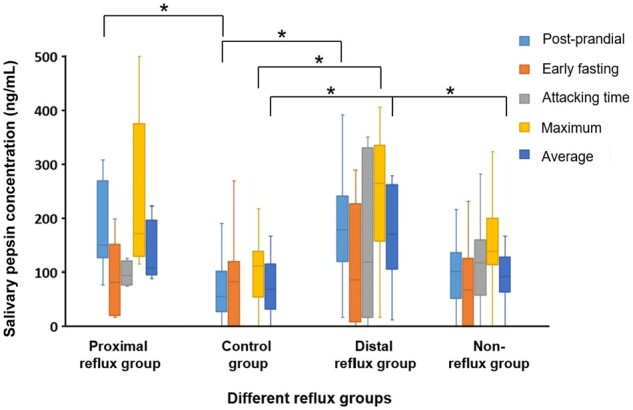
The average salivary pepsin concentration of suspected GERD patients was significantly higher than that of controls (100.63 [68.46, 141.38] vs 67.90 [31.60, 115.06] ng/mL, =0.044), although no difference was found among patients with different symptom spectrums. The distal reflux group had a higher average pepsin concentration than non-reflux patients (170.54 [106.31, 262.76] vs 91.13 [63.35, 127.63] ng/mL, =0.043), while no difference was observed between the distal reflux group and the proximal reflux group. The optimal cut-off value of salivary pepsin concentration for diagnosing pathological distal reflux was 157.10 ng/mL, which was higher than that for diagnosing pathological proximal reflux (122.65 ng/mL). The salivary pepsin concentration was significantly correlated with distal and proximal reflux parameters.
Salivary pepsin measurement can help in identifying true GERD with pathological distal reflux or proximal reflux, regardless of different symptom spectrums. A higher threshold should be applied for diagnosing distal reflux than for proximal reflux.
胃食管反流病(GERD)具有异质性,症状谱和反流特征各不相同。其明确诊断通常需要借助包括内镜检查或反流监测在内的侵入性手段。本研究的目的是探讨唾液胃蛋白酶检测作为一种非侵入性筛查工具对不同亚型GERD进行诊断的临床相关性。
对77例有GERD疑似症状的患者和12例无症状对照者进行分析。所有参与者均进行了症状评估、上消化道内镜检查、食管测压以及24小时多通道腔内阻抗-双pH探头监测。在三个不同时间点自行采集唾液:空腹早期、餐后以及症状发作时。通过Peptest检测唾液胃蛋白酶水平。根据受试者工作特征曲线确定诊断远端或近端反流的唾液胃蛋白酶最佳阈值。
尽管不同症状谱的患者之间未发现差异,但GERD疑似患者的唾液胃蛋白酶平均浓度显著高于对照组(100.63[68.46,141.38]对67.90[31.60,115.06]ng/mL,P = 0.044)。远端反流组的平均胃蛋白酶浓度高于无反流患者(170.54[106.31,262.76]对91.13[63.35,127.63]ng/mL,P = 0.043),而远端反流组与近端反流组之间未观察到差异。诊断病理性远端反流的唾液胃蛋白酶浓度最佳截断值为157.10 ng/mL,高于诊断病理性近端反流的截断值(122.65 ng/mL)。唾液胃蛋白酶浓度与远端和近端反流参数显著相关。
唾液胃蛋白酶检测有助于识别伴有病理性远端反流或近端反流的真正GERD,无论症状谱如何。诊断远端反流时应采用比近端反流更高的阈值。