O'Connor Laura M, Quinn Alesha, Denley Samuel, Leigh Lucy, Martin Jarad, Dowling Jason A, Skehan Kate, Warren-Forward Helen, Greer Peter B
Department of Radiation Oncology, Calvary Mater Hospital, Edith Street, Waratah, Newcastle, NSW 2298, Australia.
School of Health Sciences, University of Newcastle, University Drive, Newcastle, NSW 2308, Australia.
Phys Imaging Radiat Oncol. 2023 Jul 8;27:100472. doi: 10.1016/j.phro.2023.100472. eCollection 2023 Jul.
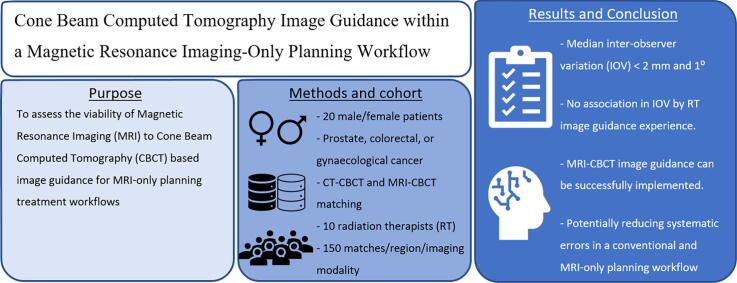
Magnetic Resonance Imaging (MRI)-only planning workflows offer many advantages but raises challenges regarding image guidance. The study aimed to assess the viability of MRI to Cone Beam Computed Tomography (CBCT) based image guidance for MRI-only planning treatment workflows.
An MRI matching training package was developed. Ten radiation therapists, with a range of clinical image guidance experience and experience with MRI, completed the training package prior to matching assessment. The matching assessment was performed on four match regions: prostate gold seed, prostate soft tissue, rectum/anal canal and gynaecological. Each match region consisted of five patients, with three CBCTs per patient, resulting in fifteen CBCTs for each match region. The ten radiation therapists performed the CBCT image matching to CT and to MRI for all regions and recorded the match values.
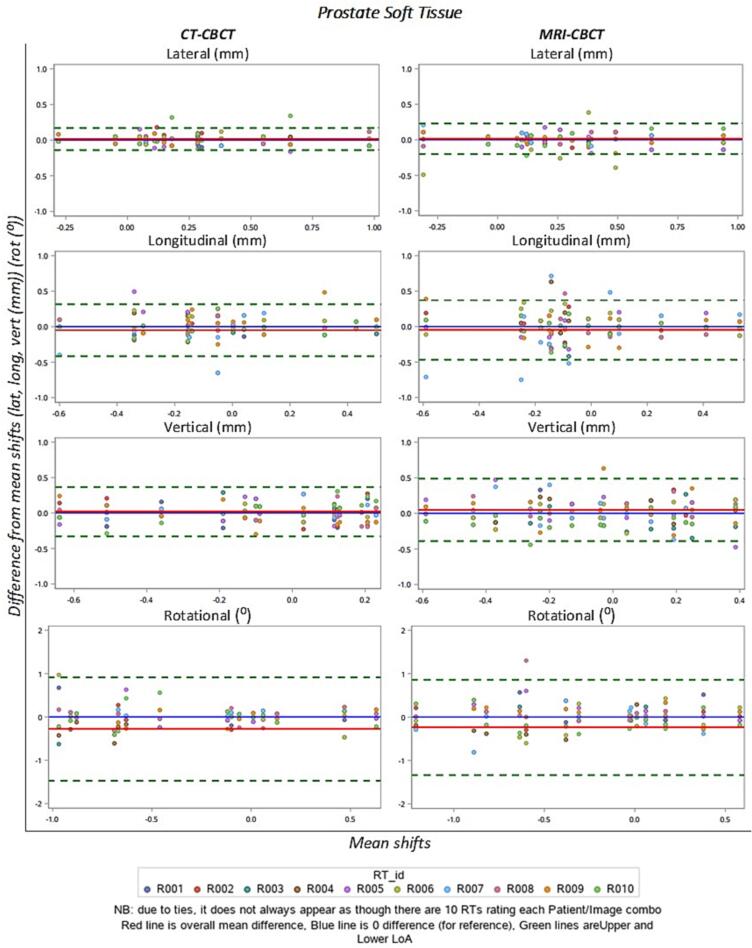
The median inter-observer variation for MRI-CBCT matching and CT-CBCT matching for all regions were within 2 mm and 1 degree. There was no statistically significant association in the inter-observer variation in mean match values and radiation therapist image guidance experience levels. There was no statistically significant association in inter-observer variation in mean match values for MRI experience levels for prostate soft tissue and gynaecological match regions, while there was a statistically significant difference for prostate gold seed and rectum match regions.
The results of this study support the concept that with focussed training, an MRI to CBCT image guidance approach can be successfully implemented in a clinical planning workflow.
仅使用磁共振成像(MRI)的治疗计划流程具有诸多优势,但在图像引导方面存在挑战。本研究旨在评估基于MRI到锥形束计算机断层扫描(CBCT)的图像引导在仅使用MRI的治疗计划流程中的可行性。
开发了一个MRI匹配训练包。十名放射治疗师,他们具有一系列临床图像引导经验和MRI经验,在进行匹配评估之前完成了该训练包。匹配评估在四个匹配区域进行:前列腺金标、前列腺软组织、直肠/肛管和妇科。每个匹配区域包括五名患者,每名患者有三张CBCT图像,因此每个匹配区域有十五张CBCT图像。十名放射治疗师对所有区域的CBCT图像与CT以及与MRI进行匹配,并记录匹配值。
所有区域的MRI - CBCT匹配和CT - CBCT匹配的观察者间变异中位数在2毫米和1度以内。平均匹配值的观察者间变异与放射治疗师的图像引导经验水平之间无统计学显著关联。前列腺软组织和妇科匹配区域的平均匹配值的观察者间变异与MRI经验水平之间无统计学显著关联,而前列腺金标和直肠匹配区域则有统计学显著差异。
本研究结果支持这样一种观点,即通过有针对性的训练,MRI到CBCT的图像引导方法可以在临床治疗计划流程中成功实施。