Takasaki Teruaki, Obana Reo, Fujiwara Daiki, Tomimoto Naofumi, Khandakar Golam Iftakhar, Satoh Ryosuke, Sugiura Reiko
Faculty of Pharmacy, Kindai University, Higashiosaka, Osaka, Japan.
MicroPubl Biol. 2023 Aug 31;2023. doi: 10.17912/micropub.biology.000711. eCollection 2023.
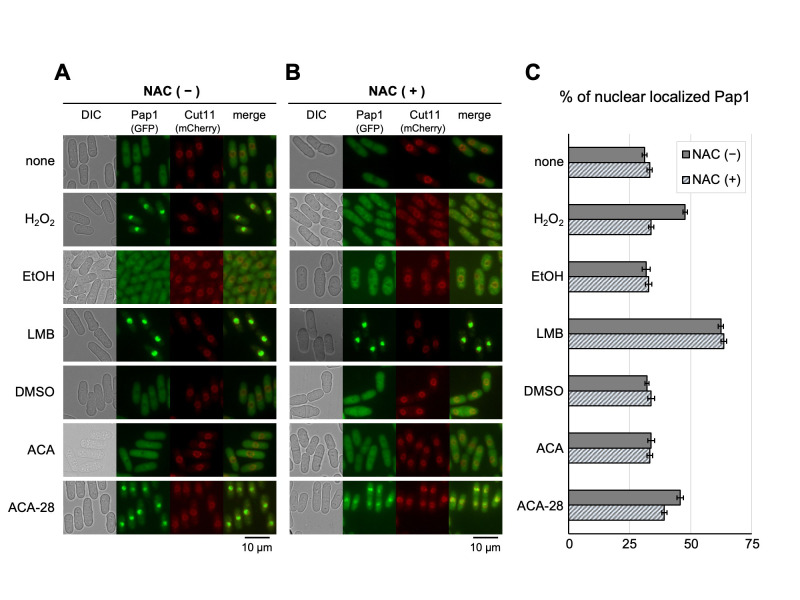
The nucleocytoplasmic transport of proteins is an important mechanism to control cell fate. Pap1 is a fission yeast nucleocytoplasmic shuttling transcription factor of which localization is redox regulated. The nuclear export factor Crm1/exportin negatively regulates Pap1 by exporting it from the nucleus to the cytoplasm. Here, we describe the effect of an anti-cancer compound ACA-28, an improved derivative of 1'-acetoxychavicol acetate (ACA), on the subcellular distribution of Pap1. ACA-28 induced nuclear accumulation of Pap1 more strongly than did ACA. ROS inhibitor N-acetyl-L-cysteine (NAC) partly antagonized the Pap1 nuclear accumulation induced by ACA-28. NAC almost abolished Pap1 nuclear localization upon H O , whereas leptomycin B (LMB)-mediated inhibition of Pap1 nuclear export was resistant to NAC. Collectively, ACA-28-mediated apoptosis in cancer cells may involve ROS-dependent and -independent mechanisms.
蛋白质的核质运输是控制细胞命运的重要机制。Pap1是一种裂殖酵母核质穿梭转录因子,其定位受氧化还原调节。核输出因子Crm1/输出蛋白通过将Pap1从细胞核输出到细胞质来对其进行负调控。在此,我们描述了抗癌化合物ACA-28(1'-乙酰氧基胡椒酚乙酸酯(ACA)的改良衍生物)对Pap1亚细胞分布的影响。ACA-28比ACA更强烈地诱导Pap1的核积累。活性氧抑制剂N-乙酰-L-半胱氨酸(NAC)部分拮抗了ACA-28诱导的Pap1核积累。在过氧化氢作用下,NAC几乎消除了Pap1的核定位,而雷帕霉素B(LMB)介导的对Pap1核输出的抑制对NAC具有抗性。总体而言,ACA-28介导的癌细胞凋亡可能涉及活性氧依赖性和非依赖性机制。