Alamdaran Seyed Ali, Bagheri Raha, Darvari Seyedeh Fatemeh, Bakhtiari Elham, Ghasemi Ali
Department of Radiology, Mashhad University of Medical Sciences Faculty of Medicine, Mashhad, Iran.
Research Center for Patient Safety, Mashhad University of Medical Sciences Faculty of Medicine, Mashhad, Iran.
Thorac Res Pract. 2023 Nov;24(6):292-297. doi: 10.5152/ThoracResPract.2023.23013.
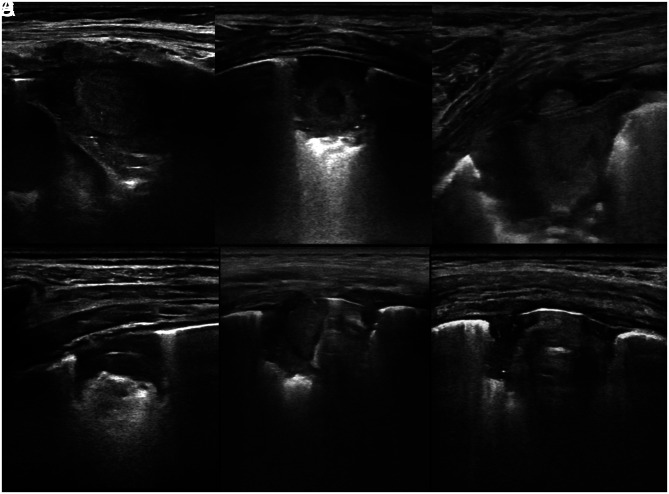
The importance of ultrasound in diagnosing pulmonary invasive fungal diseases (IFD) has yet to be assessed. Thus, this study aimed to evaluate the frequency of sonographic findings in patients suspected of an invasive pulmonary fungal infection.
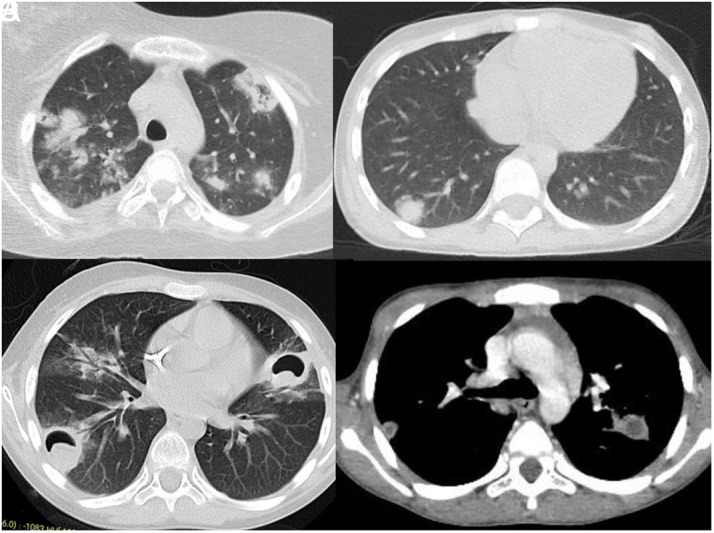
This prospective longitudinal study examined all patients with lung lesions in imaging modalities and suspected IFDs referred to Dr. Sheikh and Akbar pediatric hospitals from 2019 to 2022. Considered variables were the halo sign in the computed tomography (CT) scan; the target sign in the ultrasound and contrast-enhanced CT scan; the cavity; wedge-shaped consoli- dation; and pleuritis and extrapulmonary invasion to the chest wall or subdiaphragmatic invasion in both modalities. All patients who underwent lung CT scans and ultrasounds until the final diagnosis were followed up. The degree of agreement between ultrasound and CT scan findings and the sensitivity, specificity, and diagnostic accuracy of these signs were assessed.
This study involved 40 patients with an average age of 7.16 ± 4.23 years. Acute leukemia was the commonest underlying dis- ease detected in 17 (42.5%) cases. The target sign in ultrasound (61.9%) and the halo sign in CT scan (71.4%) had the highest frequency among the variables in patients with IFD. Cohen's kappa coefficient agreement in both modalities was 0.5 for the cavity, with significant relation (P = .02). The Cohen's kappa was less than .17 for other findings (P > .05). The diagnostic criteria in the simultaneous examina- tion of the fungus target in ultrasound and halo in CT scan showed a sensitivity of 82.4% and specificity of 76.5%, respectively.
Combining the characteristic findings of ultrasound and CT-scan provides a higher value in diagnosing pulmonary invasive fungal disease.
超声在诊断肺部侵袭性真菌病(IFD)中的重要性尚未得到评估。因此,本研究旨在评估疑似侵袭性肺部真菌感染患者的超声检查结果出现的频率。
这项前瞻性纵向研究检查了2019年至2022年转诊至谢赫儿童医院和阿克巴尔儿童医院的所有肺部有病变且疑似IFD的患者,这些患者均接受了影像学检查。纳入研究的变量包括计算机断层扫描(CT)中的晕征;超声和增强CT扫描中的靶征;空洞;楔形实变;以及两种检查方式下的胸膜炎和胸壁肺外侵犯或膈下侵犯。对所有接受肺部CT扫描和超声检查直至最终确诊的患者进行随访。评估超声与CT扫描结果之间的一致性程度以及这些征象的敏感性、特异性和诊断准确性。
本研究共纳入40例患者,平均年龄为7.16±4.23岁。在17例(42.5%)病例中检测到最常见的基础疾病为急性白血病。在IFD患者中,超声中的靶征(61.9%)和CT扫描中的晕征(71.4%)在各变量中出现频率最高。两种检查方式下空洞的Cohen's kappa系数一致性为0.5,具有显著相关性(P = 0.02)。其他检查结果的Cohen's kappa系数小于0.17(P > 0.05)。超声真菌靶征和CT扫描晕征同时检查的诊断标准显示,敏感性分别为82.4%,特异性为76.5%。
超声和CT扫描的特征性表现相结合在诊断肺部侵袭性真菌病方面具有更高的价值。