State Key Laboratory of Ophthalmology, Zhongshan Ophthalmic Center, Sun Yat-sen University, Guangdong Provincial Key Laboratory of Ophthalmology and Visual Science, Guangdong Provincial Clinical Research Center for Ocular Diseases, Guangzhou, Guangdong, China.
School Health Unit, Guangzhou Center for Disease Control and Prevention, Guangzhou, China.
JAMA Pediatr. 2023 Nov 1;177(11):1141-1148. doi: 10.1001/jamapediatrics.2023.3615.
The beneficial effects of increasing outdoor physical activity time on children's myopia onset and physical well-being are widely acknowledged. However, in countries with competitive educational systems, such as China, parents and school administrators may be relatively reluctant to increase the extracurricular physical activity time for children due to concerns that this action will compromise children's academic performance.
To investigate whether additional extracurricular physical activity time after school compromises the academic performance of schoolchildren.
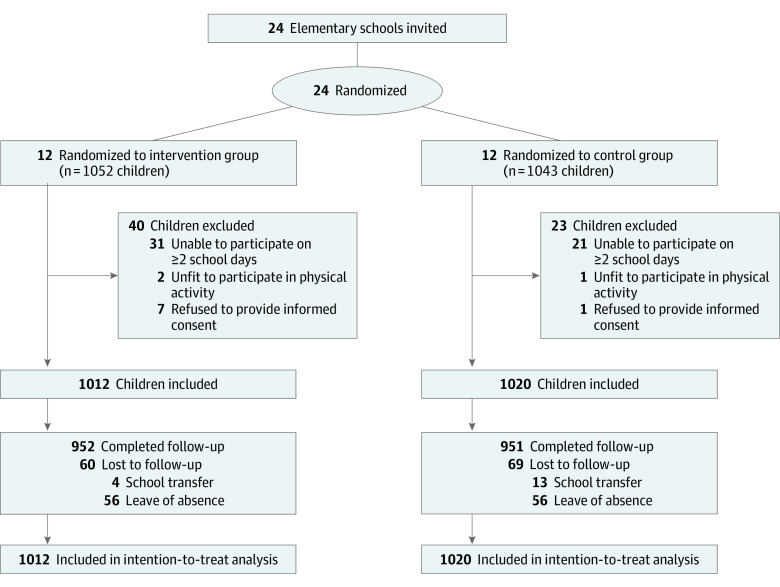
DESIGN, SETTING, AND PARTICIPANTS: This cluster randomized clinical trial was conducted from October 2020 to June 2021 in Yudu, Jiangxi, China. Eligible children in grades 3 and 4 from 24 elementary schools were randomized to the intervention or control group. Primary analysis was conducted in the full sample using the intention-to-treat principle.
The intervention group received 2 hours of after-school physical activity time outdoors on school days. The control group was free to arrange their after-school activity.
The primary outcome was the between-group mean difference in mathematics test scores at the end of 1 academic year, with a noninferiority margin of -3.3 points. Standardized mathematics tests, physical fitness assessments (in reference to the 2018 National Physical Fitness Survey Monitoring Programme in China), and cycloplegic autorefraction were performed at baseline and the end of 1 academic year. Myopia was defined as a cycloplegic spherical equivalent refraction of -0.5 diopters or less in either eye.
A total of 2032 children (mean [SD] age, 9.22 [0.62] years; 1040 girls [51.2%]) from 24 schools were randomized to the intervention group (12 schools; 1012 children) or control group (12 schools; 1020 children). The mean (SD) mathematics score at the end of 1 academic year was 78.01 (17.56) points in the intervention group and 77.70 (17.29) points in the control group. The adjusted between-group mean difference was 0.65 points (95% CI, -2.85 to 4.15). The adjusted between-group mean difference in physical fitness score was 4.95 points (95% CI, 3.56-6.34; P < .001) and -1.90% (95% CI, -18.72% to 14.91%; P > .99) in myopia incidence.
Results of this trial indicate that, compared with the control practice of free play after school, adding 2 hours of extracurricular physical activity outdoors after school was noninferior in academic performance and had superior efficacy in improving physical fitness.
ClinicalTrials.gov Identifier: NCT04587765.
增加户外活动时间对儿童近视发生和身体健康的有益影响已得到广泛认可。然而,在中国这样的竞争教育体系国家,家长和学校管理者可能相对不愿意增加儿童的课外体育活动时间,因为担心这会影响孩子的学习成绩。
研究放学后额外的课外体育活动时间是否会影响学童的学业成绩。
设计、地点和参与者:这是一项 2020 年 10 月至 2021 年 6 月在中国江西于都进行的整群随机临床试验。来自 24 所小学 3 年级和 4 年级的合格儿童被随机分配到干预组或对照组。主要分析采用意向治疗原则在全样本中进行。
干预组在上学日接受 2 小时的户外活动时间。对照组可以自由安排他们的课外活动。
主要结局是 1 学年结束时两组间数学考试成绩的平均差异,非劣效性边界为 -3.3 分。基线和 1 学年结束时进行了标准化数学测试、体能评估(参照中国 2018 年国家体能调查监测计划)和睫状肌散瞳自动折射。近视定义为双眼散瞳等效球镜屈光度在-0.5 屈光度或以下。
共有 2032 名儿童(平均[标准差]年龄为 9.22[0.62]岁;1040 名女孩[51.2%])来自 24 所学校,被随机分为干预组(12 所学校;1012 名儿童)或对照组(12 所学校;1020 名儿童)。1 学年结束时的平均(SD)数学成绩为干预组 78.01(17.56)分,对照组 77.70(17.29)分。调整后的组间平均差异为 0.65 分(95%CI,-2.85 至 4.15)。体能得分的调整后组间平均差异为 4.95 分(95%CI,3.56-6.34;P<0.001)和近视发生率降低 1.90%(95%CI,-18.72%至 14.91%;P>0.99)。
本试验结果表明,与放学后自由玩耍的对照实践相比,放学后增加 2 小时的课外户外活动在学业成绩方面非劣效,在提高身体素质方面效果更优。
ClinicalTrials.gov 标识符:NCT04587765。