Bittencourt Juliana Valentim, Leivas Eduardo Gallas, de Sá Ferreira Arthur, Nogueira Leandro Alberto Calazans
Rehabilitation Science Postgraduate Program at Augusto Motta University Centre (UNISUAM), Avenida Paris, 84, Bonsucesso, CEP, Rio de Janeiro, 21041-020, RJ, Brasil.
Physiotherapy Department at Federal Institute of Rio de Janeiro (IFRJ), Rio de Janeiro, Brazil.
Arch Physiother. 2023 Sep 18;13(1):17. doi: 10.1186/s40945-023-00171-8.
People with neuropathic-like symptoms had more unfavourable pain features than people with nociceptive. Moreover, deficient conditioned pain modulation is common in people with neuropathic-like symptoms. PainDETECT questionnaire have been used to assess the central sensitisation sign and symptoms. However, whether the painDETECT questionnaire can identify the conditioned pain modulation's impairment is still unknown. Therefore, the current study aimed to evaluate the diagnostic accuracy of the painDETECT questionnaire in detecting the impairment of conditioned pain modulation in people with musculoskeletal pain.
We conducted a diagnostic accuracy comparing the painDETECT questionnaire (index method) with the cold pressor test, the psychophysical test used to assess the conditioned pain modulation (reference standard). We determined diagnostic accuracy by calculating sensitivity, specificity, predictive values, and likely hood ratios.
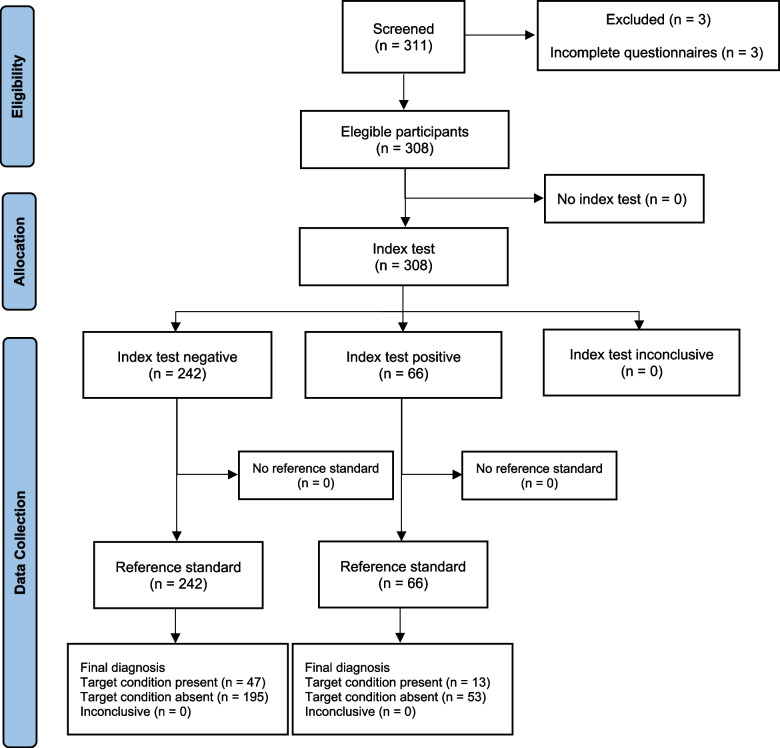
We retrospectively enrolled 308 people with musculoskeletal pain in outpatient departments. Most participants were female (n 20 = 220, 71.4%) and had a mean age of 52.2 (± 15.0) years. One hundred seventy-three (56.1%) participants were classified as nociceptive pain, 69 (22.4%) as unclear, and 66 (21.4%) as neuropathic-like symptoms. According to the cold pressor test, 60 (19.4%) participants presented impairment of conditioned pain modulation. The cutoff point of 12 of the painDETECT questionnaire showed values of diagnostic accuracy below 70% compared to the cold pressor test, except for a negative predictive value [76.9 95% Confidence Interval (CI) 71.7 to 81.5]. The cutoff point 19 showed high specificity (78.6%, 95% CI 73.0 to 83.5), high negative predictive value (80.5%, 95% CI 78.1 to 82.7), and accuracy of 67.5% compared to the cold pressor test.
The painDETECT questionnaire seems valuable for ruling out people with musculoskeletal pain and impairment of conditioned pain modulation.
与伤害性疼痛患者相比,患有类神经病理性症状的患者具有更不利的疼痛特征。此外,在患有类神经病理性症状的患者中,条件性疼痛调制缺陷很常见。疼痛检测问卷已被用于评估中枢敏化的体征和症状。然而,疼痛检测问卷是否能够识别条件性疼痛调制的损害仍不清楚。因此,本研究旨在评估疼痛检测问卷在检测肌肉骨骼疼痛患者条件性疼痛调制损害方面的诊断准确性。
我们进行了一项诊断准确性研究,将疼痛检测问卷(指数法)与冷加压试验(用于评估条件性疼痛调制的心理物理学测试,作为参考标准)进行比较。我们通过计算敏感性、特异性、预测值和似然比来确定诊断准确性。
我们回顾性纳入了308名门诊肌肉骨骼疼痛患者。大多数参与者为女性(n = 220,71.4%),平均年龄为52.2(±15.0)岁。173名(56.1%)参与者被归类为伤害性疼痛,69名(22.4%)为不明类型,66名(21.4%)为类神经病理性症状。根据冷加压试验,60名(19.4%)参与者存在条件性疼痛调制损害。与冷加压试验相比,疼痛检测问卷的临界值为12时,除阴性预测值[76.9,95%置信区间(CI)71.7至81.5]外,诊断准确性值低于70%。临界值19显示出高特异性(78.6%,95% CI 73.0至83.5)、高阴性预测值(80.5%,95% CI 78.1至82.7),与冷加压试验相比准确性为67.5%。
疼痛检测问卷对于排除肌肉骨骼疼痛且存在条件性疼痛调制损害的患者似乎有价值。