
对29株新分离的噬菌体作为针对临床标本中产生IMP-6的细菌的潜在治疗剂的特性进行研究。
Characterization of 29 newly isolated bacteriophages as a potential therapeutic agent against IMP-6-producing from clinical specimens.
作者信息
Kondo Kohei, Nakano Satoshi, Hisatsune Junzo, Sugawara Yo, Kataoka Michiyo, Kayama Shizuo, Sugai Motoyuki, Kawano Mitsuoki
机构信息
Antimicrobial Resistance Research Center, National Institute of Infectious Diseases , Higashimurayama, Tokyo, Japan.
Department of Pathology, National Institute of Infectious Diseases , Toyama, Shinjuku-ku, Tokyo, Japan.
出版信息
Microbiol Spectr. 2023 Sep 19;11(5):e0476122. doi: 10.1128/spectrum.04761-22.
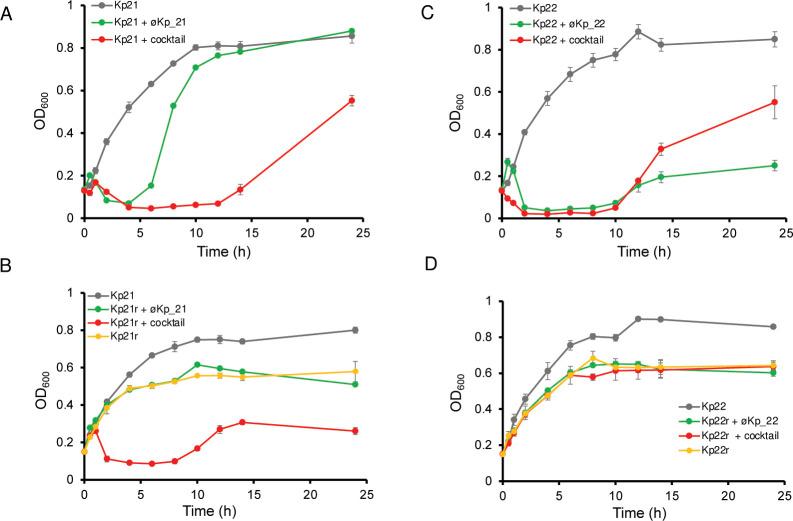
Carbapenemase-producing (CPE) are one of the most detrimental species of antibiotic-resistant bacteria globally. Phage therapy has emerged as an effective strategy for the treatment of CPE infections. In western Japan, the rise of strains harboring the pKPI-6 plasmid encoding is of increasing concern. To address this challenge, we isolated 29 phages from Japanese sewage, specifically targeting 31 . strains and one strain harboring the pKPI-6 plasmid. Electron microscopy analysis revealed that among the 29 isolated phages, 21 (72.4%), 5 (17.2%), and 3 (10.3%) phages belonged to myovirus, siphovirus, and podovirus morphotypes, respectively. Host range analysis showed that 18 strains within the isolated phages infected 25-26 . strains, indicating that most of the isolated phages have a broad host range. Notably, strain Kp21 was exclusively susceptible to phage øKp_21, whereas Kp22 exhibited susceptibility to over 20 phages. Upon administering a phage cocktail composed of 10 phages, we observed delayed emergence of phage-resistant bacteria in Kp21 but not in Kp22. Intriguingly, phage-resistant Kp21 exhibited heightened sensitivity to other bacteriophages, indicating a "trade-off" for resistance to phage øKp_21. Our proposed phage set has an adequate number of phages to combat the strain prevalent in Japan, underscoring the potential of a well-designed phage cocktail in mitigating the occurrence of phage-resistant bacteria. IMPORTANCE The emergence of harboring the plasmid poses an escalating threat in Japan. In this study, we found 29 newly isolated bacteriophages that infect strains carrying the pKPI-6 plasmid from clinical settings in western Japan. Our phages exhibited a broad host range. We applied a phage cocktail treatment composed of 10 phages against two host strains, Kp21 and Kp22, which displayed varying phage susceptibility patterns. Although the phage cocktail delayed the emergence of phage-resistant Kp21, it was unable to hinder the emergence of phage-resistant Kp22. Moreover, the phage-resistant Kp21 became sensitive to other phages that were originally non-infective to the wild-type Kp21 strains. Our study highlights the potential of a well-tailored phage cocktail in reducing the occurrence of phage-resistant bacteria.
产碳青霉烯酶(CPE)细菌是全球范围内对抗生素耐药性最强的有害细菌之一。噬菌体疗法已成为治疗CPE感染的有效策略。在日本西部,携带编码pKPI - 6质粒的菌株不断增加,这一情况日益受到关注。为应对这一挑战,我们从日本污水中分离出29种噬菌体,专门针对31株肺炎克雷伯菌菌株以及1株携带pKPI - 6质粒的菌株。电子显微镜分析显示,在分离出的29种噬菌体中,分别有21种(72.4%)、5种(17.2%)和3种(10.3%)噬菌体属于肌尾噬菌体、长尾噬菌体和短尾噬菌体形态类型。宿主范围分析表明,分离出的噬菌体中有18株感染了25 - 26株肺炎克雷伯菌菌株,这表明大多数分离出的噬菌体具有广泛的宿主范围。值得注意的是,肺炎克雷伯菌菌株Kp21仅对噬菌体øKp_21敏感,而Kp22对20多种噬菌体敏感。在使用由10种噬菌体组成的噬菌体鸡尾酒进行治疗后,我们观察到Kp21中噬菌体抗性细菌的出现有所延迟,但Kp22中没有。有趣的是,对噬菌体øKp_21产生抗性的Kp21对其他噬菌体表现出更高的敏感性,这表明对噬菌体øKp_21的抗性存在“权衡”。我们提出的噬菌体组合有足够数量的噬菌体来对抗日本流行的肺炎克雷伯菌菌株,这凸显了精心设计的噬菌体鸡尾酒在减少噬菌体抗性细菌出现方面的潜力。重要性:携带pKPI - 6质粒的肺炎克雷伯菌在日本构成的威胁日益升级。在本研究中,我们从日本西部临床环境中发现了29种新分离的噬菌体,它们可感染携带pKPI - 6质粒的肺炎克雷伯菌菌株。我们的噬菌体表现出广泛的宿主范围。我们针对两种宿主菌株Kp21和Kp22应用了由10种噬菌体组成的噬菌体鸡尾酒治疗,这两种菌株表现出不同的噬菌体敏感性模式。尽管噬菌体鸡尾酒延迟了Kp21中噬菌体抗性细菌的出现,但未能阻止Kp22中噬菌体抗性细菌的出现。此外,对噬菌体产生抗性的Kp21对原本对野生型Kp21菌株无感染性的其他噬菌体变得敏感。我们的研究突出了精心定制的噬菌体鸡尾酒在减少噬菌体抗性细菌出现方面的潜力。



 Zotero 插件