National Key Laboratory of Agricultural Microbiology, Hubei Hongshan Laboratory, Frontiers Science Center for Animal Breeding and Sustainable Production, College of Animal Sciences and Technology, Huazhong Agricultural University, Wuhan, Hubei, 430070, China.
College of Animal Sciences, Fujian Agriculture and Forestry University, Fuzhou, Fujian, 350002, China.
Microbiome. 2024 Jun 5;12(1):102. doi: 10.1186/s40168-024-01818-9.
Mammalian intestine harbors a mass of phages that play important roles in maintaining gut microbial ecosystem and host health. Pig has become a common model for biomedical research and provides a large amount of meat for human consumption. However, the knowledge of gut phages in pigs is still limited.
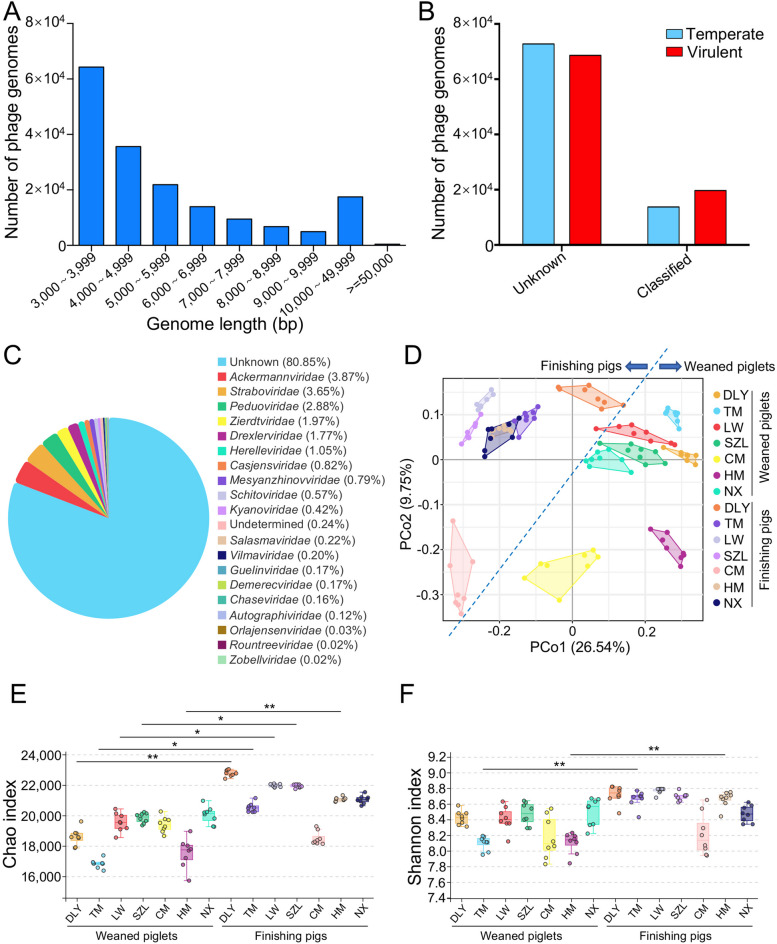
Here, we investigated the gut phageome in 112 pigs from seven pig breeds using PhaBOX strategy based on the metagenomic data. A total of 174,897 non-redundant gut phage genomes were assembled from 112 metagenomes. A total of 33,487 gut phage genomes were classified and these phages mainly belonged to phage families such as Ackermannviridae, Straboviridae, Peduoviridae, Zierdtviridae, Drexlerviridae, and Herelleviridae. The gut phages in seven pig breeds exhibited distinct communities and the gut phage communities changed with the age of pig. These gut phages were predicted to infect a broad range of 212 genera of prokaryotes, such as Candidatus Hamiltonella, Mycoplasma, Colwellia, and Lactobacillus. The data indicated that broad KEGG and CAZy functions were also enriched in gut phages of pigs. The gut phages also carried the antimicrobial resistance genes (ARGs) and the most abundant antimicrobial resistance genotype was diaminopyrimidine resistance.
Our research delineates a landscape for gut phages in seven pig breeds and reveals that gut phages serve as a key reservoir of ARGs in pigs. Video Abstract.
哺乳动物肠道中存在大量噬菌体,这些噬菌体在维持肠道微生物生态系统和宿主健康方面发挥着重要作用。猪已成为生物医学研究的常见模型,并为人类提供了大量的肉类。然而,猪肠道噬菌体的知识仍然有限。
在这里,我们使用基于宏基因组数据的 PhaBOX 策略,对来自 7 个猪品种的 112 头猪的肠道噬菌体组进行了研究。从 112 个宏基因组中共组装了 174897 个非冗余的肠道噬菌体基因组。共对 33487 个肠道噬菌体基因组进行了分类,这些噬菌体主要属于 Ackermannviridae、Straboviridae、Peduoviridae、Zierdtviridae、Drexlerviridae 和 Herelleviridae 等噬菌体科。7 个猪品种的肠道噬菌体表现出明显的群落结构,并且肠道噬菌体群落随着猪的年龄而变化。这些肠道噬菌体被预测可以感染 212 个属的广泛范围的原核生物,如 Candidatus Hamiltonella、Mycoplasma、Colwellia 和 Lactobacillus。数据表明,肠道噬菌体中还富集了广泛的 KEGG 和 CAZy 功能。肠道噬菌体还携带了抗生素耐药基因(ARGs),其中最丰富的抗生素耐药基因型是二氨基嘧啶耐药。
我们的研究描绘了 7 个猪品种的肠道噬菌体图谱,并揭示了肠道噬菌体是猪体内抗生素耐药基因的关键储存库。