Department of Obstetrics, Longgang District Maternity & Child Healthcare Hospital of Shenzhen City (Longgang Maternity and Child Institute of Shantou University Medical College), Shenzhen, 518172, Guangdong, China.
BMC Pregnancy Childbirth. 2023 Sep 19;23(1):671. doi: 10.1186/s12884-023-05980-0.
Physiological glycated hemoglobin (HbA1c) values in each trimester are not well defined. This study aimed to determine trimester-specific reference intervals for HbA1c levels in non-diabetic pregnant women in China.
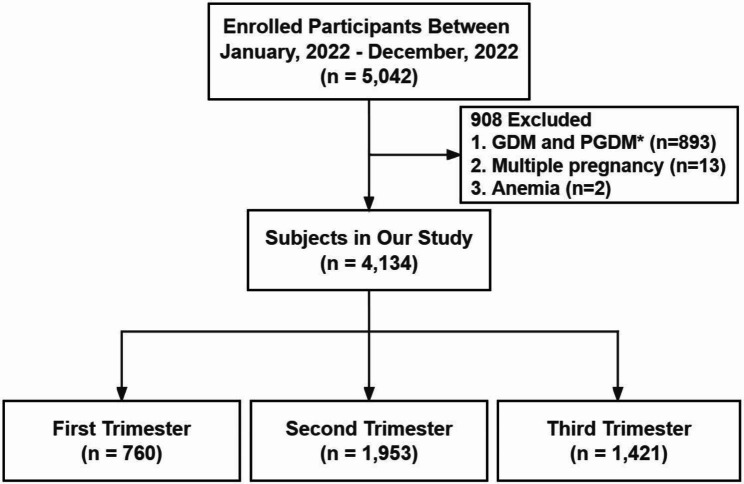
In this cross-sectional study, 5,042 Chinese pregnant women from 6 to 41 weeks of gestation were screened. An inclusion of 4,134 non-diabetic women was made to determine the reference intervals, they were divided into three trimesters: trimester 1 (T1), 6 weeks to 13 weeks + 6 days, trimester 2 (T2), 14 weeks to 27 weeks + 6 days, and trimester 3 (T3), 28 weeks to 41 weeks + 6 days. A total of 4,134 women (T1 n = 760, T2 n = 1,953, and T3 n = 1,421) provided blood samples which were analyzed for HbA1c concentrations. HbA1c was measured using high-performance liquid chromatography. The median and percentile (2.5th to 97.5th) for the HbA1c reference intervals were calculated for each trimester.
In total, 8,732 HbA1c measurements were taken. Reference intervals for HbA1c expressed as median and percentile (2.5th to 97.5th) for each trimester were: T1: 4.7 (4.0-5.5%), T2: 4.5 (3.9-5.3%), and T3: 4.8 (4.1-5.7%) respectively. The HbA1c levels were significantly lower in the second trimester compared to those in the first trimester (p < 0.0001), and higher in the third trimester compared to the second trimester (p < 0.0001).
The reference intervals for HbA1c levels were 3.9-5.7% with upper limits of 5.5% in the first trimester, 5.3% in the second trimester, and 5.7% in the third trimester. These findings highlight the importance of considering trimester-specific reference intervals for HbA1c in non-diabetic pregnant women to promote maternal and fetal health.
各孕期的生理糖化血红蛋白(HbA1c)值尚未明确界定。本研究旨在确定中国非糖尿病孕妇孕期特异性 HbA1c 参考区间。
本横断面研究纳入了 6 至 41 孕周的 5042 例中国孕妇。纳入 4134 例非糖尿病孕妇以确定参考区间,这些孕妇被分为三个孕期:第 1 孕期(T1),6 至 13 周+6 天;第 2 孕期(T2),14 至 27 周+6 天;第 3 孕期(T3),28 至 41 周+6 天。共 4134 例女性(T1 n=760,T2 n=1953,T3 n=1421)提供了血液样本,用于分析 HbA1c 浓度。采用高效液相色谱法测定 HbA1c。计算每个孕期的 HbA1c 参考区间的中位数和百分位数(2.5 至 97.5)。
共进行了 8732 次 HbA1c 测量。T1、T2 和 T3 孕期的 HbA1c 参考区间分别为:T1:4.7(4.0-5.5%),T2:4.5(3.9-5.3%)和 T3:4.8(4.1-5.7%)。与第 1 孕期相比,第 2 孕期的 HbA1c 水平显著降低(p<0.0001),而第 3 孕期的 HbA1c 水平显著高于第 2 孕期(p<0.0001)。
第 1 孕期、第 2 孕期和第 3 孕期的 HbA1c 参考区间分别为 3.9-5.7%,上限分别为 5.5%、5.3%和 5.7%。这些发现强调了在非糖尿病孕妇中考虑孕期特异性 HbA1c 参考区间以促进母婴健康的重要性。